'Say what you want, but the kids love it'

'The Nut Job's director, producer talk about movie's appeal
By Yun Suh-young
.jpg)
Director Peter Lepeniotis and CEO Ha Hoe-jin of Redrover Korea
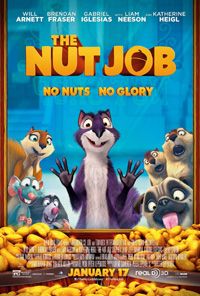
Despite a cool response from critics, “The Nut Job,” the new animated film by Peter Lepeniotis, is off to a solid start. The movie — the product of a collaboration between Canada and Korea — grossed over $30 million a week into its release, which its distributors say is beyond their expectation.
The movie, set in a fictional American town in the 1950s, revolves around the adventures of a self-serving rebel squirrel and his rat accomplice who work together to raid a nut store. There they encounter competition from other animals and also a group of humans, who use the store as a front as they attempt to rob a bank. The film is currently being shown in more than 3,400 theaters in the U.S.
The Korea Times recently sat down with Lepeniotis, who is a director at Canadian animation studio ToonBox Entertainment, and Ha Hoe-jin, CEO of Redrover Korea, the producer of the film.
The Nut Job will be released in Korean theaters on Wednesday.
Q: How did you get involved in the project together? Your companies have also worked together on “Bolts and Blip” and “The Beet Party.”
Lepeniotis:
I had done a short film in 2005 called “Surly Squirrel,” which won a lot of awards. A couple of years later I met up with Redrover. They were interested in the film and said, “We want to do something with this. We have an idea for it.” I started working on Bolts and Blip (2012) with the promise of something happening for Surly Squirrel and it did —The Nut Job. So that’s how we got it going – them being interested in the idea and having their idea as well of a heist film.
Ha:
It was initially Andy Knight, the director for “Beauty and the Beast: The Enchanted Christmas” and the founder of Red Rover, who was interested in our company, which was a three-dimensional (3D) monitor-producing company at the time.
We teamed up with Andy in 2007 to create Bolts and Blip and changed our company name to Redrover Korea to work with them globally.
But Andy suddenly died of stroke in 2008 at Cannes. After his death, the animation part of his company separated from Red Rover and became Toonbox. Since then, we’ve worked with Toonbox in partnership and decided to do all projects together for the next 10 years.
We kept our name as Redrover Korea. The original Red Rover is now a computer graphics-specializing firm run by Andy’s wife.
Q: So The Nut Job is based on “Surly Squirrel.” Where did your inspiration for that movie come from?
As a kid growing up, there were lots of squirrels around in parks. As an older animator, I started watching them – looking into their eyes. One day, I saw this manic starvation in their eyes and it clicked. I thought it would be an interesting concept to focus on the squirrel that’s really greedy and selfish.
Q: Whereas “Surly Squirrel” is set in the modern days, “The Nut Job” is set in the 1950s. Why is that?
As an animator, (the 1950s is) an exciting, stylistic time. Cities looked vibrant, car designs were amazing, people dressed well.
Secondly, it was a vital aspect to make the film feel like a fairytale. Most fairytales, especially moral fairytales, take place in the previous times. Something happening in the past is a better vehicle to tell a thematic idea.
And third, it’s a film about a heist. If I made it today, they’d have guns firing like this and jumping in the air. The 1950s allows a softer, cuter, acceptable way of dealing with something that’s dark as a bank heist.
My previous film was pretty damn violent. It’s crazy. There’s gunfire, things are exploding, and harsh language (is there). For the feature film, we had to make Surly a more redeemable character.
Q: Reviews from U.S. media have been pretty critical. There were complaints about the storyline and flat humor. Others pointed out that Buddy, the rat, looked too similar from Remy in Ratatouille. And what was with the end credits featuring Psy, the Korean rapper, when the movie was supposed to be set in the 1950s?
As for character resemblance, I want people to say Remy looks like Buddy. My short was released in 2005. Ratatouille was released in 2007.
As for Psy, as adults maybe it rubs us the wrong way. But children go completely berserk. They go crazy and at first I was like, “I don’t know about this” and then I was like “okay...this is working.” See it with kids and you will see them dancing in the aisles.
At the first test screening I was like, “Oh boy here it comes” and they went nuts. In Los Angeles, we did two focus groups and we had overwhelming responses. I’m probably like you, but in the end, results like that make distributors and producers happy.
I’m not used to this, the critical attack, because all I ever got on the short film was positive, positive, positive. So this is a brand new experience for me.
We expected criticism from U.S. media when we started because it’s foreign animation. But the critical response would have been similar even if it had been made in Europe.
Q: I heard the technology used to portray the fur in the movie was something new.
Toonbox and Redrover developed the technology together. We received a lot of help from technical directors at Toonbox. They applied their software on the modeling data and that’s how the fur effects were developed.
The production cost was half of what would have been if it had been made in the U.S. and the production period was also cut to half.
We put a lot of effort into fur and water effects. And because it was an animation for children, we tried to make the 3D effects comfortable to watch and minimize dizziness.
We have built a reputation in technical effects and it was a contributing reason to getting the movie released in over 3,000 theaters across the U.S. We were surprised when Open Road Films, our U.S. distributor, said they would invest $23 million as distribution cost, which is unprecedented.
Q: Having worked with the Korean staff, how do you evaluate the skills of Korean designers and animators?
They’re excellent. Korean animators are just like any other animators for me. They were as strong as the Canadian staff.
They were smart, focused and always on schedule — really good at meeting the deadlines. They had sense of comedy and good acting skills – very talented. Also, their design sense was very strong. My main character designer was Kim Jae-woo and he just blew the lid off. The designs look fantastic.
Q: What are your commercial expectations for this film?
We are expecting to make over $100 million if it continues at the current rate. At the moment, as an animation film, ours is leading in the box office.
(The movie almost reached the breakeven point as of Monday at $40 million. The production budget was $42.8 million. — ED.)
Q: Any plans for future projects?
Production for “The Nut Job 2” is underway and the movie will be released in 2016. There’s another animation called “Spark” which will be completed by the end of October this year and will be released in U.S. theaters next year.