‘Distinctly Korean’ BTS bring palace-front spectacle to Gwanghwamun
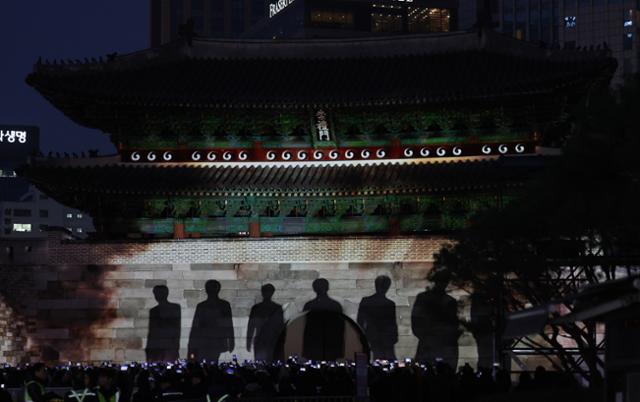
A media façade themed on BTS' new album "Arirang" is displayed at Sungnyemun Gate in central Seoul, Friday, a day ahead of the group’s Gwanghwamun comeback performance. Newsis
Global K-pop group BTS returned with their new album “Arirang” to stage a landmark comeback performance at Gwanghwamun Square, Saturday, marking the first time a single artist or group has held a standalone concert at the historic site.
Set against the backdrop of Gyeongbok Palace, the performance will highlight what BTS described as a fusion of “K-heritage and K-pop.” Their agency HYBE said it had applied to use the location with that concept, and the Korea Heritage Service granted approval on the condition that the site would be closely monitored to prevent any damage to cultural assets.
From their earliest days, BTS have incorporated Korean identity into their music and performances. Their 2013 track “Paldogangsan,” from the mini album “O!RUL8,2?,” showcased regional dialect rap, with members introducing their hometowns using local accents. Lyrics referencing regions such as Daegu and Gwangju delivered both humor and a message of unity, emphasizing that “under the same sky, we are all worthy.”
This theme continued in “Ma City” from “The Most Beautiful Moment in Life, Pt. 2” (2015), where members expressed pride in their hometowns, linking personal growth to regional identity.
BTS have also directly addressed social issues in South Korea, including academic competition, generational conflict and inequality. Their 2015 track “Silver Spoon” (also known as “Baepsae”) satirized class disparity through the proverb “a crow-tit walking like a stork will break its legs,” while "Am I Wrong" (2016) expressed frustration and cynicism toward controversial remarks by a high-ranking official, using blunt and provocative lyrics.

Pedestrians move past Gwanghwamun at Gyeongbok Palace in Jongno District, Seoul, Thursday, ahead of BTS’ Gwanghwamun performance. Yonhap
For fans, BTS performing in front of Gyeongbok Palace is not entirely new. In 2020, the group filmed performances at the palace’s main hall, Geunjeongjeon, and the pavilion Gyeonghoeru for NBC’s “The Tonight Show Starring Jimmy Fallon.” Dressed in modern reinterpretations of hanbok, BTS performed “IDOL” in the grand courtyard, blending traditional Korean aesthetics with synchronized choreography. The song itself incorporates traditional rhythms and exclamations such as “Eolssu, jota,” further emphasizing Korean cultural elements.
At Gyeonghoeru, illuminated at night, the group delivered a softer performance of “Mikrokosmos,” showcasing a different facet of their artistry against the serene palace setting.
Earlier that year, BTS also appeared as special speakers at “Dear Class of 2020,” a global virtual commencement event hosted on YouTube for graduates unable to attend ceremonies due to the pandemic. Filmed at the National Museum of Korea, the group delivered a 12-minute speech and performance, including “Boy With Luv,” “Spring Day” and “Mikrokosmos.”
With their return to a full-group lineup after nearly four years, BTS is once again drawing global attention — this time by placing Korean heritage at the center of a modern pop spectacle.
This article from the Hankook Ilbo, the sister publication of The Korea Times, is translated by a generative AI system and edited by The Korea Times.