INTERVIEW Daniel Lindemann: Adding a well-informed foreign viewpoint

Daniel Lindemann used a fluent Korean in an interview with The Korea Times at JTBC in Sangam-dong in Mapo, western Seoul, April 18. Korea Times photo by Kim Kang-min
German TV star in Korea provides information rather than fun
By Ko Dong-hwan
In a March 2018 episode of TV reality entertainment show “Stranger” on JTBC ― a show focusing on celebrities struggling with daily life in foreign countries ― Daniel Lindemann from Germany guides his friends Alberto Mondi from Italy and Canadian Guillaume Patry to Seoul venues where he used to hang out when he had little money.
While they hiked Mount An in Seoul's Seodaemun district, visited Bongwon Temple on the mountain and dined at a thrifty on-campus restaurant at Korea University, the German was often portrayed as a killjoy after he offered the others an audio guided tour of the places. Lindemann's efforts, though informative, kept failing to entertain the duo, who rather found joy in describing the German as a self-taught scholar with a bit of narcissism. He doesn't deny the description.
That's how Lindemann, 34, a self-proclaimed “infotainer” on Korean TV, shines. He told The Korea Times there is a lot of preparation for the shows, where he is expected to explain and cross-reference subjects about Korea and Germany, mostly involving history, sociology and culture.
“I mainly do infotainment shows dealing with news and culture, which I must study a lot to prepare,” said Lindemann, who earned a postgraduate degree in Korean Studies at Yonsei University in Seoul, after majoring in East Asian studies at the University of Bonn. “What I learned in postgraduate school helps me with the preparation.”
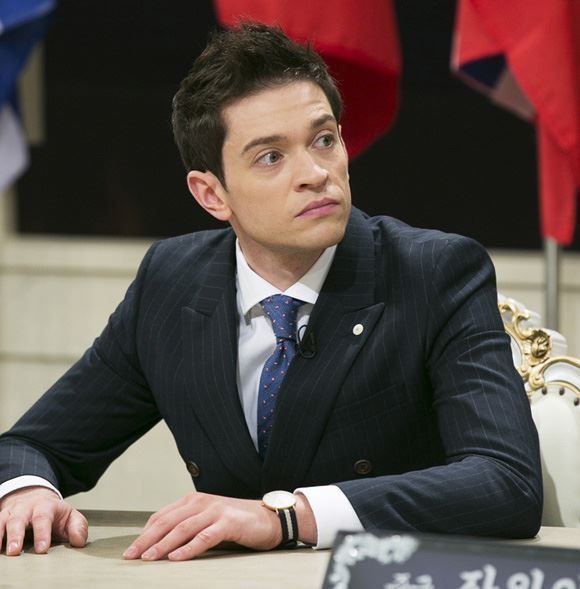
Daniel Lindemann from JTBC's "Non-Summit." Courtesy of JTBC
For Lindemann, who came to Seoul in 2008 as an exchange student to attend Korea University, being a native German helped him become one of the most prolific foreign TV figures here. He stepped into the TV industry with JTBC's “Non-Summit” in 2014 and has now appeared in more than 30 TV shows. Most recently he joined MBC's “Coming Home, A Hundred Years Later,” a four-part documentary about descendants of Korean freedom fighters from the Japanese colonial era (1910-45) living overseas.
Lindemann is fluent in Korean and German and recently appeared in shows about the history of the two countries.
“Since I am a foreigner, I don't consider myself a so-called entertainer but a German TV personality with a mission to deliver new information or propose new perspectives to viewers,” Lindemann said. “I prepare things that are outside the scope of Korean celebrities.”
What shot him to stardom in Korea was “Non-Summit,” a TV entertainment debate show featuring 11 foreigners in Korea whose Korean skills ranged from mediocre to superb. Lindemann was one of a few in the cast with exceptional Korean capable of quashing opponents with effective arguments. Its first season ended in 2017.
He first doubted he would survive in the show. He was more familiar with sedate graduate school debates and suddenly encountered a rambunctious group talk show with a heated atmosphere. Asked whether he had any animosity toward others on the show, he said they often got together at the end and on-air tensions fizzled.
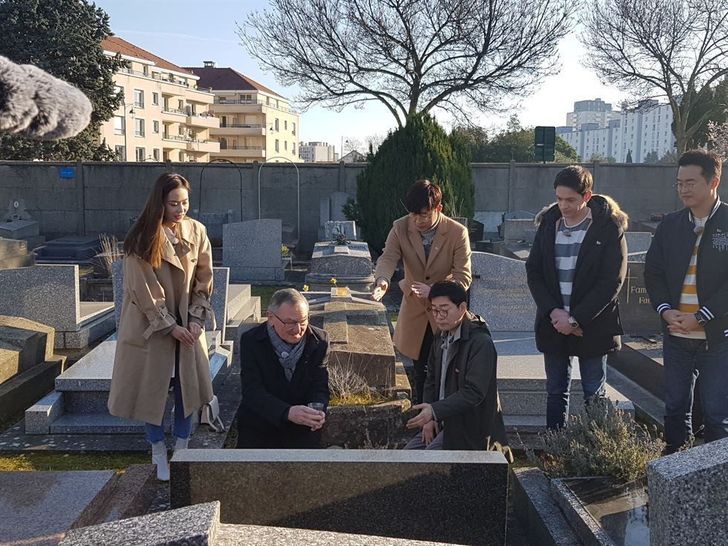
Daniel Lindemann, second from right, and other celebrities visit a cemetery in France in search of Korean independence movement activists and their descendants in overseas as they film MBC's "Coming Home, A Hundred Years Later". Courtesy of JTBC Drama House
“I learned a lot from that show,” said Lindemann. “For example, Tyler Rasch from America and I are from the same Western society but there is a clear disparity between our world views. I had argued once that hate speech shouldn't be allowed by freedom of speech because it infringes on human dignity. Tyler disagreed.”
Lindemann was excited after he received a casting call for “Coming Home” that aired in early April. It was MBC's high-profile infotainment project to commemorate the 100th anniversary of the establishment of the provisional government of Korea during Japan's occupation of the Korean Peninsula. A cast of actors, announcers, historians and Lindemann as interpreter travelled China, France and Austria as they tracked down traces of the Korean independence movement activists like Yun Bong-gil and Ahn Chang-ho.
“Korea, in my view, hasn't invested much effort in unearthing from outside Korea evidence of the independence movement,” Lindemann said. “Books and TV shows in Korea about it have shown me only a limited scope of objective extrapolation. But as I interpreted for people in Austria in my own language, I appreciated the history so much closer to my heart.
“Personally, having joined the show, despite its ratings being lower than expected, was an honor. But I don't think I will ever again be able to visit a concentration camp in Germany [from World War II]. It was a psychologically taxing experience.”
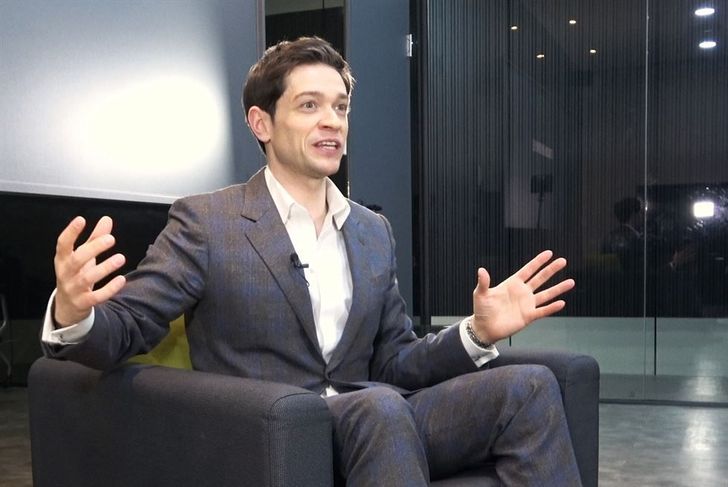
Daniel Lindemann, having focused on Korean TV shows dealing with history, culture and current affairs in Korea and Germany, says he wants to stay in Korea to further his career. Korea Times photo by Kim Kang-min
Refugees
Korea, having witnessed its citizens divided over whether to accept more than 500 Yemeni refugees who arrived on Jeju Island in 2018, often benchmarks Germany when it comes to handling refugees. Supporters had argued that the Yemenis account for only a small fraction of the population and their endangered human rights must be protected. Opponents underlined the newcomers as potential criminals and terrorists and exaggerated that the country is in danger because of them.
“To be frank, I was disappointed by Korea when I first saw the news about the Yemenis,” Lindemann said, highlighting his uneasiness at the fact that only two of 484 Yemeni asylum seekers were accepted as refugees. (Humanitarian status was given to 412, 56 were rejected and 14 either withdrew their applications or left Korea.)
“People must be clear about their reasoning when opposing refugees. When they say Arabic people are more prone to committing sexual crimes or being terrorists, they shouldn't generalize the ethnic group so easily. Regardless of refugees, immigrants, citizens, religions or nationalities, statistics showed one out of every million is always a criminal.”
Lindemann said Germany, when it welcomed some 1.2 million refugees after 2013, faced a workforce shortage in the technological industries due to its aging society and Chancellor Angela Merkel tried to offset the manpower problem with the foreigners. It resulted in cultural clashes between Germans and the migrants, pushing the country to educate the newcomers, including introducing anti-misogynistic guidelines.
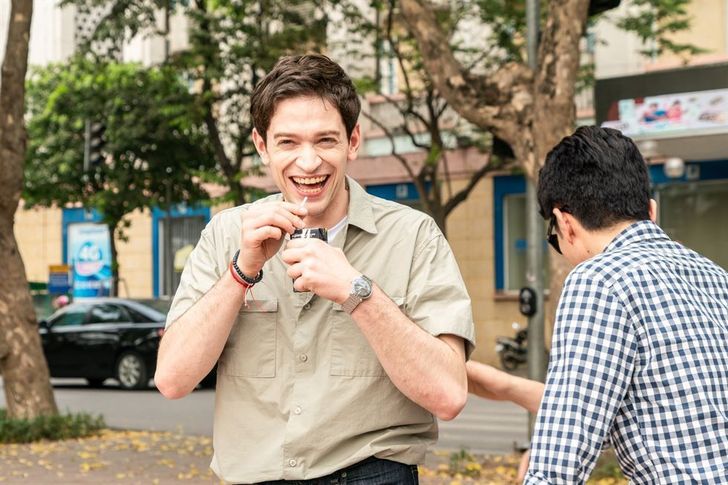
Daniel Lindemann from KBS's "Delightful Dialogue." Courtesy of JTBC Drama House
Stricter immigration regulations, supported by the political alliance of the Christian Democratic Union of Germany and the Christian Social Union, have seen the deportation of some 23,000 refugees since 2018.
Lindemann, who grew up in Langenfeld in North Rhine-Westphalia playing with the children of Bosnian and Kosovo refugees, argued that ethnicity does not cause cultural disagreements but human error does.
“I always thought carefully whenever I met people with differing world views, telling myself they grew up with different backgrounds from mine, received different educations and were raised by different parents,” Lindemann said, as he recounted how he managed to overcome the cultural barriers when he first came to Korea. For him, the cultural barrier was a bigger problem than language as he battled to assimilate.
“Germans, when referring to foreigners, don't often use the word 'foreigner' but simply mention their nationalities when addressing them, like 'Korean-German,'” Lindemann said. “In Korea, my title is always tagged with 'foreign TV personality.'”