Circular economy identified as new growth engine in exports

Finance Minister Choo Kyung-ho enters an emergency meeting of economy-related ministers held at the government complex in Seoul, Wednesday. Yonhap
Reduction in carbon emissions expected to have impact on domestic exports
By Lee Yeon-woo
Finance Minister Choo Kyung-ho pledged to accelerate the development of a “circular economy” as a new engine of growth that could enhance exports.
“The circular economy, including waste recycling, is garnering attention not just as a key strategy to achieve carbon neutrality, but also as a novel model for growth,” Choo said during an emergency meeting of economy-related ministers on Wednesday. “Given this, the government will strive to integrate this model further into Korea's industry as a new driver of growth.”
The term circular economy refers to an economic system focused on eliminating waste and facilitating the extended reuse of resources.
Choo noted that the government will initiate projects to boost the circular economy competitiveness of nine key industries, including petrochemicals, steel, automobiles and machinery. These include permitting economically viable waste resources ― like scrap steel and used batteries ― to be collectively classified as circular resources, even without individual companies' applications.
Reducing carbon emissions is expected to have an impact on domestic exports in the near future.
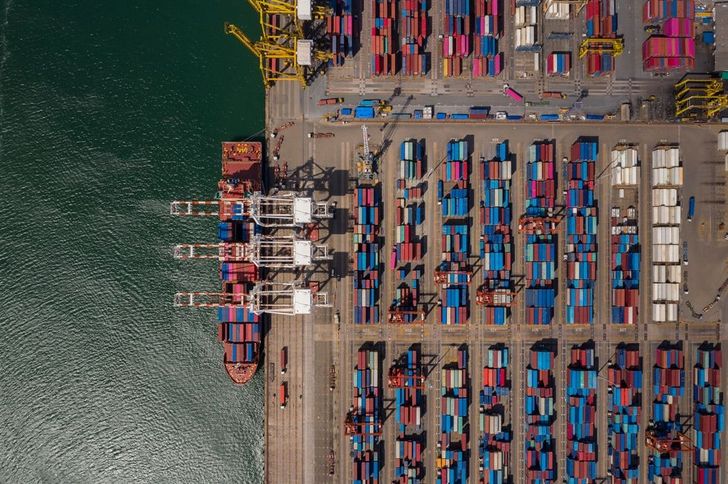
Starting this October, the European Union (EU) will begin implementing the Carbon Border Adjustment Mechanism (CBAM), which will impose a carbon cost on certain goods imported from outside the EU.
gettyimagesbank
During its trial period until 2025, corporations will need to measure and report the amount of carbon emission associated with their products to the EU. After this period, if the emissions exceed the standard, corporations will be required to purchase certificates, issued by the EU, for the excess amount in order to continue exporting to the EU market.
“There is a possibility of export disruptions during the trial period, due to additional administrative costs for measuring and verifying the amount of carbon emissions, as well as the potential shortcomings in preparing the necessary reports,” the Bank of Korea (BOK) noted in its separate financial stability report released on Wednesday.
“Following the full implementation in 2026, there are concerns about increased financial burdens on domestic export manufacturing companies, such as costs associated with purchasing certificates, given the high emissions in Korean manufacturing industries,” the report continued.
As of 2018, carbon emissions from Korea's exports to the EU were the third highest at 7.5%, following China and the United States.
BOK Governor Rhee Chang-yong also underscored the importance of aiming for carbon neutrality in the context of Korea's future exports.
“Given our industrial structure, Korea faces challenges in reducing greenhouse gas emissions over a short period. Without proactive measures, our exports could face significant restrictions due to global environmental regulations,” Rhee said during the International Conference on Green Finance on Tuesday.