3rd straight rate freeze likely this week amid sluggish economy

Bank of Korea headquarters in Seoul / Yonhap
By Yi Whan-woo
The Bank of Korea (BOK) is expected to keep its key interest rate intact for the third consecutive time in its rate-setting meeting this week, as an economic slowdown has become a bigger concern than inflation, according to analysts, Sunday.
Scheduled for Thursday, the rate-setting meeting will take place as the country's exports suffered another setback in May following seven months of consecutive declines, marking the longest period of drops in three years.
Overall inflation, on the other hand, has softened to a 14-month low of 3.7 percent in April after the BOK aggressively hiked rates, marking an aggregate 3 percentage point increase over a year and a half until January.
The key interest rate has stayed at a 14-year high of 3.5 percent since then, with the BOK freezing it at its two subsequent rate-setting meetings in February and April.
“Taking all these economic circumstances into account, the BOK, in its path to strike a balance between growth and slowdown, will have less convincing reasons than in the past to lift rates,” said Kim Wan-joong, chief economist at Hana Institute of Finance.
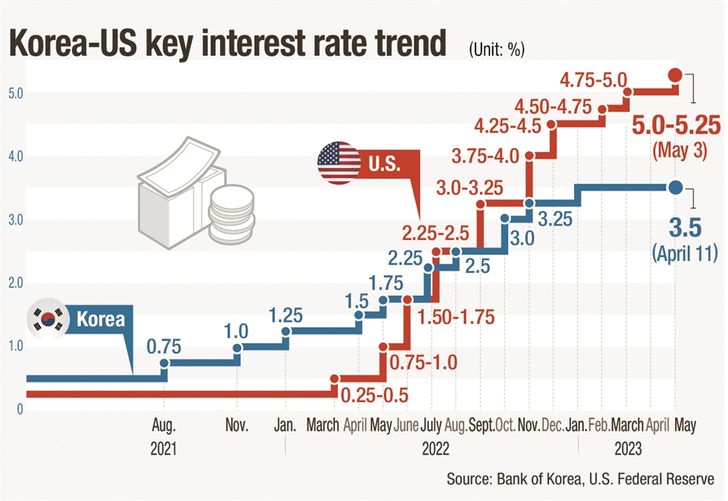
He noted that the Korea-U.S. interest rate gap, which has widened to 1.75 percentage points, and volatile core inflation, are cited by some market observers as lingering risks against the BOK's possible rate freeze.
Core inflation is used to keep track of changes in the prices of goods and services excluding food and energy, and is used to estimate a long-term trend in overall inflation. It remains in the upper 4 percent range, which is higher than the overall inflation rate.
“Nevertheless, the risks of an economic downturn have become greater than those of inflation,” Kim added, noting that the spillover effects of China's reopening is slower than expected and that it remains unclear when Korea's exports will bounce back.
The trade balance has been deteriorating as well, remaining in the red for 13 consecutive months as of April.
Lee Sang-ho, head of the economic policy team at the Korea Economic Research Institute (KERI), said the U.S. Federal Reserve is believed to be wrapping up its hawkish credit tightening cycle and that the BOK “will not be pressed to go for another hike.”
He also viewed that the BOK is geared toward joining other financial institutions in and outside the country to revise down Korea's 2023 economic growth outlook.
Multiple institutions in recent months lowered their growth forecasts for the country to the mid-1 percent range.
They include Moody's, which estimated the growth rate at 1.5 percent in its updated outlook last week, down from 1.6 percent.
The BOK projected 2023 growth at 1.7 percent in November 2022 and at 1.6 percent in February this year. It hinted at another possible downward revision last month, when it said, “The growth may slightly fall short of reaching 1.6 percent.”
Some economists said the BOK will even consider cutting rates beginning in the third quarter to help deal with an economic slowdown, under the condition that the Fed starts to lower the rates beforehand.