Korea to promote deregulation and structural reforms for private-sector-led economy: PM

Prime Minister Han Duck-soo delivers a congratulatory address during the Institute for Global Economics (IGE) 30th Anniversary Special International Conference held at Grand InterContinental Seoul Parnas, Wednesday. Yonhap
Senior officials, global scholars discuss changing world order in IGE's 30th Anniversary conference
By Anna J. Park
Amid the ever-increasing importance of the economy in current geopolitical landscapes, the Yoon Suk Yeol administration will continue pushing for reforms that aim to promote an economy led by the private sector, Prime Minister Han Duk-soo said.
In his congratulatory address at a special international conference marking the 30th anniversary of the Institute for Global Economics (IGE) held in southern Seoul on Wednesday, the prime minister emphasized that the Yoon Suk Yeol administration is conducting structural reforms in various areas of the Korean economy to boost the country's efficiency and economic vitality.
“The Yoon administration has embarked on a private-led economy that's driven by technological innovation and dynamic investment to achieve further growth. We're pursuing structural reforms in labor, education and pension system to boost efficiency and vitality of the economy,” Prime Minister Han said during the address, explaining that the government is taking bold measures to reform unnecessary practices and systems that lag behind from the perspective of the global standards.
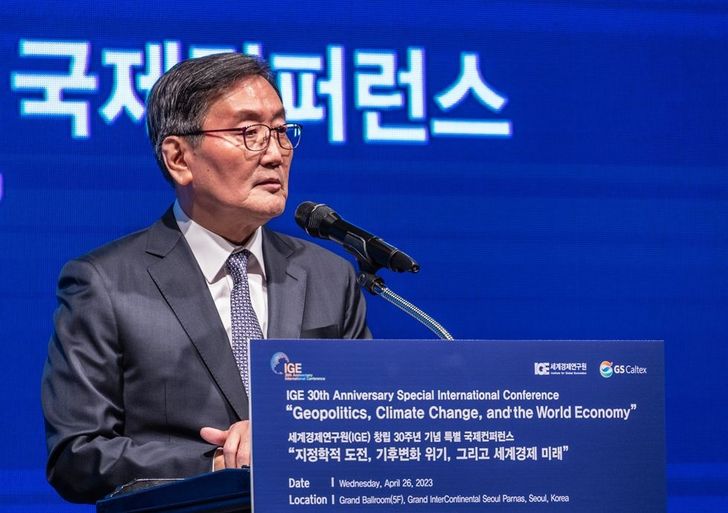
Institute for Global Economics Chairman and CEO Jun Kwang-woo delivers an opening address during the Institute for Global Economics (IGE) 30th Anniversary Special International Conference held at Grand InterContinental Seoul Parnas, Wednesday. Yonhap
Stressing that preserving Korea's freedom and prosperity should start from a level-headed analysis of the rapidly changing world order, he emphasized that the Yoon administration has set a clear vision for the free and dynamic economy led by the private sector. He added that the government will continue exploring effective strategies to weather through this new era of consistently shifting, fragmented yet strongly interconnected geopolitical landscapes.
“Korea will continue to engage in core technologies, while enhancing competitiveness by nurturing key sectors,” he said, adding that the government will also put make utmost efforts to build a strong social safety net, while fighting social problems, such as low birth rate and regional imbalances.
Titled “Geopolitics, Climate Change, and the World Economy,” Wednesday's international conference commemorating the IGE's 30th anniversary since its foundation in 1993 was attended by some of the world's leading scholars as well as Korea's senior public officials, including Deputy Prime Minister Choo Kyung-ho, Anne Krueger, former first deputy managing director of the IMF, Robert Zoellick, former president at World Bank and former U.S. Deputy Secretary of State, and Michael Spence, senior fellow at Hoover Institution, who's also a Nobel laureate in Economics.
Fred Bergsten, President Emeritus at the Peterson Institute for International Economics (PIIE), who spent the last four decades serving various government and congressional roles in the U.S., including assistant secretary for international affairs of the U.S. Treasury, undersecretary for monetary affairs at G-5 deputy and G-7 sherpa, and the Advisory Committee on Trade Policy and Negotiations through the 2010s, appointed by both former Presidents Obama and Trump, joined the conference online, delivering his keynote speech.
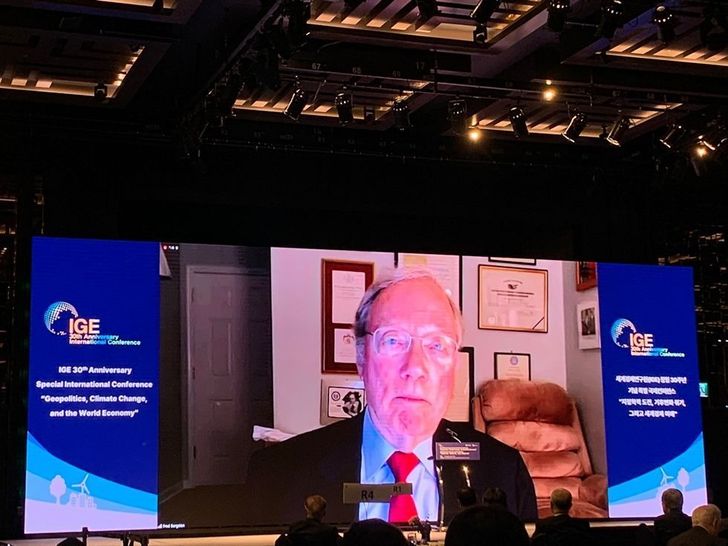
Fred Bergsten, President Emeritus at the Peterson Institute for International Economics (PIIE), delivers his online keynote speech at the Institute for Global Economics (IGE) 30th Anniversary Special International Conference held at Grand InterContinental Seoul Parnas, Wednesday. Korea Times photo by Anna J. Park
He started his keynote speech, by commenting that the think tank has provided a significant platform for Korea's growth as a major global power during the past 30 years. He went on to say that the U.S.-China conflict has been shifting the current world order, yet it's still paramount to make progress by focusing on global economic cooperation. He called the optional cooperative strategy a “functional decoupling,” which allows the two rival countries to disagree on certain topics, yet agree on global economic and environmental issues.
“The functional decoupling is where we take conscious decisions to treat different issues in different ways. It is feasible, of course. It happens all the time. Countries decouple different parts of their relationship with each other,” Fred Bergsten said during the keynote address, adding that the key is to recognize that the economic issues need cooperation between the U.S. and China to resolve global threats in constructive ways.
He emphasized that Korea will be assuming a bigger role in facilitating mutually beneficial global economic orders and the world trading system as the U.S. and China work their way through the functional decoupling to cooperate amid rising tensions from the rivalry.
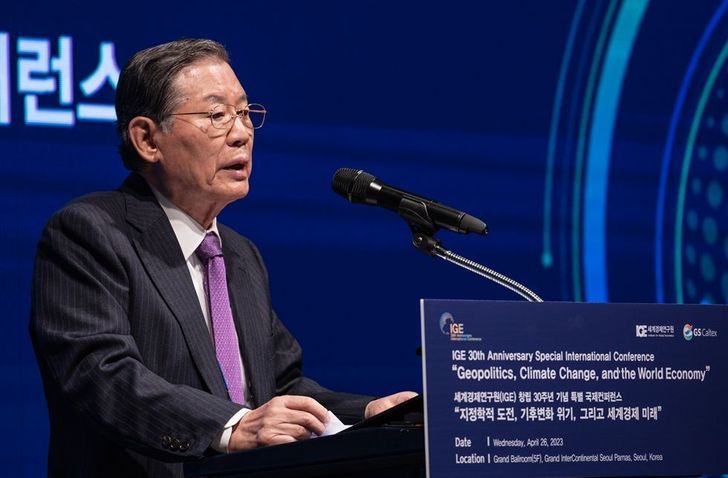
Hur Dong-soo, Honorary Chairman of GS Caltex, delivers a welcoming address during the Institute for Global Economics (IGE) 30th Anniversary Special International Conference held at Grand InterContinental Seoul Parnas, Wednesday. Yonhap
Meanwhile, Hur Dong-soo, honorary chairman of GS Caltex, pointed out that paradigm shifts in the global energy sector is posing challenges in recent years, urging the world economy to transform to a “low-consumption and high-efficiency energy structure.”
In his address during the international conference, Hur suggested countries to develop a reasonable energy mix consisting of diverse energy sources, such as renewable and nuclear energy, while taking into account the practical importance of fossil fuel.
“In light of this trend, South Korea needs to establish challenging yet realistic goals and action plans to achieve carbon neutrality that takes the unique characteristics of the country's industry and economic structure into consideration,” Hur said.
“To overcome such challenges, we must transition to a low-consumption and high-efficiency energy structure, which is the first and foundational step in developing a sustainable energy system,” he said, adding that achieving the goal would require the close cooperation of all economic players, including the government, business and the public at large.