1 Euro Project opens new possibilities for underdeveloped towns

The building of 1 Euro Project in Songjeong-dong, Seoul / Korea Times photo by Lee Yeon-woo
Once deserted building aims to create new opportunities for people
By Lee Yeon-woo
One euro, equivalent to 1,450 won ($1.1), may not seem like a lot of money, being barely enough to cover a single subway ride. But in a secluded section of central Seoul, called Songjeong-dong, 1 euro can go a long way.
A brown brick building with a large sign that reads, “1 EURO PROJECT,” stands in the crowded hipster neighborhood around Seongsu Station.
Here, anyone can open his or her own store for just 1 euro and make a meaningful contribution to the local community.
Known as the 1 Euro Project, the program was initially introduced in Europe as a means of urban regeneration. Governments offer neglected houses and buildings to the public for just 1 euro, and tenants are responsible for renovating and utilizing the spaces to live in or to run as stores. With the low cost attracting new residents, neglected areas become revitalized and the area's population begin to grow.
The movement has taken root in Songjeong-dong, led by an architectural firm called Lokaal Futures. Choi Sung-wook, the head of Lokaal Futures, said Songjeong-dong was the ideal location to launch the project.
“It has the best infrastructure ― located adjacent to Seongsu Station and surrounded by several universities, such as Hanyang University and Konkuk University. Despite the potential, the neighborhood has fallen behind and is actually one of the poorest in the district,” Choi told The Korea Times in a recent interview.
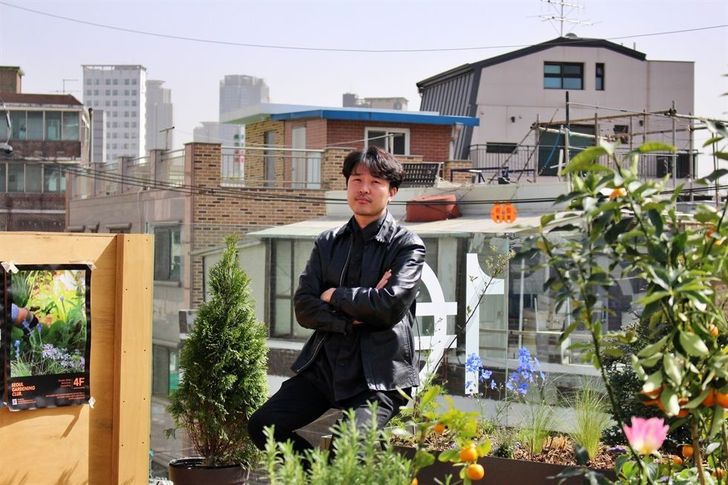
Choi Sung-wook, the chief of Lokaal Futures, poses at the rooftop of the 1 Euro Project building in Songjeong-dong, Seoul, April 12. Korea Times photo by Lee Yeon-woo
His experience as an urban regeneration expert played a crucial role in bringing the idea to Korea. With over a decade of experience in architecture, Choi has worked on various sites, including Seoul City's urban generation center. Through his work, Choi came to realize that many buildings in central Seoul were neglected and underutilized.
“For example, a person who had inherited a building from their parents may have emigrated and left it vacant. Some buildings belong to public institutions, but they may not know what to do with them and end up leaving them empty,” Choi said.
“People often complain about the lack of space, but in reality, there are already too many empty spaces. After realizing that there were no existing examples of effectively organizing and managing such cases, I saw an opportunity to create something innovative,” he added.
While studying in the Netherlands, Choi became acquainted with the 1 euro concept and was fascinated by the idea of “a social developer architect,” an approach that places publicness at the heart of urban development.
“In Amsterdam, there was an abandoned port that a group of architects acquired from the city for just 1 euro. In order to rehabilitate the polluted land, they planted greenery and repurposed abandoned ships rather than constructing new buildings, which would contribute to more pollution,” Choi said.
“The space was used by artists and architects for creative activities, while other areas were left open for residents to use, such as for communication or learning piano. As communities grew and the area was revitalized, tourists began to flock to the region,” he explained.
Win-win partnership between tenants and landlords
The main difference between the Korean version of the project and its European counterpart is that a private company is spearheading the initiative in Korea. In a country where real estate is highly valued, a question arises: Who would be willing to offer their building at such a giveaway price?
But that was the easiest part of this project, Choi said. The building owner actually reached out to Choi first, asking for help.
“My last workplace at a public urban regeneration center was in Songjeong-dong. The owner came to us seeking advice on how to utilize her empty building. The building was very old, shabby, and kind of spooky at that time. But I immediately thought 'Wow, this would be the perfect location for the 1 Euro Project.'”
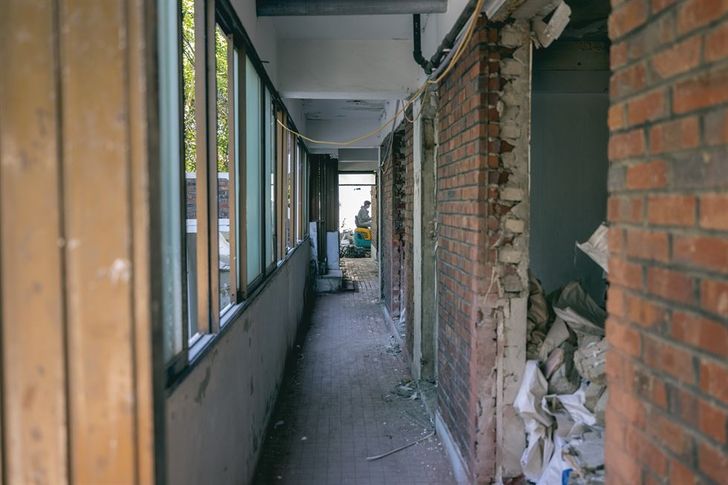
One Euro Project building in Songjeong-dong, Seoul, before renovation / Courtesy of Lokaal Futures
Before moving in, tenants renovated the building at their own expense, and they also divided and shouldered among them the cost of renovating common areas such as hallways and terraces. In exchange for providing the space, the building owner could find a new purpose for the property, and if the region experiences a revival in the future as a result of the project, the owner can also expect the value of the building to increase.
So far, the building has welcomed 17 brands. These brands have demonstrated that they can promote a positive lifestyle within the community. To secure a spot in the building, they are required to submit twice a year their plans to revive the neighborhood.
For example, one brand called Box;room offers photography services and provides free photo shoots for elderly residents in the neighborhood twice a month. Another brand, Better Earth, serves as a recycling center for the local community.
“Residents donate recyclable resources, such as plastic bottle caps, and we send them to the upcycling center. We try to minimize waste emitted within the 1 Euro Project building as well,” said Moon Hye-min, the owner of Better Earth, a zero-waste lifestyle shop.
“We also held monthly 'plogging' sessions since this building opened in February. On April 8, 120 people gathered to pick up waste in this district,” Moon added, explaining that she feels that the number of residents visiting the place is growing.
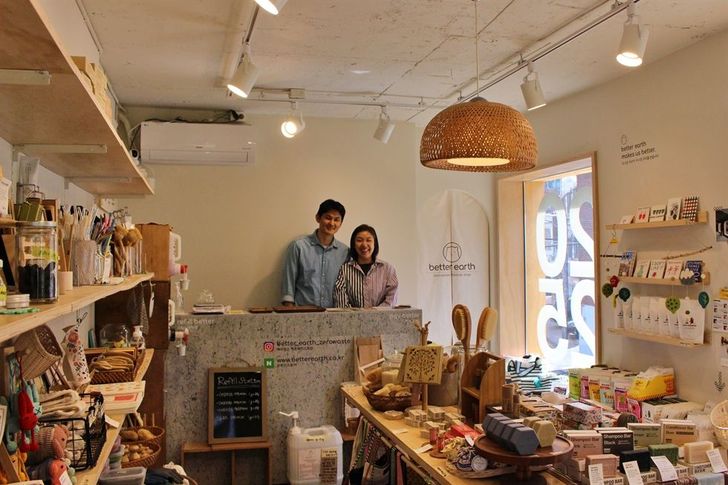
Moon Hye-min, right, and her husband, left, owners of zero-waste lifestyle shop, Better Earth, pose at their store in 1 Euro Project building in Songjeong-dong, Seoul, April 12. Korea Times photo by Lee Yeon-woo
The ultimate goal of this project is to transform this underdeveloped district into a desirable place to live in, rather than a mere tourist attraction.
“My aim is for the building to be occupied primarily by local residents, perhaps 60 percent to 70 percent, with visitors filling in the remaining 30 percent. I hope that the lives of local residents will be positively impacted after experiencing the brands within our building,” Choi said.
As such, the building also functions as a community center for residents, hosting various events such as bazaars, beverage tastings and yoga classes.
This project in Songjeong-dong is set to conclude after three years in 2025. Six months prior to the contract's expiration, the building's owner, Lokaal Futures, and the tenants will convene to discuss what to do with the edifice and whether to continue the project or not.
However, the project has garnered an overwhelming response from building owners across the country, and even local governments have expressed interest in collaborating, according to Choi.
“As a group of architects committed to making the world a better place, our project is founded on the belief that a good world is built by good people, and good people are formed by good lifestyles. Therefore, we hope that this project can serve as a source of inspiration for people to explore diverse lifestyles,” Choi said.