Financial authority to strengthen direct communication with bank boards

Financial Supervisory Service (FSS) Governor Lee Bok-hyun speaks during a press conference held at FSS headquarters in Seoul, Monday. Courtesy of FSS
FSS chief aims to improve financial firms' corporate governance
By Anna J. Park
In a move to improve financial groups' corporate governance and ethical management, the financial authority plans to strengthen direct communication with the boards of directors of major financial groups and local banks.
The plan aims at serving the Financial Supervisory Service's (FSS') key policy goal of formulating responsible management governance for financial companies. The goal is one of four key policy directions announced by the watchdog agency on Monday ― stabilization of local financial systems, strengthening supervisory functions, supporting financial sector innovation and improving responsible management governance of financial companies.
“The FSS plans to check on financial firms' board of directors, corporate governance and appropriateness of executive incentive systems so that banks' governance could run in a fair and transparent manner,” FSS Governor Lee Bok-hyun said during a press conference held at FSS headquarters in Seoul, Monday.
He explained that the supervisory agency's direct communications with the boards of financial firms will be transparent and open to the public so as to dispel any unnecessary misinterpretations about the communications.
“Given that local financial companies' procedures on selecting a chairman are falling short of global standards, making efforts to raise transparency and fairness in boards' key decision-making processes is deemed necessary,” he explained.
Regarding financial companies' hefty incentives for their executives, the FSS head recommended taking more medium- and long-term strategies and achievements into account, rather than considering short-term earnings only, in their incentive payout systems, especially when market uncertainties are as grave as now.
He also stressed that banks need to consider alternative factors to shareholders' economic returns, given the banks' special social role of providing liquidity to the real economy. The FSS chief said while he respects recent activist funds calling for increased dividend payouts from financial companies, banks are required to consider the bigger picture, beyond shareholders' gains.
“If banks focus solely on returning profits to their shareholders, their loan supply to the vulnerable brackets of society, including small business owners who suffer from high-interest rates and recession concerns, is likely to be weakened, which in turn would put the local economy into a more difficult situation,” he said, vowing that the watchdog agency will make sure lenders will supply necessary capital to those most in need.
In a move to prevent further irregularities by bank employees, the FSS will also place more emphasis on financial companies' internal control measures in its management reviews.
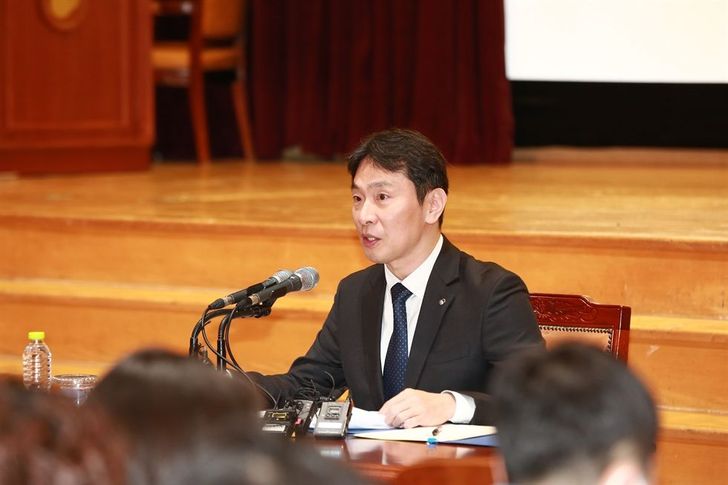
Financial Supervisory Service (FSS) Governor Lee Bok-hyun speaks during a press conference held at FSS headquarters in Seoul, Monday. Courtesy of FSS
Support for ESG initiatives and global financial business
While beefing up ESG-related supervisory functions and disclosure requirements, the FSS also plans to support financial companies' extended overseas operations. It plans to strengthen partnerships and communications with foreign supervisory agencies in countries that Korean financial companies have already entered.
The FSS plans to hold joint investor relations events with financial companies during the first half of this year in global financial hubs, such as Singapore and London, aiming to further promote Korean financial companies.
At the same time, the FSS is working on speeding up foreign financial companies' acquisition of approvals from financial authorities necessary for their operations in Korea. The supervisory agency has also newly launched a unit solely dedicated to registration and review evaluations of foreign mutual funds and private equity funds to accelerate the process.