Household debt expected to drop for 1st time in 18 years

A passerby looks at an advertisement that shows loan interest rates outside a local bank branch in Seoul on Nov. 9. Newsis
By Anna J. Park
With rising interest rates and frozen asset markets globally, the country's household debt is expected to fall this year for the first time in 18 years, since records began back in 2003.
According to data by five major local banks ― KB Kookmin, Shinhan, Hana, Woori and NH NongHyup ― the remaining amount of household debt, as of Dec. 15, stood at 693.6 trillion won ($529.4 billion), which is less than about 15 trillion won from the 709.5 trillion won logged at the end of last year.
Provided that the figure from Dec. 15 is maintained until the end of the year, it will be a 2 percent drop from the figure of last year, the first time the amount of remaining household debt at the five major banks has shown a reversed growth pattern.
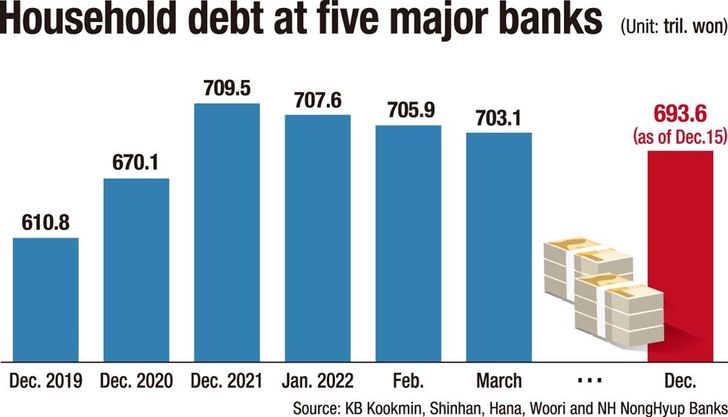
The remaining household debt at the five banks stood at 610.8 trillion won at the end of 2019, which grew to 670.1 trillion won a year later, a nearly 10 percent rise. The figure once again rose by 5.8 percent, posting 709.5 trillion won at the end of 2021. The fast-rising household debt showed a decline from early this year, as it stood at 707.6 trillion won in January, followed by 705.9 trillion won in February and 703.1 trillion won in March. The drop continued until December.
The main cause of the drop is attributed to a drastic fall in the amount of households' credit loans, which fell by more than 12 percent from last year's 139.5 trillion won to 121.3 trillion won a year later. The number of mortgage loans increased slightly by one percent from last year's 505.4 trillion won to 511.7 trillion won.
When including household debt provided by regional banks as well as non-banking financial institutes, the statistical data by Bank of Korea (BOK) also showed a fall this year, standing at 1251.8 trillion won, compared to 1261.4 trillion won posted from last year.
The BOK's data from its Economic Statistics System (ECOS) started to be compiled in October 2003, and the number for household debt provided by all financial institutes has never shown an annual decrease during the past 18 years.
Market watchers see that the skyrocketing interest rate hikes have forced borrowers to pay up their loans, particularly credit loans, which tend to have a higher interest rate than mortgage loans. The fall in the demand for leveraged investments, amid asset price corrections, is also one of the factors affecting the decrease in household debt.
As a consequence of the decrease in household debt, the financial authorities, which used to urge banks to submit their plans for controlling their household debt amounts at the end of the year, haven't yet come up with any orders for banks, regarding household debt controls for next year. At the end of last year, financial authorities recommended banks to keep the target of an annual 4 percent increase rate for their total household debt amounts for the year 2022. This year, bank insiders say they haven't yet heard any word about the matter from the financial authorities.
Meanwhile, the five major banks' remaining corporate debt has rapidly increased to 709.5 trillion won, as of Dec. 15, compared to last year's 635.8 trillion won.