Concern grows over dwindling foreign reserves

An official from Hana Bank checks bundles of dollars at its headquarters in Seoul, Thursday. Yonhap
Korea urged to sign currency swap deal with US
By Lee Min-hyung
The nation's foreign exchange reserves extended losses in October again after the Bank of Korea (BOK) sold dollar reserves as part of efforts to defend the sharp depreciation of the local currency against the greenback. While the government says the country still has abundant foreign exchange reserves, experts are urging it to take preemptive measures, as fear can trigger a crisis amid external and internal uncertainties.
According to data from the central bank, Korea's foreign exchange reserves reached $414 billion (590 trillion won) as of the end of last month, down by $2.76 billion from a month earlier. The figure has been in a continuous decline for the past three months, since August.
The foreign exchange authorities' decision was attributed to the reserves falling at a critical time as the won-dollar exchange rate recently soared to more than 1,400 won per dollar for the first time since March 2009, when the economy was grappling with the aftermath of the global financial crisis.
The step was inevitable to alleviate market unrest due to the soaring exchange rate. The won-dollar exchange rate reached a new high of 1,442.5 won on Oct. 14 for the first time in 13 years and seven months. The dollar was traded at around 1,300 won in early August, but has since been on a sharp rise ― for the past three months.
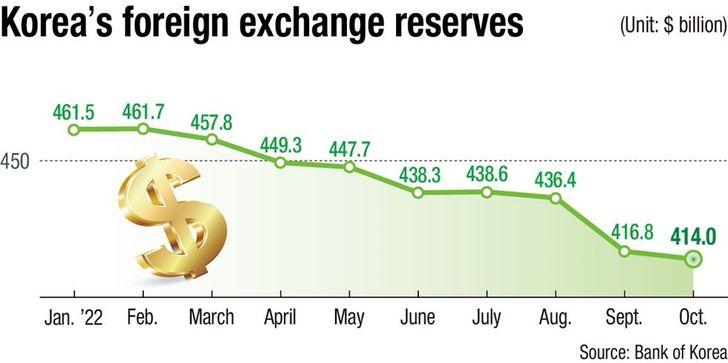
Given the ample possibility of the U.S. dollar extending its rally further amid the U.S. Fed's hawkish rhetoric, the foreign exchange authorities are also widely expected to keep intervening in the market against the Korean won's depreciation.
The BOK said it would take immediate measures to stabilize the market when necessary.
“We will take market stabilization measures when the exchange rate deepens volatility in discord with the economy's fundamentals and movements of other major currencies,” an official from the BOK said.
Market experts called for the need for the Korean central bank to sign a currency swap agreement with the Fed preemptively.
“Authorities are urged to relieve market participants' unstable sentiment regarding the falling foreign exchange reserves by taking relevant measures ― such as the Korea-U.S. currency swap agreement,” Hyundai Research Institute economist Lee Hyung-suk said.
The pace of U.S. Fed rate hikes is faster than expected, so the foreign exchange market here is showing signs of widening instability, according to him.
The Fed took another giant step of raising its key rate by 75 basis points on Wednesday. This move expanded the benchmark rate gap between the U.S. and Korea to 1 percentage point.
“The financial authorities should step up the monitoring of such unstable signs that occur particularly when the key rate gap between the two countries widens,” he said.
After the exchange rate topped the 1,400-won mark last month, it has remained in a band of around 1,420 and 1,440 won for the past few weeks. The rate closed at 1,419.2 won per dollar Friday, down 4.6 won from the previous trading day.