BOK expected to deliver second 'big step' rate hike this week

Bank of Korea (BOK) Governor Rhee Chang-yong speaks during a parliamentary audit of the BOK at the National Assembly in Yeoudio, Seoul, Friday. The BOK is scheduled to hold a rate-setting meeting, Wednesday. Yonhap
By Yi Whan-woo
The Bank of Korea (BOK) is expected to conduct another “big step” hike of half a percentage point in its rate-setting meeting scheduled on Wednesday, in a bid to fight inflation and prevent a possible capital flight, according to analysts, Sunday.
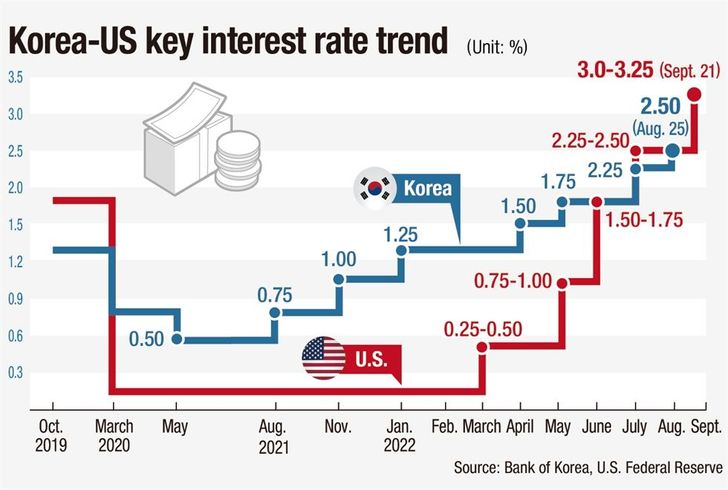
The Korean won's sharp depreciation against the U.S. dollar as well as widening trade deficit are also pressuring the BOK to consider delivering its second 50-basis-point hike following the first one in July, rather than a quarter percentage point increase it has favored. Currently, the BOK's key rate is set at 2.5 percent.
“Consumer prices are still high, and the BOK is believed to be betting on the possibility of inflation not cooling off in the coming months,” said Cho Young-moo, a researcher at LG Economic Research Institute.
Consumer prices, after hitting a near 24-year-high of 6.3 percent in July, slowed down and stayed in the 5-percent range for the second straight month in September.
The slowdown was mainly attributed to a fall in global crude oil prices, which had dropped to roughly $80 a barrel from more than $120 three months ago.
But whether inflation will peak this month as forecast by the government remains in question as OPEC and non-OPEC allies agreed on Oct. 5 to cut oil production by 2 million barrels per day beginning in November.
The move is designed to spur a recovery in oil prices.
Moreover, electricity rates in Korea will go up by 2.5 won ($0.002) per kilowatt hour for the October-December period, which is anticipated to jack up production and service costs.
Under the circumstances, the BOK's forward guidance of “piecemeal” rate hikes by quarter percentage points did not turn out to be effective in preventing the Korean won's sharp depreciation against the dollar.
Such a depreciation comes as the hawkish U.S. Federal Reserve has moved faster on rate hikes.
The U.S. interest rate has outpaced Korea's by a maximum 0.75 percentage point since the Fed's last rate-setting meeting in September where it carried out the third straight “giant step” by hiking its base rate by 0.75 percentage point to 3.0-3.25 percent.
The interest rate gap between the Fed and the BOK is expected to widen in the coming months.
The Korean stock market has already been taking a beating amid a selling spree by foreign investors.
Due to an increase in import prices, Korea's trade balance has stayed in the red since April and that shortfall amounted to $3.77 billion in September.
Korea also suffered a current account deficit for the first time in four months in August at $3.05 billion.
“The economic challenges faced by Korea in the midst of steep U.S. rate increases certainly explain the possibility of the BOK's 50-basis-point hike,” Kiwoom Securities analyst Ahn Ye-ha said.
Ahn Jae-kyun, an analyst at Shinhan Financial Investment, voiced a similar view, saying, “Curbing the fall of the Korean currency will depend on narrowing the difference between U.S. and Korean interest rates.”
Kong Dong-rak, an analyst at Daeshin Securities, noted that the central banks of major countries have been increasing their base rates by 50 basis points or higher to counter the Fed's hawkish monetary policy and that the BOK “may take that path.”