Korea likely to suffer current account deficit in August

Korean won sinks to 1,380 level against dollar for 1st time in over 13 years
By Lee Min-hyung
Korea's current account balance is likely to shift to a deficit in August amid falling exports to China and soaring import costs for raw materials, the Bank of Korea said Wednesday.
According to data from the central bank, Korea's current account posted a surplus of $1.09 billion (1.5 trillion won) in July, down $6.62 billion from the year before. This is the largest decline in more than a decade since May 2011.
This was because the goods balance, a key barometer determining the nation's current account surplus, turned into a deficit during the same period. The goods balance came in at a deficit of $1.18 billion in July, down $6.73 billion from the previous year, on soaring energy import costs and raw material price hikes, according to the central bank.
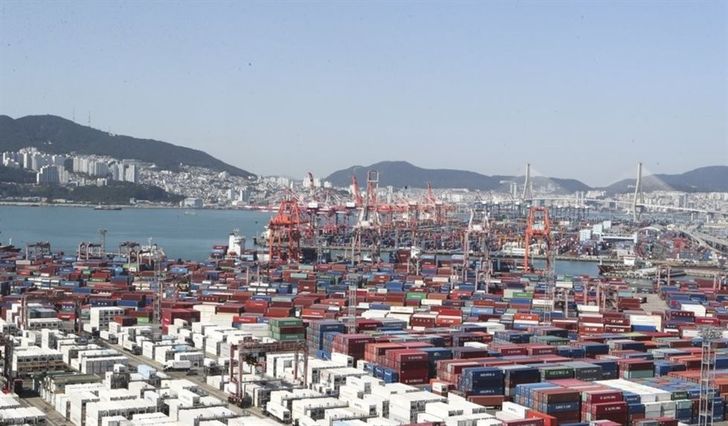
Containers are stacked up at a port in Busan, Wednesday. Yonhap
The BOK left open the possibility of a current account deficit in August for the first time since April, when the current account reported a deficit of $80 million amid a trade deficit sparked by global oil price hikes.
“The decline of the current account surplus in July is due to falling exports to China amid the country's economic slowdown and rising import costs caused by soaring raw material prices, which have resulted in a deficit in the goods balance,” said Kim Young-hwan, director of the central bank's monetary and financial statistics division.
“Considering the nation's exceptionally huge trade deficit last month, there stands a chance for the current account to turn into a deficit in August,” he said. Korea reported a record trade deficit of $9.47 billion last month.
Fears of the worsening trade deficit here pushed up the won-dollar exchange rate, which set a new more-than-13-year high of more than 1,380 won per dollar. The Korean won extended further losses on Wednesday, with the exchange rate closing at 1,384.2 won per dollar, up 12.5 won from the previous trading day. It was the highest level since March 30 when it ended at 1,391.5 won.
Experts share the view that the Korean won will slump further, as the current account is widely forecast to extend its poor performance for the time being.
“We think the current account will remain weak in the coming quarters, as energy and electronics concerns flank the won from both sides,” BNP Paribas economist Yoon Ji-ho said.
Other analysts also said the dollar will remain stronger than the local currency amid rekindled uncertainties over the U.S. Federal Reserve's monetary tightening.
“The dollar has strengthened its value amid revived uncertainties on the Fed's monetary tightening, and the Korean won will likely lose more ground against the dollar, as the market still leaves open the likelihood of the exchange rate topping 1,400 won,” Woori Bank economist Min Kyung-won said.
Amid the steep rise of the exchange rate, the BOK held an emergency meeting to step up vigilance against any unusual signs in the local financial market.
“Given the economy's fundamentals, the pace of the Korean won's sharp depreciation is too fast,” BOK Senior Deputy Governor Lee Seung-heon said. “We will keep paying close attention to the foreign exchange market and do our utmost for market stabilization.”