Digital assets continue to expand presence in both public, private sectors

gettyimagesbank
Major banks prepare for CBDC, while financial authorities aim to regulate the digital asset market
By Anna J. Park
There are many naysayers regarding the future of cryptocurrencies, calling them the contemporary version of the infamous speculation bubble surrounding Dutch tulips in the 17th century.
Despite the presence of such pessimistic voices on digital assets, it is undeniable that central banks around the globe are researching the idea of a Central Bank Digital Currency (CBDC), with the possibility of making a fiat currency in a digital form.
The Bank of Korea (BOK) has also been looking closely at the subject for the past few years and major banks in Korea have been cooperating with the central bank's CBDC pilot program.
NH NongHyup Bank is one of the major local banks that have been joining the BOK's CBDC research project and the bank announced earlier this week that it has successfully completed its pilot transaction system developed in response.
The bank stressed that the successful development of the pilot system has given the bank both a stable blockchain platform as well as the necessary payment settlement technologies that could be utilized as the bank's electronic wallets, once the BOK officially adopts a Central Bank Digital Currency.
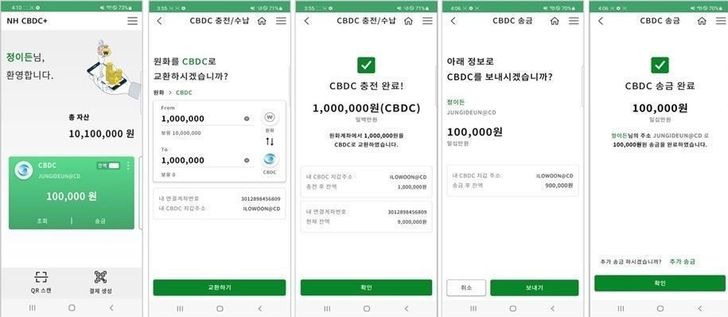
Promotional CBDC pilot system image distributed by NH NongHyup Bank / Courtesy of NH NongHyup Bank
NongHyup Bank explained that the pilot system is equipped with blockchain platforms for both an Ethereum-based decentralized open-source blockchain network as well as a hyperledger, which aims to advance cross-industry blockchain technology, as the first bank to do so in the Korean financial industry. With the blockchain platforms for the two different sets of networks, the bank has secured an expansionary and flexible system.
Based on the development of the system, NH NongHyup plans to further apply various other types of digital asset services, including NFTs, stablecoins and multi-asset electronic wallets.
“The bank plans to proactively join the central bank's various CBDC research projects and pilot programs, hoping to lead blockchain-based new digital asset businesses,” Kwon Jun-hak, chief of the bank, said.
Other major banks are also conducting their own CBDC-related initiatives, lest they begin to lag behind the new tech-driven opportunities of the digital asset market.
Shinhan Bank, for instance, also completed its pilot system for digital currencies early last year, a move aiming to respond to the BOK's potential CBDC issuance in the future. The bank is currently participating in the central bank-led pilot study project on CBDC development.
Woori Bank set up a new department within the bank in December last year that solely covers blockchain platform businesses. The innovative technology department aims to expand and accelerate new businesses concerning the digital asset market. The bank is also a joining party to the BOK's pilot study project on CBDC, while it has issued its own digital currencies, NFTs and multi-asset wallets.
KB Bank said the bank is closely following the current developments surrounding the CBDC studies and pilot programs. The bank's official said the bank plans to provide the best customer service in the digital asset market as well.

gettyimagesbank
However, the BOK said it is still difficult to specifically lay out a timeline for when it might officially adopt CBDC in the country.
During a seminar held at the National Assembly, hosted by the ruling party earlier this month, BOK officials said that the central bank will accelerate and strengthen its efforts in relation to the ongoing research and development studies.
The bank added that it has been closely cooperating with local financial institutions and companies to conduct joint pilot study projects on CBDC since August last year, while it plans to examine the necessity of revising the related law, if required, prior to the issuance of CBDC.
The central bank has also been looking into the possible expansionary functions of CBDC, such as offline payments, digital asset trading, international wire transfers and private information protection technologies.
“The central bank has been conducting pilot experiments on technologies that could bring a CBDC into reality, yet the structure designs and applied technologies haven't yet been confirmed. The bank will continue to further research and experiment to find the optimal model that befits the Korean financial environment,” an official of the BOK said.

Financial Services Commission (FSC) Vice Chairman Kim So-young, first from right, speaks during a task force meeting on digital assets held in Seoul, Wednesday. Courtesy of FSC
Keeping abreast of fast-paced digital asset research and developments in the market, the Financial Services Commission (FSC) has launched a task force team on digital assets, combining experts from both the public and private sectors. It is the first of its kind ever hosted and launched by the top financial regulator, which plans to deeply apprehend the newly-surging crypto markets and ultimately, to effectively regulate the industry.
The FSC, as well as participating experts from both the public and private sectors, will meet once a month with the task force team to jointly discuss various legal, tax policies and regulatory issues surrounding the digital asset markets.
“Digital assets are newly emerging assets developed with the advent of technologies that couldn't have been predicted in the past. Thus, the current legal framework has limitations in effectively managing the market,” the FSC vice chief said in the meeting.

Financial Services Commission (FSC) Vice Chairman Kim So-young, first from right, speaks during a task force meeting on digital asset held in Seoul, Wednesday. Courtesy of FSC
Given that crypto assets have a certain transitional nature, which allows them to easily overcome national borders, the Vice Chairman of the FSC reiterated the need to establish an international cooperative system as well as the judiciary branches' technological advances to effectively respond to new challenges brought about by digital assets. He also stressed the need for consumer protection in times of increased volatility with the digitalization of the financial industry.
“From the neutral perspective regarding digital asset technologies, the financial authority plans to facilitate an increase of consumer benefits, while supporting the promotion of blockchain-related sectors,” he added.