1970s-style oil shock unlikely despite crunch: BIS economist
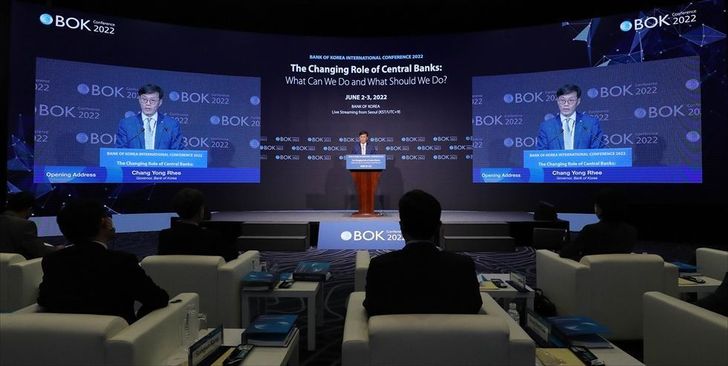
The 'Bank of Korea Conference 2022' is held at the Westin Josun Hotel in central Seoul, June 2. Yonhap
The return of the nightmarish oil shock of the 1970s is unlikely despite tight supply stemming from the Ukraine war, largely due to the world's dwindling dependence on fossil fuels and stronger policy frameworks, an economist at the Bank for International Settlements (BIS) said Thursday.
Global oil prices have skyrocketed as Russia's invasion of Ukraine in February this year triggered Western economies' sanctions on Russia, including a trade ban on Russian oil and agricultural commodities.
Russia accounts for more than 10 percent of the world's wheat and oil productions and more than 20 percent of natural gas, and it is a key supplier of industrial metals, according to BIS data.
During an economic conference hosted by the Bank of Korea (BOK) in Seoul, Shin Hyun-song, an economic adviser and head of research at the BIS, said, "Low energy dependence and stronger policy frameworks make a repeat of the 1970s unlikely, although high and volatile commodity prices could still be disruptive."
According to the economist, the energy use per gross domestic product (GDP) around the globe has fallen by around 40 percent since the late 1970s, and more so for oil.
Shin noted that the recent price hikes in energy and agriculture have considerably decreased between the end of 2019 and the present, compared to the 1972 to 1974 oil shock period.
The median inflation in advanced economies in July 2021 is only about one-third of that in December 1973, he said.
But Shin admitted that the recent commodity price increases will still weigh on global growth and add to inflation.
The impact from price hikes in agricultural commodity prices would be greater than the one from the oil price hikes, he said.
Based on the price hikes observed in the beginning of 2022, the GDP in advanced economies are expected to contract around 0.7 percent on average by 2023. The inflation could increase by over 1 percentage point, he said.
Shin said the current commodity prices hike "puts a premium on restoring low inflation quickly before it becomes ingrained in household and firms' decisions." (Yonhap)