New government puts top priority on curbing inflation

President Yoon Suk-yeol, left, speaks during his first meeting with his top secretaries at the new presidential office in Yongsan District in central Seoul, Wednesday. Yonhap
Finance ministry to launch emergency economic task force
By Yi Whan-woo
Curbing inflation was the top priority at the first meeting of President Yoon Suk-yeol with his top secretaries, Wednesday, where he stressed that soaring prices are the most daunting challenge faced by the country's economy. Deputy Prime Minister and Minister of Economy and Finance Choo Kyung-ho also promised to prioritize the stabilization of consumer prices in managing macroeconomic risks.
“Our economy faces an extremely challenging situation, with rising prices being the top challenge,” Yoon said at the meeting held at the new presidential office in Yongsan District in central Seoul.
He added that a spike in energy prices and other signs of stagflation ― a toxic mixture of stagnant growth and rising inflation ― are “a red light for the competence of businesses” which he seeks to harness to achieve his market-driven economic vision.
“Such an economic situation will not take pause at a time when there is a change of government. We must think over and over and analyze the cause of the rise in prices using all possible indicators and come up with measures to curb inflation,” the president added.
The concerns expressed by the president came as inflation is feared to have gotten out of control in recent months, making it tough for the nascent Yoon administration to jump-start the pandemic-stricken economy.
Inflation has outpaced the central bank's projection for months and hit a 13-year high of 4.8 percent in April.
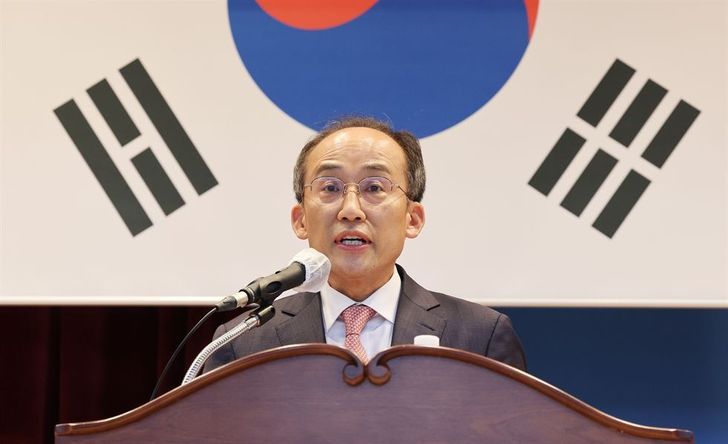
Deputy Prime Minister and Minister of Economy and Finance Choo Kyung-ho delivers a speech during his inauguration ceremony at the government complex in Sejong, Wednesday. Yonhap
Speaking before the ministry's officials during his inauguration ceremony at the government complex in Sejong, Wednesday, Choo said inflation is making it harder for people to make a living, compounded by risks from abroad and within Korea, such as the Ukraine crisis, hawkish monetary policies of the major economies, deepening income polarization and snowballing household debt.
“I am afraid the economic policy team of the new government has no time to spare to brace for the challenges and we must get started right away,” he said. “In that regard, I will put stabilizing prices and the people's livelihood on the top of the list.”
Accordingly, he vowed to set up an emergency task force responsible for monitoring the real economy as well as financial and foreign exchange markets, saying, “I will make sure there will not be even an inch-wide gap in our preemptive measures against the risks.”
The finance minister stressed that tackling inflation is one of the four policy directions to be pursued by the ministry.
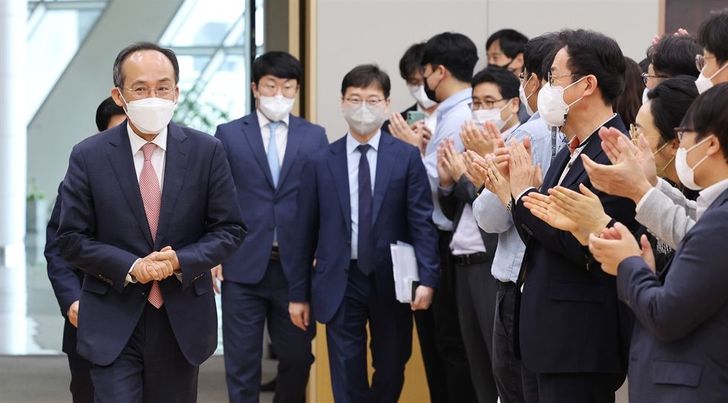
Deputy Prime Minister and Minister of Economy and Finance Choo Kyung-ho is greeted by ministry officials as he arrives at his inauguration ceremony at the government complex in Sejong, Wednesday. Yonhap
The three other policy objectives were removing red tape that hinder corporate innovation, improving the financial health of the nation and enhancing social safety nets for socially-vulnerable people.
Concerning support for businesses, he underscored a regulatory overhaul as well as active government support to create quality jobs and expand corporate investments.
To improve financial health, he called on both the public and private sectors to pursue changes in accordance with the Fourth Industrial Revolution plus the toughened carbon neutrality goals worldwide.
He said the numbers and economic indicators tend to fall short of showing whether wealth is being effectively used for the public's benefit.
“And that's why it will be important to restore ladders in society for the people to freely climb and make sure the welfare system is working properly,” Choo added
Meanwhile, the government and the ruling People Power Party agreed to draw up a supplementary budget, estimated to be between 36 trillion won ($28.2 billion) to 37 trillion won, in the first consultative meeting after the Yoon government was launched on Tuesday.
Choo, who was at the meeting, said the extra budget plan is mainly aimed at compensating the financial damage suffered by pandemic-hit small merchants and stabilizing consumer prices.