Korea embraces more market-driven economy under new president

Apartment complexes are seen from 63 Square in Yeouido, Seoul, May 6. Tax rules on the housing market are among regulations that the Yoon Suk-yeol government plans to lift or ease on its path to bolstering a market-driven economy. Yonhap
Reform plan to focus on regulatory overhaul, innovation, improving financial health
By Yi Whan-woo
Market-driven growth will be at the center of President Yoon Suk-yeol's vision for a full-fledged economic recovery, amid the looming specter of stagflation ― a toxic mixture of stagnant growth and rising inflation.
Yoon's economic reform plan accordingly reflects the demands of the corporate world to create a business-friendly environment, such as lifting and easing regulations, as well as offering support in the firms' path for innovation moving forward.
For wealth to trickle down into people's daily lives, improving fiscal health will be critical. And this is where the Yoon government will come in, by implementing what it calls “binding rules” to prioritize financial soundness in planning budgets and tackling the national debt that snowballed during the Moon Jae-in administration.
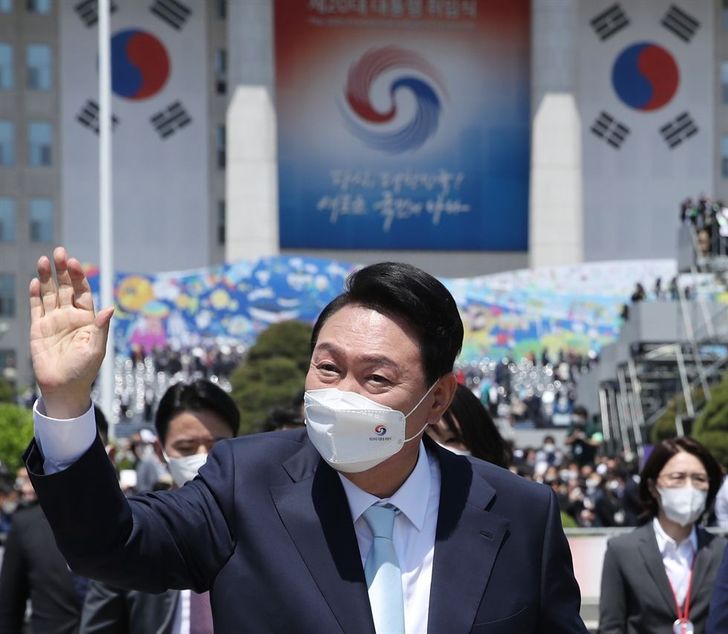
President Yoon Suk-yeol waves as he leaves after the inauguration ceremony at the National Assembly in Yeouido, Seoul, Tuesday. Yonhap
“The ideas of a market-driven economy and regulatory overhaul are perceived as cliche answers concerning growth, but they could be refreshing under the Yoon administration because they mark a turnaround from the past administration's policy,” said Park Chong-hoon, the head of economic research at Standard Chartered Bank Korea.
He was referring to Moon's income-led growth initiative, which was premised on the government actively intervening in the redistribution of wealth.
It was underpinned by massive fiscal spending that saw the national debt grow to 305.1 trillion won ($239.4 billion) during Moon's presidency ― a record for a five-year presidential term in Korea.
While the national GDP expanded 4 percent year-on-year in 2021, it was largely attributed to the government's stimulus spending as well as the base effect caused by the economic fallout in the wake of the pandemic.
Korea's economy faces a murky outlook this year, as seen from the International Monetary Fund (IMF) slashing its forecast of Korea's annual GDP growth to 2.5 percent from 3 percent and consumer prices rising 4.8 percent in April ― the highest in 13 and a half years.
“The private sector can be said to be more agile than the government in innovation, and having the former to take initiative on growth strategy can raise the chance of the country to succeed in an economic recovery,” Park said.
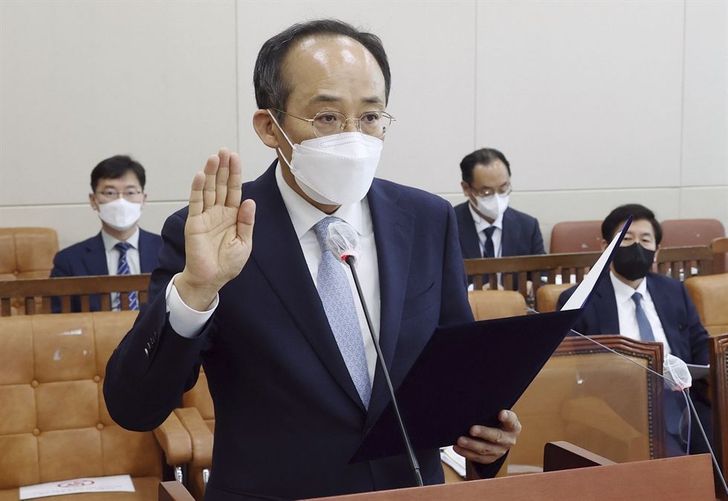
Choo Kyung-ho, President Yoon Suk-yeol's first deputy prime minister and minister for economy and finance, takes an oath for the post during a National Assembly hearing in Yeouido, Seoul, May 2. The Assembly approved Choo for the job, May 3. Joint Press Corps
Under the phrase, “A dynamic economy driven by private sector and backed by the government,” the Yoon administration, according to political sources, is expected to “go full force” to scrap any redundant regulations.
In particular, it will pursue a regular strategic meeting presided over by the president plus a joint oversight agency among the private and public sectors, including members of academia.
During a May 3 press briefing, the now-dissolved presidential transition committee explained that the president-led meeting will open a communication channel for the business community to express their needs to the president directly.
To facilitate competition in a fair and objective manner, the review process on M&As will be simplified, while punitive measures on monopolies, collusion, internal trading, technology theft and other unfair business practices will be toughened.
Double taxation will be scrapped for companies that have overseas business operations.
The inheritance tax will be eased for smaller companies run by generations in a family who found it tough to make full payments to take over their businesses.
The lending rules in the housing market possibly drew the most public attention as they were behind the soaring home prices.
The Yoon administration correspondingly will allow mortgage loans of up to 80 percent for first-time homeowners, up from the current 40 percent, referring to the loan-to-value rule that determines the available loan amount based on one's collateral.
It will seek to merge two separate, disputed property taxes levied on owners of multiple homes or a single, pricey home that exceeds 1.1 billion won in value.
Private builders will play a part in the government's plan to supply 250,000 homes.
On fiscal health, economist Park viewed that household debt and the national debt are jeopardizing the economy, and in that regard, Yoon's reform plan will be “timely and appropriate in normalizing financial stability.”
The stimulus package under the Yoon government will be different from that of Moon in that the support will be given only to those who are in dire need.
Moreover, the amount of support will be set within a lower range aimed not to burden the government.
Overall, the new administration has scaled down planned welfare spending for the next five years to 209 trillion won from 266 trillion won.