Incoming gov't set to bolster support for ESG management

President-elect Yoon Suk-yeol, right, and presidential transition committee chairman Ahn Cheol-soo hold a board displaying the 110 key policy tasks be pursued by the incoming administration during a briefing at the committee's office in Jongno District in central Seoul, May 3. The 110 tasks include those associated with environmental, social and corporate governance (ESG) management, such as aquatic ecosystems and clean energies. Joint Press Corps
Oversight to be set up by private, public sector to facilitate ESG policies
By Yi Whan-woo
The incoming administration of President-elect Yoon Suk-yeol is going full force to support environmental, social and corporate governance (ESG) management ― principles that firms around the world are increasingly obligated to observe for sustainable growth.
The incoming administration's commitment to ESG is comparable to that of the outgoing Moon Jae-in administration, which came up with the guidelines for building an ESG ecosystem in Korea in August 2021.
The guidelines were Korea's first government-initiated ESG guidelines, following the formal introduction of the principles in a report of the U.N. Global Compact's Leaders Summit in 2004.
Both the outgoing and incoming administrations are on the same page in terms of addressing the need for enhanced ESG management.
But the latter is not necessarily building on the former's work. It is rather pursuing its own path or even overturning the former's policies to achieve similar goals.
Announced by transition committee chairman Ahn Cheol-soo on May 3, the 110 key policy tasks to be carried out under Yoon's five-year presidency include establishment of a special committee dedicated to the growth of smaller companies.
Unlike conglomerates, smaller companies may find ESG to be an obstacle rather than an opportunity due to expenses and other reasons.
Tentatively titled, “the committee for sustainable growth,” it will focus on materializing measures for small and medium-sized enterprises (SMEs) to achieve the U.N. goal of reaching carbon neutrality by 2050 and expand relevant R&D on SMEs' behalf.
Also on the list of the 110 tasks are scientific approaches to the green economy transition, sustainable ecosystems for water and other aspects of nature, as well as anti-fine dust policies.
Concerning energy, the incoming government will boost the corresponding industries and markets as the Moon administration did.
But the two sides disagree when it comes to the use of nuclear energy. Yoon plans to scrap Moon's nuclear-phase out policy and revive the country's nuclear power plant business, as well as expand exports of the plants.
The safety of nuclear power plants is highly disputed on the path to zero emissions. Still, some advanced economies, including the United Kingdom and France, are finding that a mix of nuclear energy and renewable energies can be used to reduce greenhouse gas emissions in the pursuit of net zero emissions.
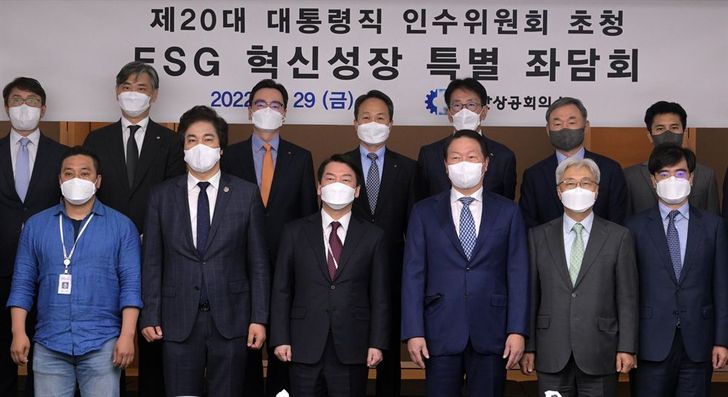
Ahn Cheol-soo, third from left in the front row, the chairman of the presidential transition committee, poses with Korea Chamber of Commerce and Industry (KCCI) Chairman Chey Tae-won, fourth from left in the front row, and other participants of a special meeting held at the KCCI headquarters in Seoul, April 29, to share thoughts on the incoming administration's plan to support innovative growth according to ESG values. Joint Press Corps
The Yoon administration's vision to bolster innovative growth according to ESG values is reflected in its plan to set up a joint oversight agency between the private and public sectors.
The envisioned “control tower” will be responsible for coordinating ESG policies among the ministries, collecting opinions from private companies and providing corresponding solutions based on data.
The plan was discussed during a special meeting hosted by the Korea Chamber of Commerce and Industry (KCCI), April 29.
Ahn represented the transition committee during the meeting, joined by KCCI Chairman Chey Tae-won, also the chairman of SK Group, and other leaders from the finance and business sectors.
The meeting was held to explain the incoming administration's plan to support ESG management and share thoughts with the corporate world before Yoon's inauguration, May 10.
“The new administration will do its utmost for companies to achieve solid results in ESG management,” Ahn said.
Financing for ESG activities will increase more than a fivefold to 310 trillion won ($244.5 billion) as a part of efforts “to help companies in general to participate in the ESG campaign without worrying too much about money.”
The incoming government will spent another 60 trillion won: 50 trillion won to explore new markets and 10 trillion won to fund SMEs and startups.
The 60-trillion-won funding plan is under a broader strategy to create five companies with “unrivaled technologies” on the international stage, to nurture 1,000 prospective startups and to create 920,000 jobs.
The support for businesses in secondary battery, hydrogen energy and environmentally-friendly cars will be given on “an extensive level,” as they are increasingly linked to national security and interests over the global battle in next-generation technologies and energies.
The business community has welcomed the incoming administration's ESG vision.
“Tackling problems related to society and climate change has become a key business agenda nowadays,” Chey said. “In that regard, companies need to capitalize on ESG as a new business opportunity, and I hope the government and the corporate world can work as a team to contribute to a sustainable Korean economy.”
The KCCI chairman suggested visualizing a system to measure the ESG performance of the companies and to offer incentives based on their performance, saying, “The system will be for the sake of the businesses and the country.”
His suggestion is in accordance with the view of international ESG experts that the standardized measurement of ESG performance at a global scale is important for the accurate and transparent valuation of companies.
Na Seok-kwon, the president of the Center for Social Value Enhancement Studies, who participated in the KCCI meeting, said that incentives, private-public sector cooperation and transformation in business models are three keys for firms to adapt successfully to ESG management.
The majority of the participants proposed that the ESG policies should be aimed at lifting barriers rather than imposing regulations.