Korean won dips to lowest level in 25 months on growing uncertainties

An electronic signboard at Hana Bank in Seoul shows the Korean currency closing at a 25-month low of 1,265.20 won per dollar, up 14.40 won from the previous close, Wednesday. Yonhap
Rapid depreciation feared to take toll on stock market, stoke inflation further
By Yi Whan-woo
The Korean won dipped to the lowest level in over two years Wednesday, as the local currency is quickly losing ground against the U.S. dollar amid lingering uncertainties over a faster-than-expected U.S. Federal Reserve tapering coupled with fears of slowing growth in China.
The weakening of the local currency can be a double-edged sword for the Korean economy, while the rapid depreciation could do more harm than good by stoking inflation further and having a far-reaching impact on the entire Korean economy.
The won closed at 1,265.20 won against the greenback Wednesday, down 14.40 won from Tuesday's close and the weakest level since March 23, 2020 when it ended at 1,266.50 won.
The won's depreciation is attributed to investors' growing preference for safe haven assets fueled by increased external economic risks associated with the Fed's aggressive credit tightening, China's largest city-wide COVID-19 lockdown of Shanghai and the prolonged Russia-Ukraine war.
The demand for the greenback is surging, as seen from the U.S. Dollar Index (DXY) against six other major currencies reaching 102.35, Tuesday _ the highest since March 2020.
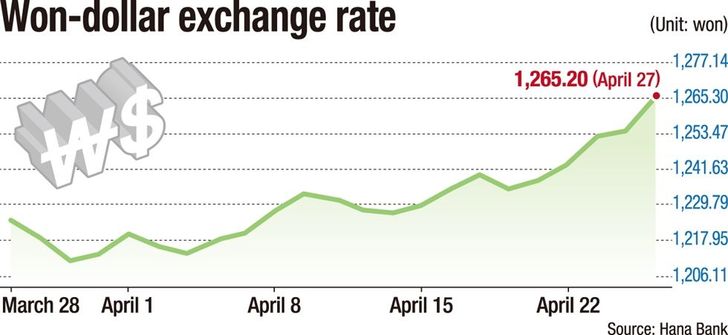
Analysts speculate the Korean won's decline against the dollar will continue and that it may slide to the range of 1,270 won and 1,280 won.
Such projections come as the Fed is expected to take a “big step” by raising interest rates possibly 0.50 percentage points or even 0.75 percentage points during its upcoming rate-setting meeting from May 3 to 4.
The lockdown of China's financial hub of Shanghai is adding to concerns over its growth slowdown which may aggravate bottlenecks in global supply chains.
Amid the Ukraine crisis and its impact on global inflation, Russian Foreign Minister Sergey Lavrov warned, Monday, that the conflict risked escalating into a third world war and that the risk of a nuclear conflict must not be underestimated.
“Under the circumstances, it would not be going too far for someone to say that the Korean won will weaken up to 1,280 won per dollar,” said Seo Jeong-hun, a senior researcher at Hana Bank. “And whether the exchange rate reaches an inflection point will be likely to be determined by the Fed's rate-setting meeting next month.”
Kim Seung-hyuk, an analyst at NH Futures, said the Korean currency will continue to depreciate through the end of the second quarter this year and may bottom out at the 1,270 won range.
“Such a scenario is plausible considering the next largest economies after the U.S., namely China, Europe and the European Union, are embracing monetary easing policies, compared to the Fed's accelerated pace of interest rate hikes.”
Kim Dae-jung, an analyst at Korea Investment & Securities, pointed out that the DXY has hovered above 102 and that the Korean won has more room to lose ground against the strong dollar.
The Korean won's depreciation, according to experts, can pose a threat to the country's path for an economic recovery.
The price of buying raw materials and other goods from abroad will go up, aggravating inflation and affecting consumer spending and investment, which are the main factors behind Korea's slowed quarter-to-growth of 0.7 percent in the January-March period.
For trade, the weakening won can be beneficial for some exporters as it can make Korean products cheaper to buy abroad.
For instance, Korea International Trade Association said in a report in August 2021 that, for every 10 percent depreciation of the Korean won, the operating profit of machinery manufacturers will inch up by 3.5 percent, while that of computer and electronics makers will rise by 2.5 percent.
But even so, the surge in energy and commodity prices will affect their manufacturing costs and their business in the long term, analysts point out.
Airlines and steelmakers are anticipated to suffer the most from the depreciation as their profits rely heavily on the import prices of jet oil, iron ore and coal, among other raw materials.
The steep decline of the Korean won's value can take a toll on the stock market amid a selling spree by foreign investors.
On Wednesday, the benchmark KOSPI closed down 1.10 percent at 2,639.06 due to global inflationary pressure and concerns over the tightening of the U.S. monetary policy, which also affected the U.S. stock market overnight.
“The strong dollar provokes foreign investors to offload stocks and lead to falls in the KOSPI,” said Kim at Korea Investment and Securities.
He said the KOSPI has shown a tendency of a downward trajectory since 2000 whenever the Korean won fell 3 percent or more against the dollar on a monthly basis.