Fears of stagflation grow amid inflation, rate hikes, weakening won

Agricultural produce are on display at a grocery market in Seoul, Sunday. The International Monetary Fund (IMF) projected Korea's 2022 inflation at 4 percent, the second-highest among the eight advanced economies in Asia as categorized by the IMF. Yonhap
Gov't urged to take preemptive measures against stagflation
By Yi Whan-woo
The specter of stagflation, a deadly cocktail of stagnant growth and inflation, has been growing, as a triple whammy of rising prices, interest rate hikes and the weakening Korean won have combined to weigh heavily on the Korean economy.
Such fears come as the ongoing Russia-Ukraine war, coupled with escalated COVID-19 lockdown restrictions in parts of China, have hampered economic recovery while leading to hikes in energy prices and supply chain disruptions worldwide.
The high inflation is feared to disrupt Korea's 2022 growth target of 3.1 percent, with problems caused by the hikes in the key interest rate and a sharp depreciation of the Korean won against the U.S. dollar, also putting pressure on the recovery path.
According to Statistics Korea, consumer prices reached their peak in more than a decade at 4.1 percent in March, after surpassing the Bank of Korea's (BOK) inflation projection of 2.1 percent and gaining more than 3 percent since October 2021.
The International Monetary (IMF) revised up its inflation projection for Korea from 3.1 percent to 4 percent in its update on the global economy last week.
The IMF's 4-percent inflation prediction is the second-highest after New Zealand's 5.9 percent, among the eight advanced economies in Asia categorized by the IMF. The eight advanced economies in Asia include Japan, Australia, Singapore, Hong Kong and Macau and Taiwan.
The rise in inflation prompted the BOK to take countermeasures earlier this month by raising the key interest rate to 1.50 percent, which is the highest level in nearly three years.
It was the BOK's fourth rate hike since August 2021, and the move was in accordance with the monetary policies of the major economies in their steps in return to normalcy amid the pandemic era.
However, the BOK's 1.50-percent base rate has fueled fears of hindering the government's financial relief aid package, while further boosting interest burdens on indebted Korean households.
Moreover, the key rate is speculated to go up to 2 percent by the year-end, with inflation showing no signs of letting up.
“Dealing with both inflation and growth may be the trickiest task in economics, and extreme caution against stagflation is urged, although Korea has yet to enter the phase of stagflation,” said Seoul National University economics professor Ahn Dong-hyun.
It also remains to be seen whether the Korean central bank's pace in rate hikes can cope with the U.S. Federal Reserve's faster-than-expected tapering, which otherwise could result in a reversal of the interest gap between the two countries and possible capital flight.
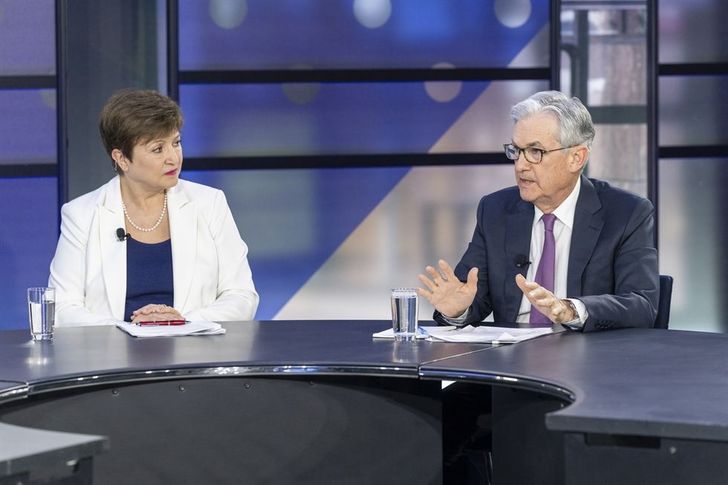
U.S. Federal Reserve Chairman Jerome Powell, right, and International Monetary Fund (IMF) Managing Director Kristalina Georgieva participate in the Debate on the Global Economy during the 2022 Spring Meetings at IMF headquarters in Washington, D.C., Thursday. EPA-Yonhap
The Fed has repeatedly signaled an additional increase in its key interest rate after lifting the country's near-zero rate for the first time since March 2018.
The latest signal was given last week when Fed Chairman Jerome Powell said that the U.S. central bank is likely to raise interest rates by half a percentage point at its next rate-setting meeting scheduled from May 3 to 4.
Powell indicated that similar rate increases could be warranted after the May meeting. There will be five more meetings this year.
Against this backdrop, the local currency sank to the 1,240 won-range against the dollar for the second time this year during intraday trading, Friday. It closed at 1,239.1 won, down 0.1 won from Thursday's close.
Foreign investors correspondingly have been on a selling spree on the Korean stock market, dumping stocks worth 20.8 trillion won ($16.8 billion) on the benchmark KOSPI and secondary Kosdaq this year.
Amid this situation, the IMF revised down Korea's economic outlook from 3 percent to 2.5 percent, while Fitch Ratings slashed its economic outlook for the country from 3 percent to 2.7 percent.