Interest rate, inflation weighing on Korean economy: S&P
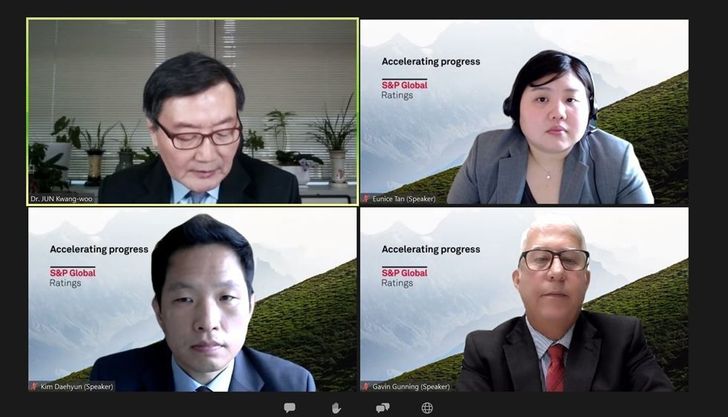
Institute for Global Economics (IGE) Chairman Jun Kwang-woo, top left, speaks during a webinar held on Wednesday with three market analysts from S&P Global. Screenshot of the webinar
By Anna J. Park
The Korean economy and the Asia-Pacific economy in general are facing risk factors from the “four i's” ― namely interest rate, inflation, invasion and infectious disease ― which put downward pressure on the region's economic growth forecasts for this year, according to analysts from S&P Global Wednesday.
During a webinar hosted by Institute for Global Economics (IGE) that invited three market analysts from S&P Global, Eunice Tan, head of credit research of the Asia-Pacific region at the global ratings agency, said that Korea needs to pay particular attention to the possibility of reductions to its current account surplus as well as persistent inflationary rates.
She said that as a net energy-importing country, Korea is expected to suffer from a decrease in its current account surplus this year, which attributed to the credit rating agency's lowering of the country's economic growth rate forecast for this year to 2.5 percent from an earlier forecast of 2.7 percent.
She explained that if companies pass on the burden of increased raw material prices to consumers, it could restrain the recovery of consumption to some degree. Financial companies are required to prepare a larger amount of reserves for bad loans.
Yet she stressed that concerns about stagflation remain at a moderate level for advanced economies including Korea, as developed countries have been recovering to pre-pandemic levels of growth. The danger of stagflation looms large for emerging markets, she added.
“However, if the price surge in raw materials like energy and grain continues for the longer term, the negative impacts on GDP growth rate cannot be avoided,” Tan said.
Regarding the risks of Russia's invasion of Ukraine, Gavin Gunning, senior director at S&P Global's financial services ratings division, said banks in Korea as well as the Asia-Pacific region have relatively little exposure to the crisis.
Yet, he added that these countries could suffer from secondary impacts, such as the slashing of Korea's GDP growth rate prospects by 0.2 percentage points due to the ongoing geopolitical uncertainty.
Meanwhile, regarding the issue of ESG management in the Korean banking sector, S&P Global Director Kim Dae-hyun highlighted that most Korean banks are well-prepared for the sustainable management requirements, as they are fairly well-equipped with ESG committees within their boards.
The analyst added that among the three components of the environmental, social and corporate governance (ESG) matters, Korean banks are more pressed to enhance their social and governance perspectives, as seen in cases of mis-selling of problematic funds and financial products to consumers, rather than the environmental component, which is more easily manageable among Korean banks with their diversified business portfolios.