Coordination on policy mix gets critical for incoming administration

Choo Kyung-ho, the nominee for the deputy prime minister and minister of economy and finance, speaks during a press conference at the Bankers' Club in central Seoul on the day he was nominated, Sunday. Joint Press Corps
Sharp rise in Treasury bond yields shows need for cooperation
By Yi Whan-woo
The two nominees for the top posts of the nation's economic control towers are being urged to work closely, concerning the policy mix ― fiscal policy and monetary policy ― as the incoming Yoon Suk-yeol administration seeks to expand government spending and curb soaring inflation at the same time.
The two nominees are Choo Kyung-ho for the deputy prime minister and minister of economy and finance and Rhee Chang-yong for the governor of the Bank of Korea (BOK), with the former to be in charge of fiscal policy and the latter responsible for monetary policy.
It has always been desirable for the finance ministry and the central bank to work on the aforementioned policies in a mutually complementary manner in accordance with the economic situation.
However, such harmony may be more difficult to achieve now, according to financial sources, Wednesday, given the fact that the incoming government faces the tricky job of both fostering growth and managing inflation in the pandemic-stricken economy.
Concerning growth, President-elect Yoon plans to spend an extra 50 trillion won ($40.5 billion) ― in addition to the supplementary budget of 16.9 trillion won already allocated by President Moon Jae-in administration earlier this year ― in relief funds for small business owners and the self-employed.
The plan has raised concerns that it may worsen soaring consumer prices and significantly diminish the BOK's efforts to curb inflation by hiking the benchmark interest rate.
The failure to balance out the conflicting interests in fiscal and monetary policies is feared to result in stagflation ― a toxic mixture of stagnant growth and rising inflation.
The Korean economy is forecasted to grow by 3.1 percent in 2022. But speaking at a press conference with foreign correspondents in Seoul, Tuesday, Finance Minister Hong Nam-ki said that the figure may be revised while inflation “will be projected to rise to a higher level.”
Consumer prices have continued rising for months and gained 4.1 percent in March ― the steepest increase in a decade and above the central bank's outlook of 3.1 percent.
“You can see that intricate coordination in fiscal and monetary policies is needed now more than ever,” an economist said on condition of anonymity. “Even a minor misstep between the finance ministry and the BOK might lead to the worst economic situation we could imagine.”
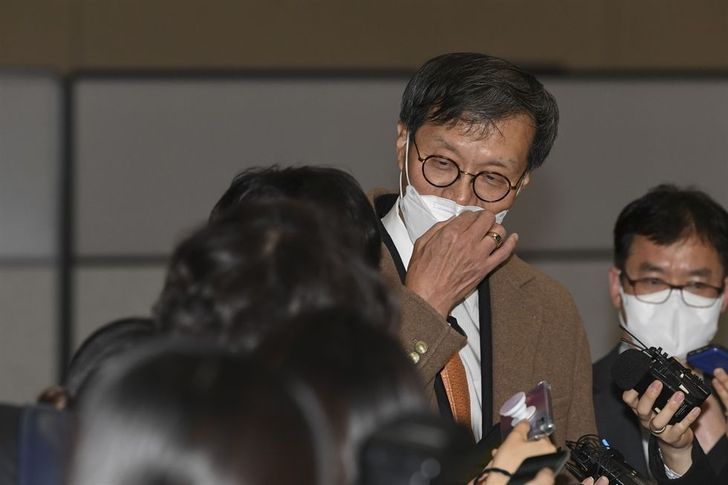
Rhee Chang-yong, the nominee for the Bank of Korea (BOK) governor, responds to journalists at Incheon International Airport, March 30, a week after he was tapped for the post and wrapped up his former job as the IMF's director of the Asia and Pacific Department. Korea Times file
Against this backdrop, the sources found it hopeful that Choo and Rhee worked together at the Financial Services Commission (FSC) in 2009. Back then, Rhee was the FSC vice chairman and Choo, a former career bureaucrat, was a director in the commission's policy planning area.
On separate occasions, the two nominees expressed willingness to consult with each other in tackling the mounting economic challenges.
During a press meeting shortly after his nomination, Sunday, Choo said, “I will meet the BOK governor frequently ― so frequently that meetings between the finance minister and the BOK governor do not become worthy of being covered as news.”
The finance minister nominee addressed the importance of “a combination of fiscal and monetary policies that can minimize public anxiety over inflation, to the extent that they do not hurt the macro economy.”
The former director of the IMF's Asia and Pacific Department, Rhee has been preparing for a National Assembly hearing scheduled for April 19 after being tapped as the BOK governor on March 23.
He told reporters on April 1 that the BOK “will actively engage in dialogue with the central government and coordinate relevant policies,” saying, “The central bank's role has been changed from in the past when it stressed its independence in decision making, only aiming at price stability.”
In particular, Rhee said that monetary measures should be implemented in “a comprehensive, consistent and coordinated manner.”
The sharp rise in Treasury bond yields is seen as one of the areas that urgently requires coordination between the two. For instance, the yield on three-year Treasury bonds jumped 19.9 basis points to close at 3.186 percent, Monday, the highest in about 10 years, although it fell to 3.105 percent, Tuesday.
Such a jump was attributed to expectations that the central bank will continue to raise rates, while the government will keep selling bonds to finance the massive extra budget.
Choo noted that stabilizing the Treasury bond market “always remains a key task to be jointly dealt with by the finance ministry and the central bank.”