INTERVIEW Dictionaries help defectors to tackle lack of financial literacy

Kim Byeong-uk, the president of the North Korea Development Institute, talks about the dictionaries of financial and real estate terminologies for North Korean defectors in this photo taken in December 2021. The financial terms dictionary was published in September 2021 and the real estate terms dictionary was published in February this year. Courtesy of Kim Byeong-uk
Kim comes up with dictionaries to prepare for inter-Korean unification
By Yi Whan-woo
A lack of financial literacy _ the ability to understand basic financial principles and skills such as personal financial management, budgeting, and investing _ is a challenge faced by North Korean defectors who settle in South Korea.
Even South Korea, the world's 10th largest economy, lags behind when it comes to financial literacy, which means it is that much harder for the defectors to become familiar with the concepts of capitalism.
Only 33 percent of South Korean adults were financially literate, ranking the country 81st out of 142 in a Standard & Poor's Global Financial Literacy Survey.
This is how Kim Byeong-uk, the president of the North Korea Development Institute, came up with two dictionaries since last year _ one on financial terms and another on real estate terminology _ that explain relevant terms in South Korea to the defectors and compare the differences in the usage of words across the Demilitarized Zone.
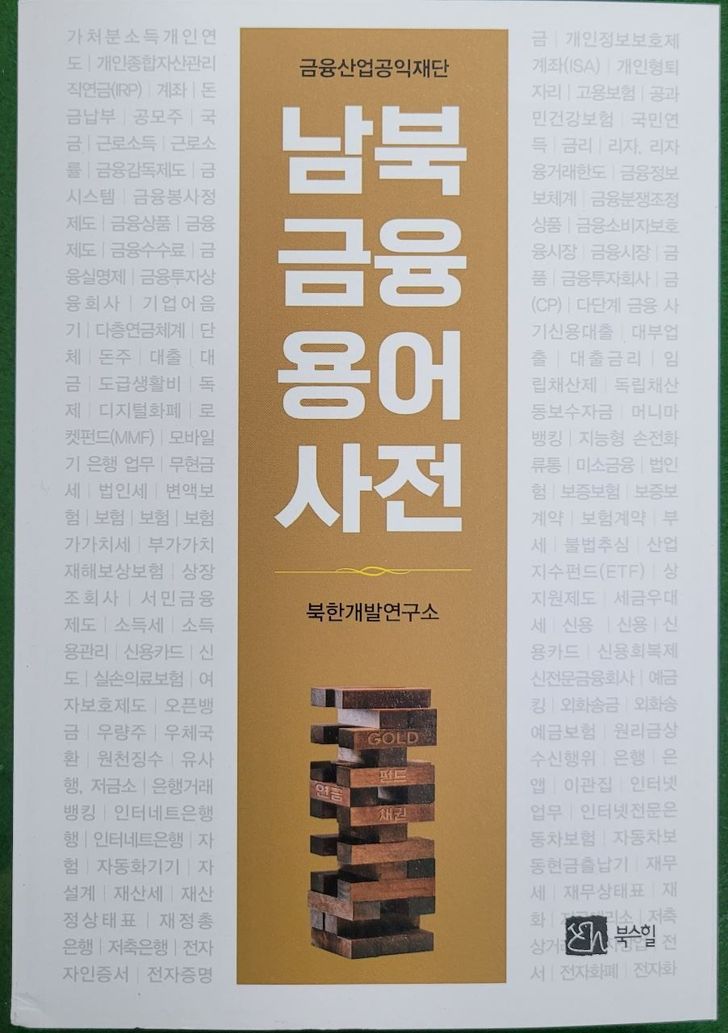
Front cover of the “Dictionary of South-North Financial Terms” published by the North Korea Development Institute / Courtesy of Kim Byeong-uk
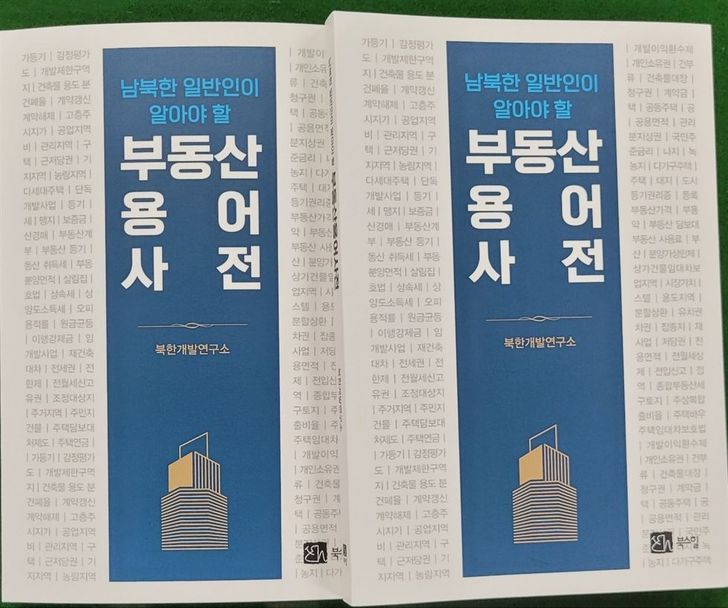
Front cover of the “Dictionary of Real Estate Terms South and North Koreans Should Know” published by the North Korea Development Institute / Courtesy of Kim Byeong-uk
The dictionaries are the first two works of the institute's so-called “53 project” of publishing dictionaries covering 53 major academic disciplines categorized by the government and academia here.
The project is intended to narrow the language gap between the two Koreas to prepare for unification down the road.
The 53 subjects range from computer science, history, music, philosophy and politics to religion.
The fact that the project prioritized finance and real estate implicitly shows the urgent nature of the language gap felt by the defectors concerning the two areas, according to Kim.
“The frustration and struggle of the defectors regarding financial literacy can be too much for them to bear considering they come from a country where the economy is completely the opposite to that of South Korea,” Kim told The Korea Times in a recent telephone interview.
“The dictionaries are intended to help them overcome difficulties stemming from ideological and economic gaps and better adapt to South Korean society,” he added.

Kim Byeong-uk, fifth from left, the president of the North Korea Development Institute, is joined by financial experts during a discussion about the “Dictionary of Real Estate Terms South and North Koreans Should Know” in this photo taken in January this year. Courtesy of Kim Byeong-uk
Kim, 60, is also a defector who used to be a top manager of state-controlled factories in all of North Hamgyong Province before he escaped the North with his family in 2002.
He said he did not have much financial knowledge, but did not experience too much difficulty here because of support from his wife who was an accountant back in the North and was good with numbers.
He was surprised when he happened to be the only one who did not fall victim to financial fraud, including voice phishing, targeting defectors. The victims included individuals who were smart enough to earn master's and doctoral degrees.
“While banking, insurance and other financial services do exist in North Korea, they are fully state-controlled and simple, whereas ones in the South involve both the public and private sectors and the relevant products keep evolving over time,” Kim said. “The stark contrast makes defectors who have other things to adjust to and are busy making a living have a tough time catching up with financial subjects here.”
The frequent use of English and rapidly-changing banking environment using digital devices only make things more difficult for defectors, according to Kim.
Published in September 2021, the dictionary of financial terms is 368 pages long. In Korean alphabetical order, the book explains 120 terms that were carefully chosen by 26 experts _ 11 from the South and 15 formerly from the North _ after months of work.
The 26 experts included researchers from the Bank of Korea, Korea Development Bank, Industrial Bank of Korea, KB Kookmin Bank and Hana Bank as well as university professors.
There have been other dictionaries of financial terms targeting North Korean defectors. But this is the first time such a dictionary was made in collaboration with experts from the South and those who defected from the North.
The dictionary is available in both print format, including 2,500 copies donated to public libraries nationwide, and a smartphone app.
Published in February this year, the dictionary of real estate is 270 pages long. It explains 100 terms.
The two dictionaries can be regarded as glossaries in some aspects. But Kim insisted on calling them encyclopedias, noting that they offer more than just definitions of words and accordingly provide charts, illustrations and other information that can deepen the understanding of the users.
“The encyclopedic style of explanation was necessary because many terms do not even exist in the North,” Kim said, citing terms such as capital gains tax, financial derivatives, M&A, price gap on apartments that are associated with a free market economy and regulations to adjust supply and demand.
Asked about the public's response, he said, “We get calls from defectors as well as members of separated families who request the printing of more copies, while advising us to add more words in case a second and additional publications are available.”
Through the two dictionaries, Kim assessed that the institute “won the public's trust” concerning its capacity for inter-Korean relations at the civilian level after it began in 2012 as a small gathering aimed at helping defectors studying at graduate schools write thesis reports.
He accordingly thanked the Financial Industry Public Interest Foundation and UniKorea Foundation. The former funded 150 million won ($123,500) for the financial terms dictionary project and the latter financed 20 million won for the real estate terms dictionary.
“The biggest present that the defectors can bring to their hometowns in the North is to contribute to narrowing gaps and that is what the institute is committed to doing,” he said.