Will foreign investors continue to desert KOSPI?

gettyimagesbank
By Anna J. Park
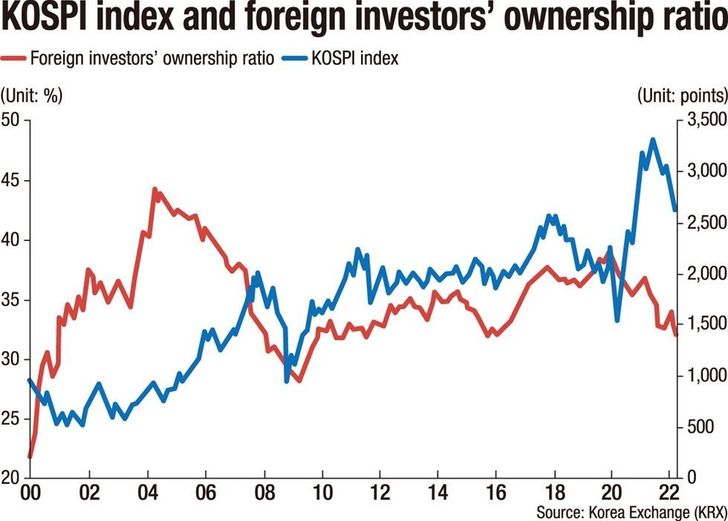
Foreign investors are dumping Korean stocks, with the percentage of foreign ownership among KOSPI-listed stocks falling to its lowest level in six years. Analysts say these investors are likely to continue net-selling Korean stocks for the time being, as the Korean economy has turned out to be comparatively more vulnerable to global inflation, due to its lack of raw materials and energy resources.
This month alone, foreign investors net-sold 5.24 trillion won ($4.32 billion) worth of Korean stocks on the benchmark KOSPI market. In 12 of 15 trading sessions this month until Wednesday, foreign investors opted to net-sell Korean stocks.
When calculated from late February when Russia began its invasion of Ukraine, foreign investors have dumped some 6 trillion won worth of local stocks on the KOSPI so far. When their net-selling on the tech-heavy Kosdaq and futures markets are also counted, nearly 8 trillion won left the local stock market.
The selloff pulled down foreign investors' ownership ratio of KOSPI-listed stocks to around 30 percent, the lowest level in six years since 2016.
Behind the net-selling are the rising global interest rates and growing geopolitical uncertainties, which are both fueling foreign investors' exodus from emerging markets.
Market watchers say they expect the complex web of other related factors, such as exchange rates, the country's relatively low economic growth outlook and local companies' lower profit forecasts for this year, to trigger foreign investors' net-selling for the time being.
“Foreign investors continued net-selling since 2020 has resulted in their stake ratio on the KOSPI falling to the lowest level in recent years,” said Yoo Myoung-gan, an analyst at Mirae Asset Securities.
“Large-scale net-selling could be alleviated, yet it's still too early to expect their position to turn to net-buying, when considering global macroeconomic conditions and local companies' profit momentum.”
“It is hard to expect additional net-buying momentum by foreign investors, when U.S. Federal Reserve Chair Jerome Powell is slated to hold various interviews and press conferences this week,” said Lee Kyoung-min, an analyst at Daishin Securities.
Some market watchers pointed out that the Korean economy is especially vulnerable to global inflation, due to its lack of raw materials and energy resources compared with other more resource-rich Asian countries, which is driving the exodus of foreign investors. Korea's consumer price index forecast stands at 3.6 percent, which is much higher than those of other Asian countries, such as Taiwan at 2.5 percent, Malaysia at 3.3 percent and Vietnam at 3.1 percent. Analysts thus say the real turnaround will only be possible when global inflation pressures stop mounting.
However, some market experts anticipate that foreign investors could switch to net-buying in the local market if the won strengthens enough against the dollar or when global concerns over tapering interest rates are somewhat alleviated.
“Since March 2020, foreign investors have so far net-sold some 40 trillion won worth of local stocks on the KOSPI, due mainly to the increased volatility of the local market and depreciation of the Korean won against the dollar,” said Yeom Dong-chan, an analyst at Korea Investment & Securities.
“When considering that the strengthened dollar has led to the exodus of foreign money, it could flow back into the Korean stock market when the dollar value is somewhat stabilized.”