President-elect may scale down assistance for Moon's New Deal fund

The Financial Services Commission (FSC) oversees state policy concerning the fund aimed at raising up to 220 trillion won ($180.1 billion) in investments for President Moon Jae-in's Korean New Deal initiative. Korea Times file
By Yi Whan-woo
President-elect Yoon Suk-yeol may scale down the government's assistance for a disputed fund aimed at realizing President Moon Jae-in's signature economic initiative, the Korean New Deal, according to financial sources, Tuesday.
Sources said Yoon might cut state assistance for the fund as he urgently needs 50 trillion won ($40.9 billion) in relief funds as he promised to support small business owners and self-employed people hit by economic fallout from the pandemic.
Funding the 50 trillion won is a tricky task. The country's national debt is snowballing fast and will reach up to 1,064 trillion won this year, making it impractical to draw up another round of the supplementary budget in addition to the 17 trillion won allotted by the Moon administration earlier this year.
The 17 trillion won is the latest in a total of 10 rounds of supplementary budgets under the Moon government, and is separate from the 2022 budget worth 608 trillion won, which is the largest to date.
The Ministry of Economy and Finance will find it tough to adjust the planned expenditure and squeeze out 50 trillion won, out of the 608 trillion won, on the forthcoming Yoon government's behalf.
This is mainly because the discretionary budget for 2022 ― which refers to the costs for non-mandatory spending purposes, and therefore is relatively lower priority ― shrank 10 percent from the previous year.
The reduced discretionary budget means little flexibility will be allowed in revising the spending plan.
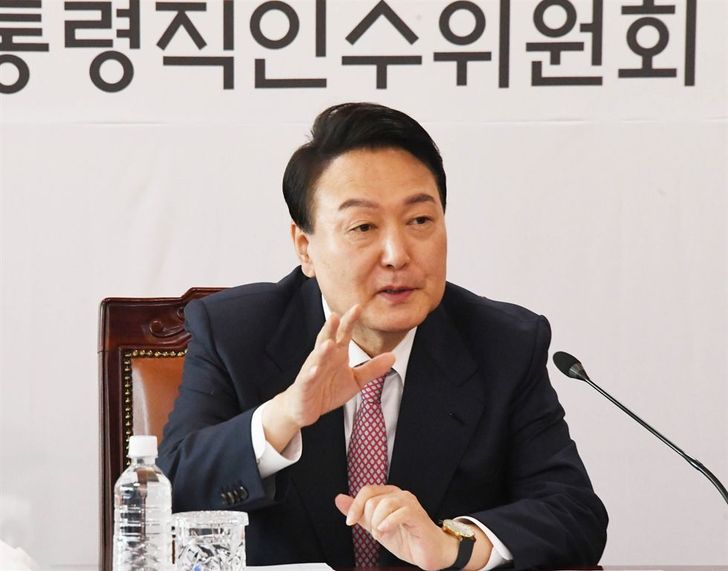
President-elect Yoon Suk-yeol presides over a meeting with members of the presidential transition committee at the committee's office in central Seoul. Tuesday. Yonhap
“Under the circumstances, the government's assistance for the Korean New Deal fund is being mentioned as a possible way to draw up the 50 trillion won,” a source familiar with the Financial Services Commission (FSC) said.
The FSC oversees the state policy concerning the fund, which the government has sought to foster so that it can meet Moon's goal of expanding investments for the Korean New Deal to 220 trillion won by 2025. The amount is up from the initially planned 160 trillion won.
The FSC and Korea Development Bank (KDB), which manages the fund, were allotted with a combined 600 billion won from the government budget.
Another source observed that the disputes concerning the fund may be a signal that Yoon will probably reduce state support.
The fund deals with green and digital technologies, the two pillars of the Korean New Deal that ultimately aim to revitalize the country's economy.
The financial risks associated with the fund have been controversial, as investments were often made on unlisted companies, while the government, using taxpayers' money, guaranteed to cover as much as 20 percent of the losses.
Rep. Yun Chang-hyun of the People Power Party (PPP) said the fund is on the same track with Yoon's policy direction in terms of digital transformation and carbon neutrality.
He still said the government's financial support for the fund “may need to undergo change,” adding that “the relevant budget is somewhat too much.”