Yoon tasked with stabilizing overheated housing market

President-elect Yoon Suk-yeol speaks during a press conference, Thursday, after winning the election a day earlier, at the National Assembly in Seoul. Yonhap
Alleviating tax burden considered top priority for market stabilization
By Lee Min-hyung
President-elect Yoon Suk-yeol is tasked with changing what are considered by many as abnormal and anti-market real estate policies after taking office in May.
Yoon pledged to drastically reform the real estate policies of his predecessor to coincide with market principles by easing punitive taxes that have been imposed on multiple homeowners in hopes of deterring real estate speculation. Instead, the President-elect aims to tame soaring housing prices by constructing more than 2.5 million new homes nationwide during his single, five-year term.
It remains to be seen whether Yoon's pledge will be fulfilled in a timely fashion and lead to immediate effects on the market. But the move is a step in the right direction to stabilize the market from a long-term perspective, experts said.
They said the ball is now in the court of the presidential transition team.
No specific details have been announced yet, since it has been only a few days since Yoon won the election. But the transition team is widely expected to map out policies aimed at applying market principles to housing policies due to the need to deal with the overheated housing market.
There are multiple cards that the new administration can play _ including the integration of the comprehensive real estate holding tax and the property tax _ which is also cited as one of Yoon's key housing market pledges.
“But as some of the key pledges will be time consuming, we need to wait and see what specific measures Yoon's presidential transition team will take,” Kwon Dae-jung, a professor of real estate at Myongji University, said.
The revision of some real estate policies require approvals from the National Assembly, so the pledges will likely hit a snag before realization due to a possible boycott from the incumbent ruling party.
“Despite the setback, the President-elect may sign an executive order mandating the revisions of some existing real estate policies,” the professor said. “As the transition team is to be launched soon, a detailed roadmap of the next administration's real estate policies will be shared soon.”
After Yoon was elected as Korea's next president, Goldman Sachs also released a report on the outlook of the country's housing market after his inauguration.
The investment bank also focused on Yoon's market-friendly approaches by easing tight regulations and reducing the tax burden.
“On housing markets, Yoon plans to stabilize housing markets by focusing on supply measures, rather than demand constraints, as has been pursued by the current administration,” Goldman Sachs economist Kwon Goo-hoon said in the report. “The plan is to increase housing supply by up to 2.5 million units during his presidency, 500,000 on average per annum, 10 percent more than the average over the last two years.”
The economist expected deregulation and tax incentives to drive the housing supply during Yoon's presidency.
“With 80 percent of the supply to come from the private sector in high-demand areas, the main implementation tools will be deregulation and tax incentives,” he said. “In this context, the administration intends to relax restrictions on floor areas and induce multiple homeowners and retirees to sell their houses in the secondary markets through tax incentives.”
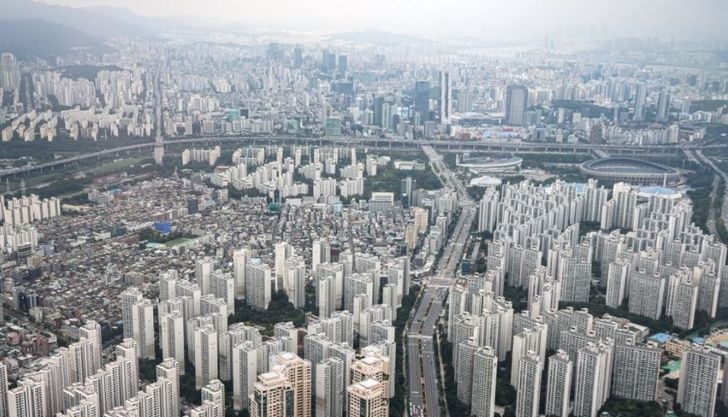
Seen above are apartment complexes in Seoul. Yonhap
For now, those who purchase more than three houses in regulated areas should pay a maximum of 75 percent of their gains as a transfer income tax when they sell one of the properties.
The introduction of the heavy tax system froze multiple homeowners' sentiment in the housing market for the past few years. This ended up reducing housing supplies in key regulated areas _ such as Seoul _ where housing demand remains high and supply falls far short of demand.
Prices of apartments in the capital, most regulated and even some deregulated provincial areas have soared during the past five years due to the side effects of the failed housing policies by the incumbent administration.
Yoon plans to ease the tax burden by revising the transfer income tax system to induce multiple homeowners to sell their houses.
Kim Dae-jong, a professor of business administration at Sejong University, expected the incoming administration to take immediate action to normalize the housing market right after Yoon in inaugurated on May 10.
“The Moon administration failed to stabilize the market by unwaveringly pushing ahead with an unpredictable set of policies to curb soaring housing prices,” he said. “The administration should have left an impression on the public that the government has consistency in its housing policy by expanding supply, but this was not the case.”
Reflecting on the failure, the presidential transition team will focus on normalizing the market by abolishing or revising some of the policies that have ended up confusing the market for the past few years, he added.
The incoming administration also considers easing mortgage rules on non-homeowners. For now, a non-homeowner cannot borrow more than 40 percent of the price of an apartment in Seoul, even if the price tags of most houses have surged in most regulated areas.
But the U.S. Fed's planned rate hikes come as a burden for the incoming administration to push for easing lending rules at a time when Korea's household debts rose to a historic level.
“The Bank of Korea will also increase the key rate further in line with how much the Fed does so this year,” the professor added.