Soaring inflation weighs further on Korean economy

Energy prices push consumer prices up 3% for five months straight
By Yi Whan-woo
Fears are looming that Korea may not be able to tackle the rise in inflation that analysts largely attribute to surging oil prices pressured further by Russia's invasion of Ukraine. Reports released Friday showed a 3 percent increase for the fifth month straight in February.
Economy watchers said the high price of dining out, another major cause of inflation last month, is anticipated to climb further as the government eases social distancing rules and consumers release their pent-up desire for outdoor activities.
According to Statistics Korea, Friday, consumer prices gained 3.7 percent year-on-year last month, after advancing 3.2 percent in October, 3.8 percent in November, 3.7 percent in December and 3.6 percent in January.
The quarterly figure continues to remain above 3 percent for the first time in almost a decade, with the high prices of petroleum products and dining out combined accounting for 1.6 percent of February's inflation.
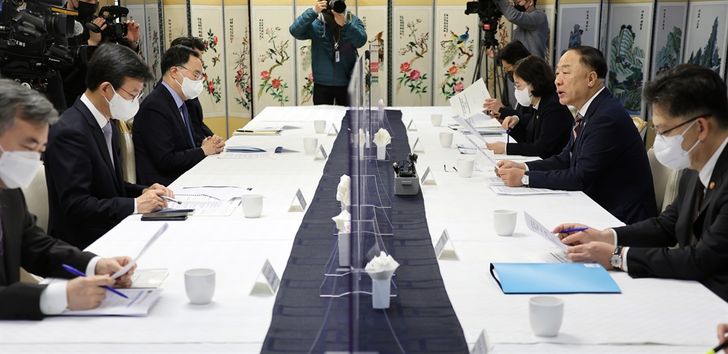
Deputy Prime Minister and Minister of Economy and Finance Hong Nam-ki, second from right, speaks during a meeting with relevant ministers on inflation at the Government Complex Seoul in central Seoul. Friday. Yonhap
To ease inflationary pressures, the government announced on Friday the extension of a record 20 percent fuel tax cut. Originally intended to end in April, it has been extended three more months until the end of July.
In the first meeting on inflation among related ministers, Deputy Prime Minister and Minister of Economy and Finance Hong Nam-ki said the government is open to a discussion on raising the fuel tax cut if global oil prices increase at a higher rate.
“Of course, the three-month extension of the fuel tax cut was vital to fight inflation and the government should be credited for that, but it doesn't mean that inflation will be fully curbed,” Lee Sang-ho, head of the Korea Economic Research Institute's (KERI) economic policy team, told The Korea Times. “And this is because the inflation results from a stranded global supply, which remains out of the government's control.”
Lee referred the ongoing shipping crisis in the United States and suspended plant operation in China over the Omicron variant.
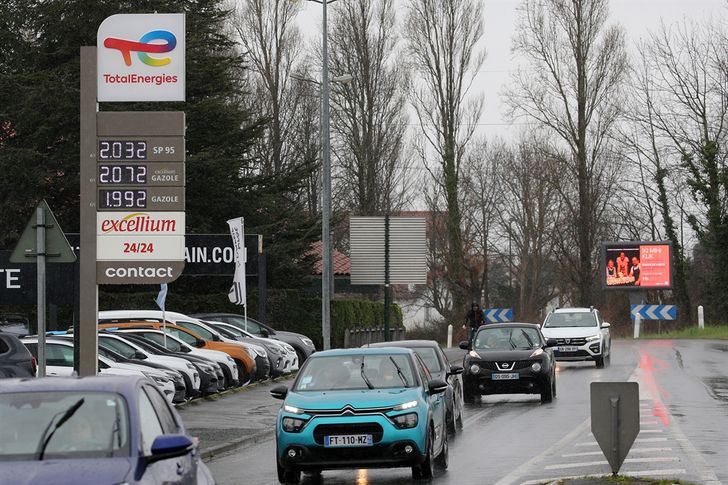
Cars drive past a gas station where gasoline prices have surpassed 2 euros ($2.22) per liter in Saint-Jean-de-Luz, southwestern France, Thursday. Oil prices continued to climb as Russian forces bombarded Ukraine's second-largest city and besieged two ports, Thursday. AP-Yonhap
Russia's full-scale invasion of Ukraine since Feb. 24 is anticipated to complicate the supply of oil and raw materials, as the White House is under bipartisan pressure to review its decision to exclude the Russian energy sector from U.S.-led sanctions.
Lee noted the bottleneck in the global supply chain has been affecting producer prices, a major barometer of consumer inflation, which marked a year-on-year increase in January for the 14th month straight at 8.7 percent, according to the Bank of Korea (BOK).
“The government's measures against inflation may help minimize damage to the economy, but I am not sure whether they can fully curb inflation,” the KERI economist said, adding that a possible additional hike in the benchmark interest rate will not be helpful, either.
Joo Won, deputy director of the Hyundai Research Institute, voiced a similar view, saying, “The government's fight against inflation can be effective only when crude oil prices remain at $110 per barrel or lower.”
Worries about disruption to Russia's oil exports prompted Brent and U.S. West Texas Intermediate (WTI), both crude oil benchmarks, to raise their figures to multi-year highs during the session, Thursday. Brent soared to $119.84, its highest since May 2012, and WTI hit its highest since September 2008 at $116.57.
Some in the industry speculate oil prices could break the $120 mark if the U.S.-led sanctions on Russia's energy industry materialize.
Concerning the surge of infections related to Omicron, Joo speculated markets could also be hit by harsher inflation as there will be soaring demand for dining out and outdoor activities once case numbers decrease.