BOK chief hints at additional rate hike to fight inflation

Bank of Korea (BOK) Governor Lee Ju-yeol bangs the gavel to open a rate-setting meeting at the BOK headquarters in central Seoul. Thursday. Yonhap
Key interest rate frozen at 1.25% amid pandemic, Ukraine crisis
By Yi Whan-woo
The Korean economy will face persistently high inflation “for a substantial period of time,” Bank of Korea (BOK) Governor Lee Ju-yeol said Thursday, as he hinted at additional rate hikes in 2022.
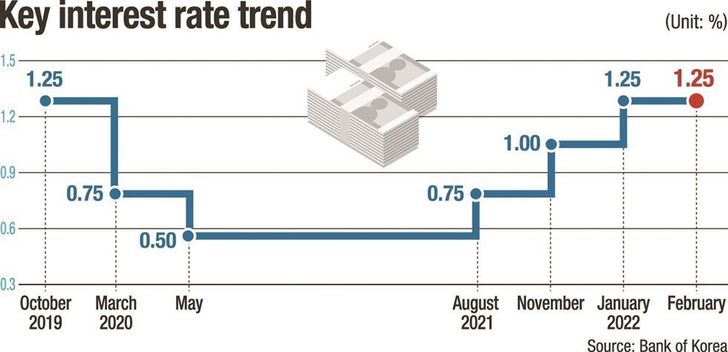
His remarks came after the central bank decided to keep the key interest rate unchanged at 1.25 percent at a monetary board meeting earlier that same day.
In a separate announcement, the BOK revised up the 2022 inflation projection, from 2 percent in November 2021 to 3.1 percent.
It is the first time in 11 years that inflation is forecast to hover around the 3-percent range, with surging oil prices and the escalating Ukraine-Russia conflict anticipated to add to growing inflationary pressure, according to Lee.
“It is projected that inflation will remain high and continue to go on an upward trend for a substantial period of time,” he told reporters. “The need to reduce risks related to financial imbalances therefore remain the same, and adjusting the monetary policy in an appropriate and manner will be important.”
He explained that the readjusted inflation projection took into account a larger-than-expected hike in oil prices, which surged to over $100 a barrel, in the wake of the heightened military tensions between Ukraine and Russia.
He implicitly noted that the situation could get worse, saying, “The revised inflation does not take into account the possibility of a full-scale war.”
He speculated that a possible full-scale war would affect Korea's exports because it would result in toughened sanctions from the Western powers and hurt the global economic recovery.
Asked whether the benchmark key interest rate could rise to 1.75 percent or 2 percent by the end of year, he said, “Such market expectations are believed to be based on rational forecasts of the economy.”
Lee went on to say that the BOK and the financial market have “little difference” when it comes to criteria ― such as the annual economic outlook, inflation and the monetary policies of involved countries ― in making predictions for the key interest rate.
The BOK brought the key interest rate back to pre-pandemic levels in January by hiking the base rate by 25 basis points to 1.25 percent, following increases of 25 basis points each in November and August.
Lee, who was open to further hikes, explained that the rate freeze this month was necessary, saying, “The three hikes were made as preemptive measures, and that now is the time to wait and see how the external factors are changing and how they influence our economy.”
Meanwhile, the BOK kept the country's annual growth outlook steady at 3 percent for 2022 and 2.5 percent for 2023.
It assessed that the economy, despite increasing internal and external uncertainties, is forecast to continue its sound growth, supported by the reopening of global economic activities and the easing of domestic social distancing measures.
Thursday's rate-setting meeting was the last for Lee. His term will end in March.
The BOK plans to hold eight meetings this year, with the next one scheduled on April 14.