Discovery fund fiasco victims continue fight for justice
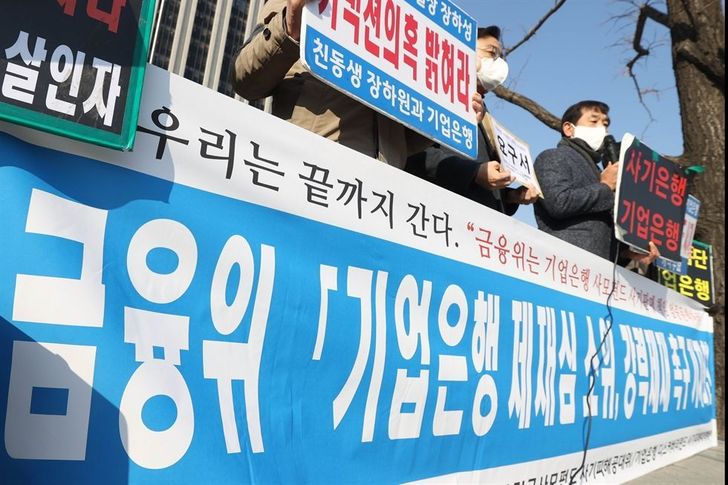
Members of an association of fund fraud victims protest in front of the Seoul government complex in central Seoul, urging financial authorities to impose sanctions on financial companies responsible for the mis-selling of funds, Feb. 10. Yonhap
By Anna J. Park
Most victims of the mis-selling of Discovery Asset Management's fraudulent funds have yet to receive compensation for losses incurred since the funds suspended redemption in 2019. But they are still urging financial authorities to take firm action on the dragged-out matter by imposing sanctions on banks and securities firms that sold the funds to clients.
Industrial Bank of Korea (IBK) sold two different types of Discovery funds valued at a total 679 billion won ($566 million) from 2017 to 2019. The amount is the highest among 12 financial companies ― including banks and securities firms ― that sold the funds to their clients. As of April last year, about 256 billion won of the invested money has not been redeemed.
Discovery Asset Management was founded in 2016 by Jang Ha-won, a brother of former presidential policy chief Jang Ha-sung. Jang Ha-sung was presidential policy chief until late 2018 and has been serving as Korea's ambassador to China from April 2019.
Since July last year, a travel ban was placed on Jang Ha-won while police have been investigating how a company, just one year after being founded with a capital of 2.5 billion won, could be able to sell such a huge amount of fund products through IBK, a state-run bank, from 2017. The police have found documented evidence that both Ambassador Jang and Kim Sang-jo, former chief of policy at the Presidential Office, invested 6 billion won and 400 million won in the funds, respectively.
While the investigation is ongoing, victims and financial companies that sold the funds failed to narrow differences on the conditions of compensation. While the dispute arbitration committee of the Financial Supervisory Service (FSS) advised IBK to compensate victims from 40 to 80 percent of their original principal in May last year, many victims did not accept the recommendation, asking instead for compensation in total, as seen in the case of Korea Investment Securities. Korea Investment compensated 100 percent of the company's clients who invested in the funds.
Victims also raised questions that financial authorities in particular seem to be much slower and less transparent in their dealings with the matter, compared to other mis-selling cases like Lime and Optimus fiascos. They expressed doubts on whether the financial authorities' evasive and lukewarm stance on the matter is one of the core reasons why state-run banks like IBK have not taken any proactive compensation measures for victims.