Inflation growth hits over 3% for fourth straight month in January
gettyimagesbank
Korea's consumer prices rose more than 3 percent for the fourth consecutive month in January due mainly to high prices of oil products and dining out amid soaring energy prices and a global supply chain crisis, data showed Friday.
Consumer prices advanced 3.6 percent year-on-year last month, compared with a 3.7 percent gain in December, according to the data compiled by Statistics Korea.
Inflation has increased more than 3 percent every month since October last year, marking the first time in almost a decade that the figure remained over 3 percent for four months in a row.
It also grew more than the central bank's midterm target of 2 percent for the 10th straight month in January.
Core inflation, which excludes volatile food and oil prices, rose 2.6 percent year-on-year last month, the largest figure since December 2015, according to the data.
The statistics agency attributed the growth to rising oil prices and high prices of personal services and agricultural products.
Prices of petroleum products soared 16.4 percent, and those of industrial products increased 4.2 percent.
Oil prices have surged on tight supplies and escalating tensions over Russia's potential invasion of Ukraine.
Dubai crude, Korea's benchmark, reached about a seven-year high of $87.58 per barrel as of the end of January. Korea depends mainly on oil imports for its energy needs.
Prices of agricultural, livestock and fishery products climbed 6.3 percent year-on-year in January.
Electricity prices also spiked 5.0 percent last month, the largest since September 2017, as the country's state power firm, the Korea Electric Power Corp., adopted a flexible electricity rate system last year linked to global fuel prices in a move to improve its profitability.
Prices of eating out jumped 5.5 percent and other personal services, including medical insurance premiums, went up 2.8 percent to pull up the overall prices.
Home prices increased 2.1 percent last month, with "jeonse" rising the most in more than four years at 2.9 percent.
Under Korea's decades-old jeonse system, tenants pay a large lump-sum deposit, known as key money, to the landlord, which is then returned at the end of the rental agreement, which usually lasts two years. During the lease period, the tenants do not pay monthly rent.
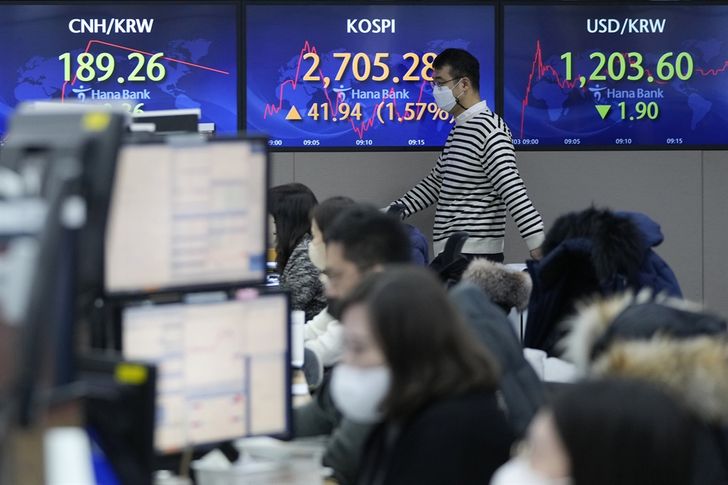
A currency trader passes by screens showing the KOSPI and the foreign exchange rate between the dollar and the Korean won, right, in the foreign exchange dealing room at the KEB Hana Bank headquarters in Seoul, Feb. 3. AP-Yonhap
Prices of daily necessities ― 144 items closely related to people's daily lives, such as food, clothing and housing ― rose 4.1 percent, according to the data.
"The high inflation is not only due to rising demand but supply-related external factors such as high global energy prices and supply chain disruptions," Eo Woon-sun, a senior Statistics Korea official, said. "Such large growth is highly likely to continue for some time."
The statistics agency noted that upward pressure on inflation appears to outweigh downward pressure in February due to soaring oil prices and the continued spread of the Omicron variant of COVID-19 across the globe, vowing to make all-out efforts to tame inflation.
Finance Minister Hong Nam-ki vowed to stabilize consumer prices as he apologized for their recent hike.
"Interest rates, liquidity issues and higher farm prices, as well as global inflation and other various external measures, appear to have pulled the prices up higher than expected," Hong said during a session of the National Assembly Strategy and Finance Committee.
"The government will strive further, though we've had some difficulties in responding to the matter as the global supply issues have greatly affected the market."
In 2021, consumer prices rose 2.5 percent from a year earlier amid rising prices of raw materials and the economic recovery. They marked the steepest year-on-year rise since 2011.
Earlier, the Bank of Korea forecast that consumer inflation is expected to exceed its target by running at the 2 percent range this year amid the global supply chain crisis and high energy prices. (Yonhap)