Korea urged to explore ways to reduce China reliance

Getty images
Korean firms need to diversify production bases abroad
By Yi Whan-woo
Korea is being urged to sharpen its strategy to reduce economic dependence on China more than ever, as China is feared to mark its third-slowest growth performance in 2022 since its economy first started taking off in the late 1970s.
True, diversification of export markets has been taken as gospel when forging a breakthrough strategy to tackle risks associated with a heavy reliance on China, especially over Beijing's weaponization of trade in the form of export bans or consumer boycotts.
Such strategy, however, appears to have resulted in little progress, as implicitly noted by Joo Won, a senior economic researcher at Hyundai Research Institute.
“I can't think of any countermeasure that hits the spot in the short term if the Chinese economy gets worse and haunts us,” he said.
Under the circumstance, other economists contacted by The Korea Times underlined a need to capitalize on the U.S.-China decoupling in supply chains.
They also suggested shifting away from an export pattern characterized with heavy sales of intermediate goods to China and instead expand sales of consumer goods.
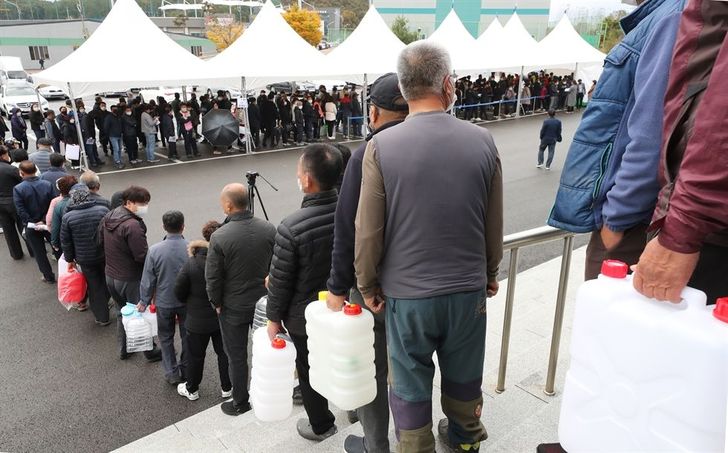
Owners of diesel cars and trucks are lined up in Iksan, North Jeolla Province, to buy diesel exhaust fluid (DEF) ― sometimes called “urea water” ― in the midst of the DEF shortage over China's tightening of its export in November 2021. Korea Times file
“You can't give up on China, because it remains the world's most lucrative market, despite its rapid slowdown in growth most recently,” said Jun Bo-hee, a senior researcher at the Korea International Trade Association (KITA).
She went on to say, “The pullout of factories and other drastic measures to cut reliance on China will therefore be unrealistic, and it is preferred to make adjustments on our investment infrastructure in China in accordance with the changing global business environment.”
The KITA economist explained this is where the U.S.-China decoupling in supply chains can come in handy for Korean businesses to restructure their China-centered factory operation and “dualize” it between the world's two largest economies.
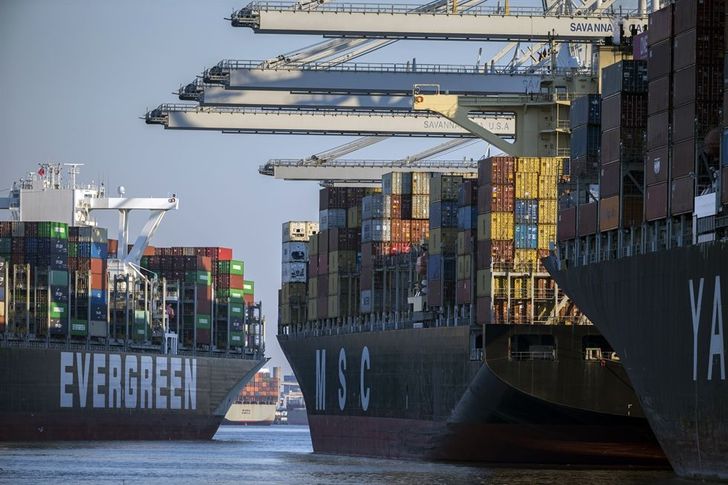
A container ship moves down river past the Georgia Ports Authority's Port of Savannah in this photo taken in September 2021. A World Trade Organization arbitrator in January decided that China can impose retaliatory tariffs on imports from the United States totaling up to $645 million a year, capping a decade-long dispute over U.S. duties on some Chinese goods. AP-Yonhap
The decoupling is a result of the Washington-Beijing trade row, one of the factors that are attributed to China's projected economic slowdown after its growth hit a one-and-a-half year low at 4 percent in the final quarter of 2021.
Among other aforementioned factors in the short-to long term is the prolonged COVID-19 pandemic, the looming property crisis triggered by the collapse of the real estate giant Evergrande, the Chinese Communist Party's (CCP) tightening grip on tech start-ups and other promising private enterprises, the plummeting birthrate and deepening wealth gap.
Multiple international financial institutions accordingly forecast the world's second-largest economy will expand in the range of four to five percent, which will be the lowest in 32 years, other than 1990 at 3.8 percent and 2020 at 2.3 percent.
Specifically, the World Bank has revised down its 2022 outlook on China from 5.4 percent to 5.1 percent. The International Momentary Fund (IMF) has it from 5.6 percent to 4.8 percent.
“Taking such background into account, forming a two-track manufacturing structure abroad in line with two envisioned supply chains will be helpful, with one to be led by the U.S. and the other by China,” Jun said.
She said it does not mean each of the structures will solely be built in the U.S. and China, respectively, but rather, on the soil of their respective allies or economic partners as well.
For instance, the factories exporting to the U.S. can be set up in West European nations, and the ones for export to China can be built in Southeast Asian or Latin American countries.
Lee Sang-ho, head of the Korea Economic Research Institute's (KERI) economic policy team, voiced a similar view, with reference to developing countries in Southeast Asia being touted as Korea's next manufacturing destinations in replacement of China.
“Vietnam and other ASEAN countries have been mentioned whenever issues of diversification of export markets was brought up. And for this reason, forming a two-track manufacturing structure can be helpful on our path to such a goal.”
Concerning intermediate goods, Lee said it accounts for most exports to China and such a pattern should be revised.
According to the Bank of Korea (BOK) in November 2021, 80.6 percent of the export items were intermediary goods while only 3.8 percent were finished goods.
The trade risk linked to intermediate goods is also serious in terms of imports.
In its November 2021 report, the Korea Institute for Industrial Economics and Trade (KIET) listed 1,088 items as “sensitive” for trade with China, meaning Seoul relies on more than half of their supplies from Beijing while maintaining a trade deficit.
The items included urea, silicon, lithium and magnesium, which collectively formed one-fifth of the 5,300 imports goods in total from China.
“You can see that China can exploit our dependence on intermediary goods, in both export and import, in case bilateral ties worsens as witnessed in the past,” the KERI economist said.
Lee Geun-tae, a senior research fellow at the LG Economic Research Institute, suggested enhancing cooperation between businesses and trade authorities as a way to overcome problems caused by China's economic slowdown.
Asked whether Korea's export reliance on China has been on an upward trajectory, all experts said, “No,” and that it brings a slight hope in tackling the overly China-dependent economy.
The Korea Customs Service 2021 data showed China accounted for 25.2 percent of Korea's export worth $644.4 billion.
For every 1 percentage point fall in Chinese GDP growth, Korea's economy will contract by 0.5 percentage points, according to Hyundai Research Institute.