'Gray rhino starts closing in on us'
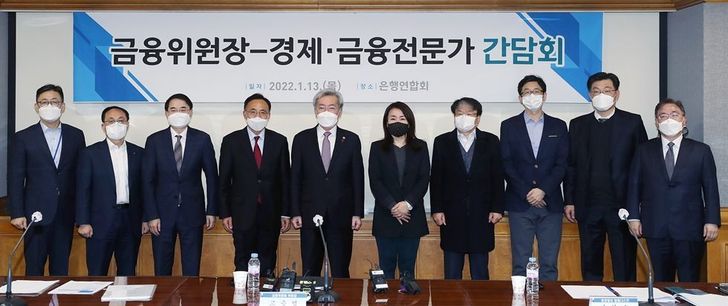
Financial Services Commission (FSC) Chairman Koh Seung-beom, fifth from left, poses with economic and financial experts at the Korea Federation of Banks headquarters in Seoul, Thursday. Courtesy of FSC
Financial regulator urged to brace for risks from China
By Park Jae-hyuk
The nation's top financial regulator has vowed to take measures against looming threats to the economy, putting its top priority on stability in the financial market.
“Potential risks that have been likened to 'gray rhinos' have become reality one by one,” Financial Services Commission (FSC) Chairman Koh Seung-beom said during a meeting with market experts in Seoul, Thursday. “The gray rhino that had been further away has started closing in on us.”
A “gray rhino” is used as a metaphor for a highly probable and significant threat that is neglected by decision makers. The term has become popular globally since American author Michele Wucker came up with the concept during the World Economic Forum in 2013.
The FSC chairman was especially advised at the meeting to brace for the impacts of China's economic slowdown and conflict with the U.S., which are leading to a reorganization of the global value chain.
“In order to justify Xi Jinping's third term, the Chinese government is pushing ahead with policies aiming for annual economic growth of 5 percent, but there exist internal and external risks, such as real estate market contraction, business regulations and conflict with the U.S.,” Korea Center for International Finance President Choi Jae-young said.
Ahn Yu-hwa, a professor of Sungkyunkwan University's Graduate School of Chinese Studies, warned of stagflation in the Chinese economy in the worst-case scenario.
“Because the U.S. is highly likely to raise its interest rate during the first half of the year, China's quantitative easing intended to stimulate its economy may not be effective enough,” Ahn said. “The inflation pressure caused by the delayed recovery of the global supply chain is feared to bring about stagflation in the trade-reliant Chinese economy.”
Korea Development Bank's research center head, No Hyeong-bok, emphasized the necessity of strategies to diversify manufacturing facilities and the supply chain, given that the U.S.-China feud has led suppliers to focus more on national security and stable production, rather than cost and efficiency.
“There exist risks related to the import of raw materials from China,” No said. “Data shows that 1,088 items imported from China showed strategic vulnerability. Among them, 604 are intermediary goods.”
The FSC chairman agreed with the experts.
“In addition to the lingering COVID-19 pandemic, China's economic slowdown and the U.S.-China dispute are expected to affect our economy and financial market this year,” he said. “I will communicate more with experts in various fields, making continuous efforts to 'promptly detect,' 'accurately analyze' and 'preemptively prevent' internal and external risks that could harm our country's financial stability.”