Korea to launch industrial security advisory body
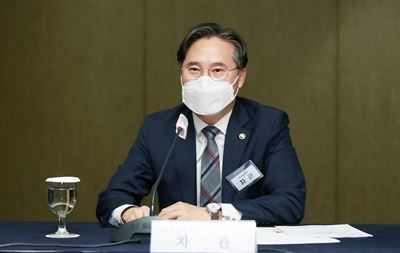
First Vice Minister of Trade, Industry and Energy Park Jin-kyu. Korea Times file
By Lee Kyung-min
The industry ministry has decided to establish an external advisory body dedicated to enhancing the country's industrial security policies, as part of its efforts to better manage supply chain issues threatening the long-term growth of local exporters and technology developers as well as the expansion of foreign investment.
The measure seeks to strengthen protections for the country's key growth driver firms and cooperation with their peers in advanced economies, to strengthen and set up bilateral and multilateral supply chains to be insulated from unforeseen disruptions and complications, not unlike the COVID-19 pandemic. In talks with Korea for the shared objectives are the U.S. and European countries.
The Ministry of Trade, Industry and Energy said Tuesday that the advisory body will be composed of 17 academic and private-sector experts with in-depth knowledge and experience. Senior researchers at state-run think tanks, lawyers and university professors will join the group.
“The government will foster and protect technological development in the future, to strengthen supply chains, security of the country's key resources and closer integration among industry, energy, trade and investment to respond swiftly to and navigate emergencies and crises,” a ministry official said.
The ministry held a meeting attended by members of a taskforce set up for risk management concerning key export and import items critical to the stable operation of manufacturing and other key industries.
The 15th meeting presided over by First Vice Minister Park Jin-kyu discussed ways to improve the current regulations to better resolve the challenges experienced by local firms, especially by revising laws governing trade, key materials and parts manufacturing, high-tech industries, industrial espionage and foreign investment.
The move to strengthen institutional frameworks is the latest development in the ministry's policy response measures developed since February, when Washington issued a supply chain executive order to help guarantee more resilient and secure supply chains for critical and essential goods including batteries and semiconductors.
Korea and the U.S. have since bolstered bilateral ties to increase cooperation for the prosperity of the two key high-tech industries as well as electric vehicle manufacturing, mostly in the form of greater investments and developing existing communication channels.
Korea has outlined a variety of response measures to help increase the country's standing on the global stage as a key stakeholder in global supply chains, a measure brought on in October by the U.S. announcement of the Indo-Pacific Economic Framework, defined by common principles and standards concerning infrastructure, supply chains and climate change for closer cooperation with its allies.
Meanwhile, the ministry plans to advance the green initiative to meet the goal of carbon neutrality by 2050.
In a joint press briefing earlier in the day, attended by ministers and high-ranking officials of the trade, environment, fisheries, science and education ministries, the government said 2022 will be the year when the eco-friendly drive will make its rapid, clear transition to a low-carbon society. The digital economy and nurturing talented young workers to lead the green discussions will be the top policy priorities, it added.
About 87.9 billion won ($73.9 million) will be spent next year to support carbon-neutral facilities built by small and medium-sized firms. The government will set up and enforce a law to increase tax incentives for firms with green business models.