Finance industry wary of presidential candidates' pledges as election approaches

Lee Jae-myung, the presidential candidate of the ruling Democratic Party of Korea, shakes hands with a merchant during his visit to a traditional market in Pohang, North Gyeongsang Province, Monday. Yonhap
By Yi Whan-woo
The finance industry is increasingly wary of the pledges being made by the two major presidential candidates ― Lee Jae-myung and Yoon Suk-yeol ― concerning sensitive issues involving the sector as the March 9 presidential election nears.
On the priority list of the two candidates is a shake-up of the supervisory roles of the Financial Services Commission (FSC) and the Financial Supervisory Service (FSS).
They are also interested in the easing of current restrictions on bank credit loans aimed at curbing household debt as well as relocating public companies and agencies to rural regions to spur balanced development in different parts of the country.
The course of measures can vary depending on who is elected as the next president and the financial industry is paying close attention to how the pledges will ultimately take shape.
“It is being taken for granted among financial authorities and public enterprise executives that they will need to set a yearly plan in the beginning of 2022 and then revise it completely after the election in accordance with the successful candidate's pledges,” an industry source said.
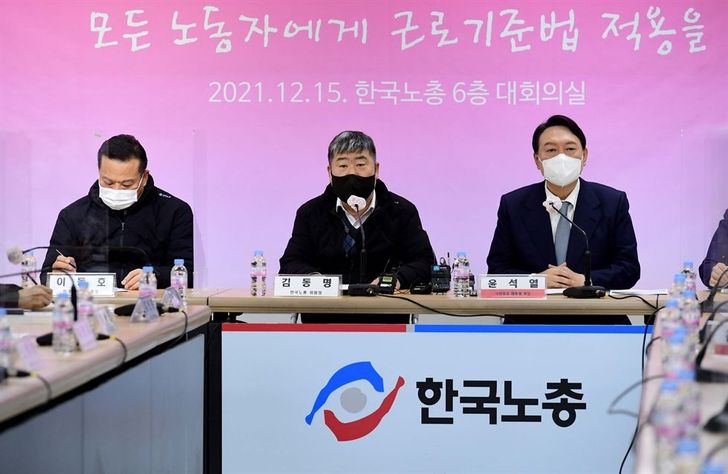
Yoon Suk-yeol, right, the presidential candidate of the main opposition People Power Party, speaks during his visit to the Federation of Korean Trade Union, a major umbrella labor group, in Seoul, Wednesday. Yonhap
The need to revamp the roles of the FSC and the FSS has been addressed for years following criticism that the current structure was ineffective in preventing financial scams and massive damage inflicted on consumers.
Critics have argued that the existing regulatory structure is too outdated to keep up with the market and oversee any irregular and illicit activities.
Since 2008, the government's financial supervisory functions were split between the FSC, an administrative body responsible for establishing regulatory policies, and the FSS, a special entity technically under the FSC's control and designed to implement its policies.
Lee of the ruling Democratic Party of Korea is considering empowering the FSS with the authority to establish and implement regulatory policies.
The FSC, in return, will be responsible for the remaining roles and also will take over the administrative duties of the Ministry of Economy and Finance, which Lee has accused of wielding power over other ministries and therefore should undergo restructuring.
Under Lee's envisioned plan, the ministry will be downsized and solely focus on budget spending.
Yoon of the main opposition People Power Party considers elevating the FSC into a ministry-level organization, in addition to splitting some of its functions with the FSS and the Ministry of Economy and Finance.
Both candidates are on the same path when it comes to loosening strict rules on lending. The government's regulations have discouraged people who are in actual need of money as the interest rates imposed on loans have been on the rise as part of measures to curb a fast-growing household debt level.
In particular, Lee promised to enable all citizens, regardless of their credit ratings, to borrow up to 10 million won ($8,400) for 10 to 20 years at an interest rate in the 2 percent range.
Commercial banks view such an idea as being too radical.
A bank official, who spoke on condition of anonymity, said, “The idea can have repercussions at a serious level if implemented.”
Concerning public firms, Lee pledged to move all of the remaining institutions in the Seoul metropolitan area to other provinces.
Many state-run companies were relocated to rural areas for years as part of a campaign for balanced development.
Still, an estimated 200 public firms remain in the Seoul metropolitan area and many of them are financial entities.
Among them are Export-Import Bank of Korea, Korea Development Bank. Industrial Bank of Korea.