Korea to raise inflation target to above 2% next year
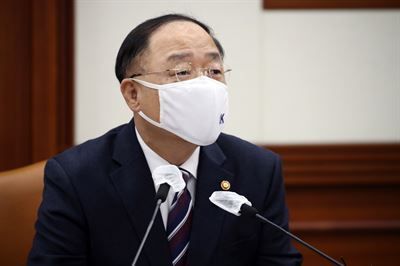
Deputy Prime Minister and Finance Minister Hong Nam-ki. Korea Times file
By Lee Kyung-min
The government is expected to raise its annual inflation target for next year to above 2 percent, in an unprecedented revision reflecting the rapid, sustained price rises for goods and services.
The 2 percent target has not been increased (or exceeded) since 2016 when the Bank of Korea (BOK) first set the figure as part of a medium-term price stabilization mandate. Korea registered a year-on-year inflation high of 1.9 percent in 2017.
The finance ministry is set to announce the significant upward revision from an earlier target of 1.4 percent at a press briefing for the 2022 government policy directives next Monday.
The possible revision follows the country's headline consumer price inflation staying at the psychologically significant over 3 percent level for the past two months, up from the 2 percent range maintained in the first nine months of the year.
Statistics Korea data for November showed consumer price growth registered a 3.7 percent increase in November from a year earlier, up from 3.2 percent in October.
The figures staying above 3 percent were driven by rising global oil and raw materials prices that translated to an increase in the costs of consumer goods and services, as illustrated by the manufacturers of frequently purchased products raising their prices by double-digit percentages. Energy prices, notably heating costs, are also climbing.
The ministry's revision is thus widely expected, as evidenced by the central bank's Dec. 3 revision of the inflation target to over 2.3 percent for this year. This revision essentially recognizes that the previous target of 2 percent no longer functions as guidance, since commodity prices are likely to soar well beyond this next year, brought on by geopolitical uncertainties.
The government is expected to leave electricity and gas prices unchanged until the first half of next year, mindful of the price rise implications triggered by state-run entities on the rise of other goods and services prices in the private sector.
Yet, whether energy prices will be increased remains to be seen. The energy ministry is reportedly in discussions with the state-run Korea Gas Corp. (KOGAS) to raise its prices by as much as 10 percent for private use.
The Ministry of Trade, Industry and Energy and KOGAS are reviewing ways to raise energy costs by about 10 percent from January next year. The move is due to global oil prices rising to $80 (94,300 won) a barrel, with the central bank and other institutes projecting the price to continue to strengthen for the time being.