Ruling presidential candidate shifts stance on short-selling

Ruling Democratic Party of Korea presidential candidate Lee Jae-myung poses at the Korea Exchange building in Seoul, Nov. 4. Korea Times photo by Oh Dae-geun
Retail investors unsatisfied with Lee's cautious approach
By Park Jae-hyuk
Ruling Democratic Party of Korea (DPK) presidential candidate Lee Jae-myung started to soften his stance toward short-selling on the local stock market, in contrast to last year when he supported a ban on the investment move which bets on a drop in a stock prices.
The issue is raising concerns from retail investors, as they have been urging the DPK presidential candidate to specify more detailed measures to ensure fair competition with overseas and institutional investors.
Earlier this week, the DPK candidate wrote on Facebook that individual investors should be allowed to borrow a greater amount of shares for short-selling, so that they can engage in competition with larger investors on a level playing field.
He also mentioned the possible necessity of harsher punishments for illegal short-sellers, such as those who conduct short-selling without actually borrowing stocks.
Lee, however, did not call on the complete prohibition of short-selling on the Seoul bourse, nor asked financial regulators to continue the ongoing ban on shorting stocks that are not included in the KOSPI 200 and Kosdaq 150 indices.
During his visit to the Korea Exchange last week, he also declined to comment on the complete resumption of short-selling in domestic stock markets.
In August last year, the former Gyeonggi Province governor said that the government should continue its temporary ban on short-selling for at least six more months, citing the lingering COVID-19 pandemic, although he has never denied advantages of the investment method, such as enhancing market effectiveness and liquidity.
At that time, he proposed imposing up to 20-year prison sentences or significant fines on illegal short-sellers. “It's not too late to resume short-selling after improving the market conditions,” he said.
MSCI coincidence?
His latest stance on short-selling is in line with his support for Finance Minister Hong Nam-ki's plan to resume talks with MSCI, a U.S. index provider, on reclassifying the Korean equity market as a “developed market.”
“In order to upgrade the Korean equity market that has been underestimated by overseas investors, we should make efforts to win the MSCI developed market status,” Lee said last week. “If Korea is included in the developed market index, the net inflow of foreign capital will reach at least 18 trillion won ($15.2 billion) and potentially up to 62 trillion won.”
In its latest market reclassification review in June, MSCI mentioned Korea's short-selling ban on small-cap stocks, which has continued since the outbreak of the coronavirus pandemic, as a reason for rejecting the request to upgrade the domestic equity market from “emerging” to “developed” status.
After banning short-selling temporarily on the local stock market in March last year in the wake of the pandemic, the government partially lifted the ban in May, allowing short-selling for large-caps.
However, there is no timeline on the resumption of short-selling for small-caps at this moment, although Financial Services Commission (FSC) Chairman Koh Seung-beom said in September that the complete resumption of short-selling on the stock market is inevitable.
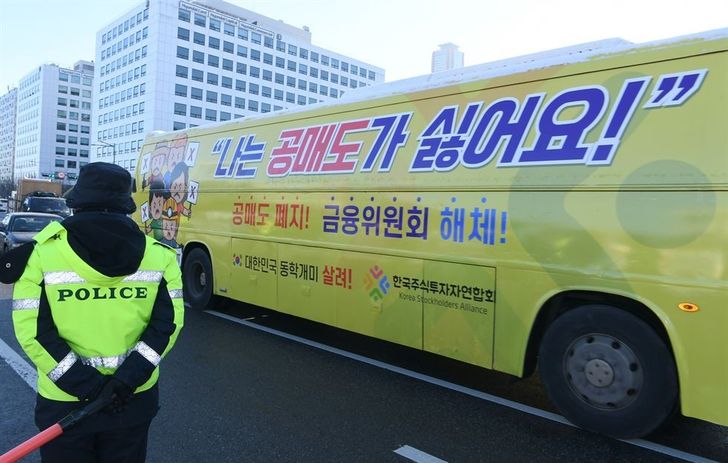
The Korea Stockholders Alliance holds a rally in front of the National Assembly in Seoul, with a bus showing a slogan that reads, “I hate short-selling,” in this February file photo. Korea Times photo by Wang Tae-seok
Retail investors viewed Lee's recent comments as just a reiteration of what the FSC has claimed.
They criticized him for not mentioning the necessity of forcing overseas and institutional investors to repay their borrowed stocks for short-selling within 90 days, as required of individuals.
“We hope he pledges to abolish transfer income taxes on retail stock investors,” Korea Stockholders Alliance leader Jung Eui-jung said.
Lee's rival, main opposition People Power Party (PPP) presidential candidate Yoon Seok-youl, has yet to present his own thoughts on the stock market.
Before the former prosecutor general was elected as the PPP candidate, one of his rivals in the party, Rep. Hong Joon-pyo, vowed to completely abolish short-selling on the stock market, based on his belief that the investment scheme is not worth it. The Korea Stockholders Alliance has also asked presidential candidates to pledge to prohibit short-selling, as Hong did.