Finance ministry calls for overhaul of educational subsidies
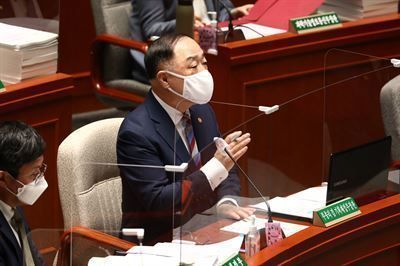
Deputy Prime Minister and Finance Minister Hong Nam-ki. Korea Times file
By Lee Kyung-min
The Ministry of Strategy and Finance said a program offering educational subsidies should be revised to reduce revenue from taxes allocated to local governments, since the number of students in Korea is on a rapid decline due to the country's persistently-low birthrate.
The recommendation coincides with a deterioration of the government's fiscal soundness brought on and exacerbated by the COVID-19 pandemic. The government has drafted 115 trillion won ($98 billion) over the course of six supplementary budgets since the beginning of the pandemic, mostly for emergency policy and cash assistance for low-income earners and small businesses.
A ministry official published an opinion in a monthly report on the government's fiscal plan, Thursday, underscoring the urgent need to redesign the overall educational financing grant system in response to changing demographics.
This is in line with the ministry's budget bureau, which is discussing ways to improve the system to streamline the education budget for elementary and secondary school students and to use money saved to offer lifelong education and vocational training.
By law, at least 20.79 percent of the government's total tax revenue should be spent on municipal education offices for the education of students and educators as well as administrative purposes. Currently, up to 70 percent of their budget comes from the central government.
No discretion is allowed for the change in the amount set by law governing mandatory education, a reason why critics have long argued that the rule is overprotective of local education offices and that finances should be reviewed to fully reflect demand as defined by the number of students.
The claim has merit, since the amount of money allocated would increase as long as the country grows as measured by GDP, leading to a waste of government revenue at the expense of taxpayers.
This is backed further by the local educational budget rising to a record amount, while the number of students is on a steep decline.
Education grants for local municipalities rose to 53.5 trillion won last year, significantly up from 39.4 trillion won in 2015. The figure inched up to 59.6 trillion won this year and is expected to jump to a record 64.3 trillion won in 2022.
Data from Statistics Korea showed the number of pre-schoolers, and elementary and secondary school students combined stood at 6.71 million last year, down from 7.56 million in 2015.
The figure is expected to drop to as low as 4.88 million in 2035, from 5.97 million in 2025.
The Ministry of Education said in June that it was inappropriate to argue that local educational finances should be reduced only because of the number of students, since schools and educational facility maintenance needs must be considered.
The budget amount carried over to the next school year was 6.6 trillion won in 2019 and 4.4 trillion won last year.