'The window to avoid catastrophic climate change is closing soon': DNV report

DNV's Group President and CEO Remi Eriksen / Courtesy of DNV
DNV's Energy Transition Outlook warns current green efforts fall short of achieving Paris Agreement
By Anna J. Park
A recent report about energy transition from DNV ― a Norway-headquartered global accredited registrar and quality assurance operating in more than 100 countries ― has warned that even if all electricity was “green” from this day forward, the world will still fall short of achieving the 2050 net zero emissions goal of the Paris Agreement, adopted at 2015 United Nations Climate Change Conference (COP21).
DNV's Energy Transition Outlook, now in its fifth year and set to be released two months before this year's United Nations Climate Change Conference (COP26) will have its launch event in Glasgow in November. The report provides an independent forecast of developments in the global energy system to 2050.
The report highlights the global pandemic as a “lost opportunity” for speeding up the energy transition, as COVID-19 recovery packages have largely focused on protecting rather than transforming existing industries.
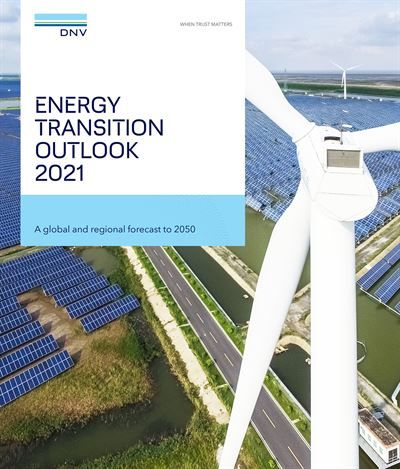
“Energy Transition Outlook 2021” main report cover / Courtesy of DNV
Electrification is expected to double in size within a generation and renewables are already the most competitive source of new power. However, DNV's forecast shows global emissions will reduce only 9% by 2030, with the 1.5 degree Celsius budget agreed by global economies emptied by then. The Paris Agreement was intended to keep global warming to “well below 2 degree Celsius” and strive to limit its increase to 1.5 degree Celsius.
DNV has been consistent in forecasting a rapid transition to a decarbonized energy system by the middle of the century. Yet as rapid as that transition is, DNV's forecast is that despite every effort being made, it remains definitively not fast enough for the world to achieve the ambitions of the Paris Agreement and warns the planet will most likely reach global warming of 2.3˚C by end of the century.
“We've seen governments around the world take extraordinary steps to manage the effects of the pandemic and stimulate a recovery. However, I am deeply concerned about what it will take for governments to apply the resolution and urgency they have shown in the face of the pandemic to our climate. We must now see the same sense of urgency to avoid a climate catastrophe,” Remi Eriksen, Group President and CEO of DNV, said.
“Many of the pandemic recovery packages have largely focused on protecting, rather than transforming, existing industries. A lot of 'building back' as opposed to 'building better' and although this is a lost opportunity, it is not the last we have for transitioning faster to a deeply decarbonized energy system,” the CEO added.
Energy efficiency remains the biggest opportunity to tackling climate change as the world drifts further away from achieving the Paris Agreement. Securing significant improvement in this vital area is viewed as the most significant lever for the transition, as achieving greater efficiency is the reason why global energy demand will level off, even as the global population and economy grows.
Reductions in the use of fossil fuels have been remarkably quick. Oil demand looks set to halve, with coal use reduced to a third by mid-century. However, these sources, especially gas, will still constitute 50 percent of the global energy mix by 2050 ― making the need to invest in and scale hydrogen, and carbon capture and storage all the more important, says the report.
ETO 2021 also reveals that while 69 percent of grid-connected power will be generated by wind and solar in 2050, and indirect electrification, such as hydrogen and e-fuels, and biofuels remain critical, none of these sources are scaling rapidly enough.
The report stressed that hydrogen is the energy carrier that holds the highest potential to tackle hard to abate emissions. Yet DNV's forecast indicates hydrogen only starting to scale from the mid-2030s and, even then, only building to 5 percent of the energy mix by 2050.
“Extraordinary action will be needed to bring the hydrogen economy into full force earlier - but these are extraordinary times. The window to avoid catastrophic climate change is closing soon, and the costs of not doing so unimaginable,” CEO Eriksen highlighted.