Record 2022 budget to raise national debt to W1,068 tril.

Finance minister denies inconsistency between fiscal, monetary policies
By Park Jae-hyuk
Korea's national debt will surpass 1,000 trillion won ($862 billion) next year for the first time in history, as the government's annual spending will go up 8.3 percent year-on-year to the record-high 604.4 trillion won in 2022.
The Ministry of Economy and Finance announced Tuesday that the national debt will reach 1,068 trillion won next year, or 50.2 percent of the GDP. In other words, each Korean citizen will be burdened with more than 20 million won debt.
The ministry's blueprint for its fiscal management between 2021 and 2025 showed that the national debt will even exceed 1,408 trillion won in 2025, or 58.8 percent of the GDP, despite its plan to cap its spending increases at 5 percent starting in 2023.
Such a medium-term plan has raised criticism that the Moon administration is attempting to shift its responsibility for deteriorated fiscal soundness onto the next government.
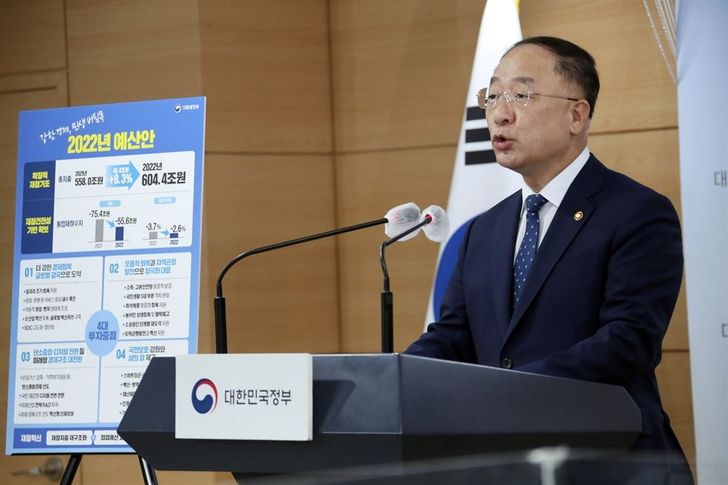
Deputy Prime Minister and Finance Minister Hong Nam-ki announces the government's budget for 2022 and fiscal management plans between 2021 and 2025 at the Government Complex Seoul, Tuesday. Yonhap
Deputy Prime Minister and Finance Minister Hong Nam-ki, however, elaborated the plan is just intended to normalize the government's fiscal management after the COVID-19 pandemic's impact on the economy comes to an end.
“As far as we know, most developed countries are planning to continue fiscal expansions until next year, while considering normalizing their fiscal management after 2023,” he told reporters during an online press conference at the Government Complex Seoul.
The deputy prime minister also reiterated that the government's expansionary fiscal policies are not contradictory to the Bank of Korea's monetary tightening, despite the central bank's latest decision to hike the key rate to 0.75 percent from 0.5 percent and an additional rate hike highly probable within this year.
“The policy mix does not necessarily mean that every policy must face the same direction,” he said. “Under these circumstances, it will be more effective if the monetary and the fiscal policies play each of their roles properly.”
Hong said the government had no choice but to issue deficit-covering bonds to keep its expansionary fiscal policies alive until at least next year for the economic recovery from the pandemic, and for investments to brace for a great transformation in the post-pandemic era.
Of the total expenditure of 604.4 trillion won, the government will earmark the largest amount of 216.7 trillion won for the health, welfare and labor sectors, up 8.5 percent from this year, followed by 96.8 trillion won for general and provincial administration.
It will set aside 83.2 trillion won for education, while spending 55.2 trillion won for defense, 29.8 trillion won for R&D and 11.9 trillion won for the environment.
In detail, the government seeks to spend 5.8 trillion won on COVID-19 prevention measures, including 2.6 trillion won to be used to purchase 80 million doses of mRNA vaccines and 10 million doses of vaccines developed by Korean companies.
It will also offer 3.9 trillion won in financial support next year to the country's smaller merchants, who have suffered grave difficulties due to the pandemic.
In addition, the government will inject 12 trillion won toward achieving its goal of eliminating carbon emissions by 2050, as well as 33.7 trillion won to be used for the Korean New Deal 2.0, which will focus more on supporting underprivileged people than the previous version of the policy.
Specifically, the government emphasized its fiscal deficit will decrease significantly to 55.6 trillion won next year from 90.3 trillion won this year, expressing an optimistic outlook for the increase in its tax revenue.
“Following the economic recovery next year, there seems to be a significant increase in income from corporate and value-added taxes,” Hong said. “We do not expect the assets market to create excessive tax revenue again next year.”
During a Cabinet meeting held just before the announcement of the 2022 budget plan, President Moon Jae-in also emphasized the importance of expansionary fiscal management.
“The expansionary fiscal policies have created a virtuous cycle for economic recovery, increase in tax revenues and improvements in fiscal soundness in the midst of the crisis,” he said, according to Cheong Wa Dae press pool reports. “The budget for next year is what will focus on a complete recovery from the coronavirus and strategic investments for the country's future. Above all, the government will make every effort for a complete recovery from the pandemic.”
Economic experts, however, called for measures to slow down on the snowballing national debt.
“Over the past few years, the national finance has come under a difficult situation,” Yonsei University economics professor Sung Tae-yoon said. “The government needs to start managing its heavy reliance on fiscal measures.”