ANALYSIS Korea considers exit strategies from early US tapering

Export companies to raise in-house cash reserve
By Lee Min-hyung
Korea is considering applying exit strategies in a way to minimize any possible impact from the U.S.'s earlier-than-expected tapering.
The possibility of initiating relevant protocols is increasing in the nation's financial circles, after the minutes of the U.S. Fed's July meeting were released Wednesday (local time) in support of starting to reduce asset purchases there earlier than previously expected. This raised the likelihood for the Fed to begin its post-pandemic tapering as early as November.
The message from the Fed is sending alarm bells to Korean financial authorities, pushing them to come up with specific measures to avoid potential shocks from the gradual reduction of market liquidity in the world's largest economy.
The Bank of Korea (BOK) is widely expected to raise the key interest rate by 25 basis points to 0.75 percent next week, in a preemptive measure to be in tandem with monetary tightening gestures from the Fed. The widening financial imbalance here also increases the chances for the central bank to put an end to its year-long monetary easing at its upcoming board meeting for the first time since the pandemic began last year.
Financial regulators have been consistently sending repeated warning signals lately over surging household debts ahead of the possible rate hike.
Financial Services Commission (FSC) Chairman nominee Koh Seung-beom remained hawkish regarding the rapid rise of household debt, saying the FSC will take additional measures by utilizing “all possible policies.”
Households are exposed to potential risks from their worry-level of loans, and this may ignite a bubble in the asset market which is vulnerable to collapse. “This may hamper growth of the real economy, so it is very urgent for the FSC to remove any macroeconomic risk factors from the household debt,” he said.
The Financial Supervisory Service (FSS) is also standing shoulder to shoulder with the FSC, and recently ordered banks to reduce the credit line for households. The regulator plans to expand the order to non-banking sectors, such as insurers and card firms.
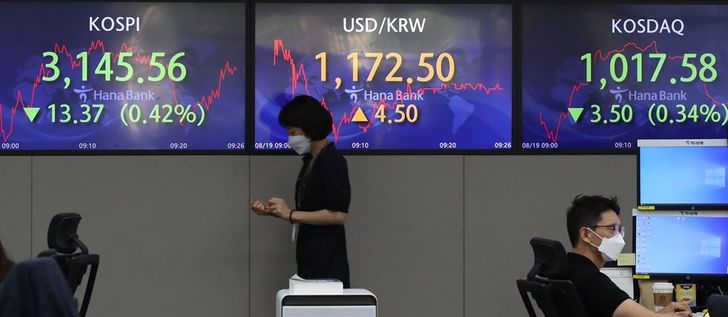
An electronic board set up at the Seoul headquarters of Hana Bank shows a drop in the nation's stock markets on Thursday morning. Yonhap
Economists advised investors to be wary of a possible stock market fall here induced by foreigner investors' mass exodus due to fears of the early U.S. tapering.
“The Federal Open Market Committee's July minutes confirmed that the Fed would likely start tapering no later than the end of this year,” Woori Bank economist Min Kyung-won said. “Generally speaking, when the Fed normalizes its policies, foreign investors adjust their positions on assets invested in emerging countries.”
Even if the local stock markets showed signs of stabilization on Wednesday after they underwent week-long falls due to a recent selling spree by foreign investors, there still stands an ample chance for additional capital outflow in the local stock markets amid lingering concerns over the foreign exodus, as tapering fears remain in place, according to the economist.
The benchmark KOSPI had plunged for eight consecutive trading days until Tuesday before finishing with a slight gain on Wednesday. Foreign investors' selling spree of Korea's large-cap chip stocks drove the market fall.
Some other experts, however, argued that the U.S. tapering is not a serious fear factor that will have much impact on the country's equity markets.
“Our view is that the impact of the tapering risk on the local stock market will be limited, as a series of economic indices ― such as a fall of the two-year U.S. Treasury yield ― show that the global financial market does not take the tapering risks seriously,” Hi Investment & Securities analyst Park Sang-hyun said.
Stock markets from emerging countries ― including Korea ― would regain momentum for growth if the ongoing pandemic risk clears away, and this is a more important factor determining the future direction of the KOSPI and secondary Kosdaq than the tapering issue, according to him.
The surging infection cases of the Delta variant of the coronavirus here are pushing export-driven companies here to pile up more cash on reviving fears that the prolonged pandemic may dampen the recovery momentum of the global economy.
But companies are likely to change their asset management strategies after a possible rate hike, to avoid having to pay more interest from debts. They may find other options by increasing investments on expectations for more gains in the post-pandemic era.
Earlier, financial regulators here have advised local banks to secure enough cash to deal with a possibly further prolonged pandemic shock, urging them to reduce dividend offerings.