Despite COVID spread, BOK expected to raise key rate in August

By Lee Min-hyung
The Bank of Korea (BOK) is expected to raise its key interest rate in late August, in a preemptive move to cushion the blow from snowballing household debt and surging home prices, despite fears of the surging Delta variant of COVID-19, according to experts, Tuesday.
“Even though Korea has continued to report four-digit new infection cases over the past few weeks, my view is that it is inevitable for the central bank to raise the key rate in August,” said Korea University economist Kim Jin-ill.
The central bank may freeze the rate if it is convinced that the coronavirus spread will come to an end soon, but the reality shows otherwise, according to Kim. This uncertainty is an uncontrollable external factor, so it appears to be desirable for the BOK to raise the rate this month to deal with concerns on a financial imbalance induced by the post-pandemic near-zero interest rate, he said.
U.S. investment bank JPMorgan also forecast the BOK will increase its benchmark rate to 0.75 percent at its upcoming Aug. 26 rate-setting meeting.
“We confirmed from the July monetary policy committee meeting minutes that the median view of the committee prefers an initiation of policy normalization in the near-term, which should imply hike action in August,” the bank's Park Seok-gil said.
Data from the Financial Services Commission (FSC) show the country's household debt soared by 10 percent in July, compared to the previous month. This was primarily due to an unceasing “craze” for leveraged investing here, industry observers noted.
Citing the widening financial imbalance, the central bank and financial authorities have in recent months sent repeated signals of a rate hike.
In July, BOK Governor Lee Ju-yeol said the monetary policy board would start discussing a possible adjustment in its year-long monetary easing stance as early as August. Five out of six monetary board members at the BOK, excluding Lee, also underscored the need for monetary tightening during their latest meeting, July 15.
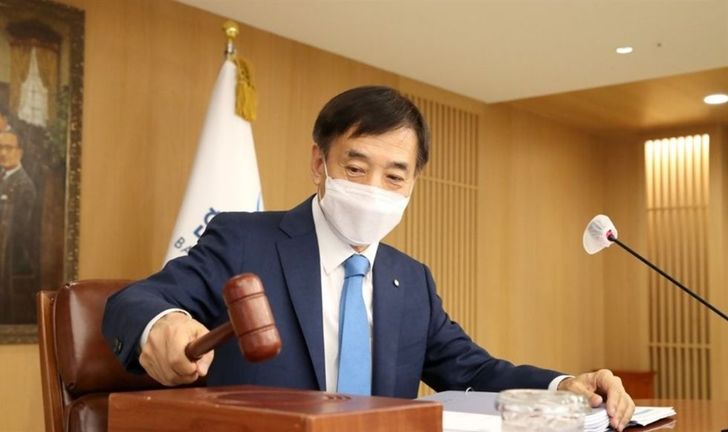
Bank of Korea Governor Lee Ju-yeol bangs a gavel during the last rate-setting meeting at its headquarters in Seoul, July 15. Yonhap
The BOK's rate hike projection is picking up steam on hopes that the United States will engage in earlier tapering.
According to a report released by the central bank, Tuesday, major overseas banks ― such as Standard Chartered ― expect the U.S. Fed to announce its timeline for tapering sometime no later than November.
However, any possible rate hike here is feared to put more of a burden on the self-employed and small business owners at a time when they face worsening domestic consumption amid toughened social distancing rules here.
The rise in the rate will also likely help stabilize the recent surge in the won-dollar exchange rate, according to economists. From this month, the exchange rate has been rising to top 1,170-won per dollar as of Tuesday.
Economists said the exchange rate would likely stabilize, unless concerns over an early U.S. tapering become a reality.
“The recent surge in the exchange rate will soon be halted unless tapering worries are further highlighted,” Hi Investment & Securities economist Park Sang-hyun said. “Normalization will temper the overshooting in the foreign exchange market, which was caused by the excessive selling spree of local stocks by foreign investors in a short period of time as stock markets in major developed countries continued to rally,” he said.