Hawkish Bank of Korea set to raise key rate this month

Bank of Korea Governor Lee Ju-yeol / Korea Times file
By Lee Kyung-min
The Bank of Korea (BOK) is increasingly tilting toward raising the key policy rate as early as this month, as inferred by its July 15 meeting minutes which showed that five out of the six members of its rate-setting monetary policy board were in agreement over the need to place greater emphasis on monetary policy normalization for financial stability.
The next meeting is scheduled for Aug. 26, to be followed by one for Oct. 12 and for Nov. 25.
The central bank is in a tighter bind over whether the financial imbalance defined by rising consumer prices and snowballing household debt should be mitigated by the earlier-than-expected rate hike, an argument weakened by growing voices of concern over the continued spread of the coronavirus Delta variant hampering economic recovery.
In a 5-1 decision, the board decided to leave the policy rate at an all-time low of 0.5 percent at its July 15 meeting.
But minority opinion was expressed by Koh Seung-beom, who called for an increase of 25 basis points, citing uncontrollable shock in the real economy, scarred by deteriorating financial soundness due to excessive leverage by financial institutions and their consumers. “However limited the policy rate hike may be, the central bank can expect a signaling effect in the market,” he said.
The minutes released Wednesday showed five members voicing the need for policy adjustments.
They each said that monetary policy should be revised “soon,” “in a few months” and “not before too late,” in a notable change in stance from previous rate-setting meetings.
Inflation and a clear rebound in the economic recovery strengthen the case for a rate hike, in their view, bolstered further by the need to bring under control rapidly rising debt enabled by cheap liquidity.
“Given the recent developments in the macroeconomic conditions and financial stability, it seems necessary to start adjusting monetary policy easing at a time that is not too late,” one member said.
“However, the board should set a timeline for policy normalization, while closely monitoring the economic situation with the recent surge in the virus caseloads factored in. Monitoring against financial imbalance should be to limit any unwanted secondary effects of emergency policy easing.”

Only one member expressed clear opposition to an immediate rate hike, saying discussions on the drawdown of pandemic-triggered expansionary policy should begin after the country makes considerable progress in its vaccination efforts.
“The pandemic-triggered shock is manifesting itself as more of an income and asset polarization. Policy adjustment should be pursued with caution, since the recovery in income will vary by industries, economic and credit status,” the member said.
Strengthening dovish opinion is a difficulty amid the continued spread of the coronavirus Delta variant and subsequent consumer sentiment tightening. Daily caseloads have hovered over 1,000 every day for the past few weeks, prompting the government to have to implement stricter distancing measures.
According to a survey conducted by the Central Disaster Management Headquarters, under the Ministry of Health and Welfare, of 1,000 men and women between July 27 and 29, 84 percent said that they agreed to the government's extension of the Level 4 social distancing measures in Seoul and the surrounding metropolitan areas. Over a fifth, or 20.5 percent, said that they would agree to an extension of the measures to Aug. 31.
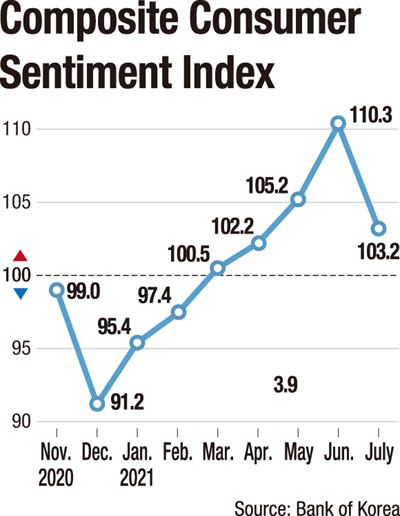
Data from the central bank released July 28 showed that the Composite Consumer Sentiment Index (CCSI) reported a month-on-month dip of 7.1 points to 103.2 in July, dampened by Delta variant fears. It was the first year-to-date decrease.
The index hit a low of 91.2 last November but has since climbed to a year-to-date high of 110.3 in June.
JPMorgan, a top-tier investment bank, said in a report that the central bank may raise its key policy rate “two times” throughout next year. The U.S.-based investment bank expects the Korean central bank to raise its rate by one quarter “within the fourth quarter” of this year.