Korea, Lone Star brace for imminent ruling on 9-year-long dispute

A sign indicating the location of Lone Star Fund's former Korean office at the Star Tower in Seoul is seen in this March 2006 file photo. Korea Times file
Fears remain over possible outflow of taxpayers' money
By Park Jae-hyuk
Both the Korean government and Lone Star Funds have taken quite unusual steps this month, prompting speculation that the International Center for Settlement of Investment Disputes (ICSID) will make its final ruling this year on their nine-year-long legal tussle, which revolves mainly around the Financial Services Commission's (FSC) delayed approval of the Texas-based private equity firm's (PEF) sale of its stake in Korea Exchange Bank (KEB) to Hana Financial Group in 2011.
While the government convened a meeting recently of officials from the justice, finance and foreign ministries as well as the National Tax Service and the FSC, to explore possible countermeasures for every scenario, the U.S. firm reportedly laid off a majority of its staff in its Asian offices, July 8, in a retreat from the region.
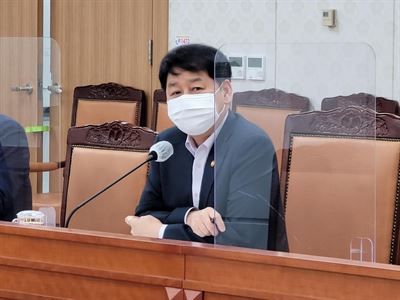
Office for Government Policy Coordination Minister Koo Yun-cheol speaks during a meeting at the Government Complex Seoul, Tuesday. Courtesy of Prime Minister's Office
“Given that the Lone Star case has entered its final phase, the government should do its best to take countermeasures immediately, whenever the ruling comes out,” Office for Government Policy Coordination Minister Koo Yun-cheol said in the meeting, Tuesday.
ICSID is expected to declare the termination of proceedings in the near future. In that case, the international arbitration institution will have to make its final ruling within 120 days after the declaration.
The government is said to be considering applying measures to nullify the ruling if it loses the case, although it declined to disclose any specifics.
“It is difficult to reveal what we've discussed to the media at this moment, because we should conceal our strategies from the opponent,” Han Chang-wan from the Ministry of Justice's international dispute settlement division said.
Lone Star, meanwhile, dismissed 25 investment professionals recently at its mainland China, Hong Kong and India offices ― accounting for nearly 60 percent of its total workforce there ― as it could not find much investment opportunities in Asia outside Japan, according to a report from Reuters, Wednesday.
“In connection with the consolidation of Asia into its global leadership structure, we have made other changes to streamline Asia operations,” Lone Star said in a press release issued July 8.
The restructuring was carried out as the chances have become slim for the company to receive as much compensation from the Korean government as it initially sought.
Lone Star initially asked Seoul to pay $4.68 billion for its losses caused by the “belated” approval, but it sent a settlement proposal last year, offering to end the international dispute if the government pays just $870 million.
The government remains doubtful about the validity of the document and ended up refusing to accept the offer, although the U.S. firm officially verified its authenticity in an email sent to The Korea Times last December.
Legal experts did not rule out the possibility of an outflow of a large sum of taxpayers' money after the final ruling.
“Regardless of the outcome, litigants should burden costs for arbitration proceedings,” said Song Ki-ho, an attorney with Lawyers for a Democratic Society. “The government will need to pay billions of won to the arbitrators and an additional tens of billions of won to its legal representatives.”
The lawyer, however, added that Korea does not seem likely to be forced to pay the entire $4.68 billion to Lone Star, because ICSID will not accept the U.S. firm's claim that Korea should compensate for taxes it had paid.
Industry insiders expect the government will pay around 1 trillion won ($870 million) to Lone Star, considering that the PEF lost to Hana Financial Group in a separate litigation it filed alleging the Korean firm had deceived it to purchase the KEB shares for a lower price.
“The ruling in the Hana Financial case indicates the government is considered at fault for the price cut and delayed approval,” a lawyer-turned-local PEF executive said on condition of anonymity, contradicting the government's claim that the ruling in the Hana Financial case will not affect its dispute with Lone Star.