Bank of Korea will discuss key rate hike in August: governor

Bank of Korea Governor Lee Ju-yeol speaks during a press conference after holding a monetary policy board meeting at its headquarters in Seoul, Thursday. Courtesy of Bank of Korea
Central bank freezes benchmark rate at 0.5%
By Lee Min-hyung
Bank of Korea (BOK) Governor Lee Ju-yeol said Thursday that the central bank will discuss a possible key rate hike during its next monetary policy board meeting in August, as the economy is projected to achieve a solid recovery throughout the year despite escalating fears over a fourth wave of the COVID-19 pandemic.
“Taking into account the ongoing economic recovery, rising prices and the widening financial imbalance, the central bank needs to review whether to adjust the level of monetary easing during the next board meeting,” Lee told reporters during a press conference after the July meeting of the seven member monetary policy board.
As widely expected, the board kept the benchmark rate frozen at 0.5 percent, but of note was the dissent of board member Koh Seung-beom who argued there was a need for a rate hike of 25 basis points.
This was the first time the board did not reach a unanimous decision over the BOK's rate policy since May 2020 when the central bank cut the key rate to the record low 0.5 percent.
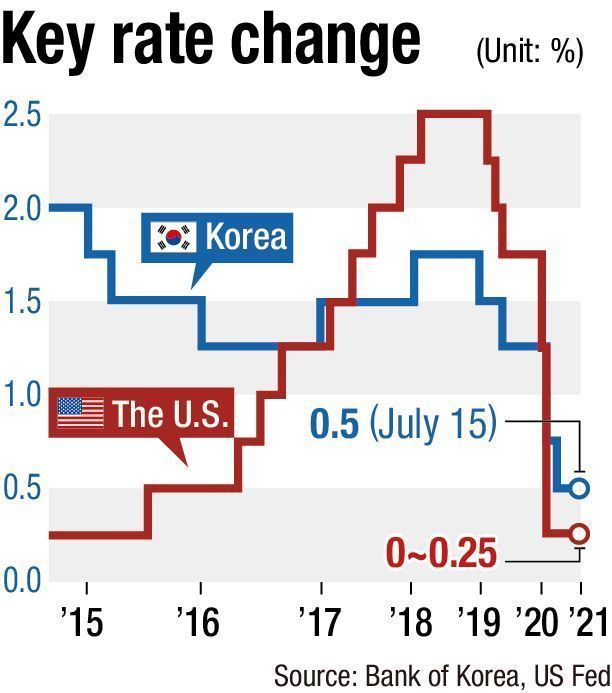
Lee also noted that the BOK would keep a close watch on how long the pandemic will last here and how serious its impact will be, even though the central bank does not consider it a serious risk factor that will dampen the economic recovery here.
“Our view is that the economy will continue on a path for recovery as a follow on from the government's expansionary budget, but we need to thoroughly monitor how the spread of the pandemic will affect the economy,” he said. “That is why we decided to keep the rate frozen at the latest meeting.”
He also maintained a rosy outlook on the economic rebound this year.
“The toughened social distancing may weaken a recovery in domestic consumption, but the economy will likely achieve 4 percent growth this year,” Lee said. “Uncertainties remain in place over the rise of coronavirus cases, but this is not serious enough to affect economic growth momentum.”
Daily infections in Korea have been on a steep rise over the past week. According to data from the Korea Disease Control and Prevention Agency, the number of new COVID-19 cases here set a new high of 1,615, Wednesday. The figure has topped 1,000 for the past week.
The BOK's optimistic forecast raises the likelihood for a potential rate hike no later than the end of 2021 unless the pandemic shock escalates enough to cripple the economy.
The central bank chief also issued a warning on the surging household debt amid prolonged low interest rates.
“Economic entities' profit-taking is too excessive, so most board members called for the need to resolve the financial imbalance here,” Lee said. “In particular, housing prices in Seoul and its surrounding areas are overvalued, and prices are rising on expectations of an additional rally.”
Economists have argued that the central bank should hike the rate as early as next month under the assumption that toughened social distancing measures take effect and reduce the number of new daily infections.
“No one would refute the economy has jumped onto a solid recovery path, so my view is that the central bank preemptively starts increasing the rate in August if the pandemic spread subsides for the next few weeks,” Sejong University economist Kim Dae-jong said.
“But if the economy continues to grapple with the fourth pandemic shock, the BOK will delay the timeline to around the end of this year,” he said. “The central bank will have to keep freezing the rate if the daily infection cases continue to set a new high and top the 1,000-mark.”
The central bank will make its next rate decision during a board meeting scheduled for Aug. 26.