Rising interest rates set to deal blow to Korean households
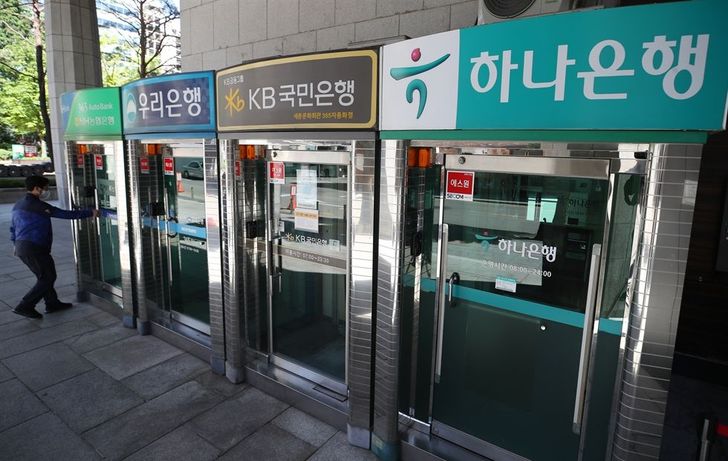
Automated teller machines (ATMs) in central Seoul operated by various banks / Yonhap
By Anna J. Park
Reflecting global markets' expectations for a rise in interest rates in the near future, local banks have continued to increase their rates on credit (non-secured) loans and mortgages, despite the Bank of Korea (BOK) keeping its key interest rate frozen at 0.5 percent for over a year.
The lowest interest rate offered on one-year loans by the four major banks here ― KB Kookmin, Shinhan, Hana and Woori ― stood at between 2.57 percent and 3.62 percent Monday. This is 0.58 percentage points higher than the lowest rate offered by them last July when their interest rate band stood at between 1.99 percent and 3.53 percent.
Mortgage interest rates also showed a similar pattern during the same period. The lowest possible rate among the four banks was 2.55 percent this week, 0.3 percentage points higher than the 2.25 percent available last July, which was the lowest in several years. The current level is the highest in almost 20 months since June 2019.
On the surface, the rising interest rates for bank bonds have influenced the major banks' actions. According to the Korea Financial Investment Association (KOFIA), the rate for an AAA-rated one-year bank bond rose to 0.835 percent, as of the end of April, up 0.074 percentage points from last July's 0.761 percent. The AAA-rated five-year bank bond's rate soared to 1.841 percent from 1.277 percent over the same period.
The fact that banks have provided more favorable interest rates for some VIP clients based on their income or past track record, in compliance with the government's effort to cut back on households' loans, is also attributed to the rise.
Bond analysts stress that the speed at which banks raise interest rates could accelerate from late May due to expectations for a global economic recovery. As demand for oil and raw materials has been rising, the country's consumer price index has also risen to its highest level since August 2017.
“The Korean bond market is showing strong upper move tension, particularly among long-maturity bonds. Amid expectations about the economic recovery as well as inflation rates, the rate on 30-year maturity treasury bonds reached 2.24 percent, the highest level since the outbreak of COVID-19,” Yoon Yeo-sam, an analyst at Meritz Securities, wrote in his latest report published Monday.
Another expert said central banks worldwide could increase their key interest rates earlier than market forecasts.
“One has to maintain a cautious approach that normalization of monetary policies could take place earlier than expected. If such a risk is realized, the increase in key interest rates could possibly come during the first quarter of 2022 in Korea, and in the first half of 2023 in the case of the U.S.,” said Cho Yong-gu, a bond analyst at Shinyoung Securities.
Increases in interest rates are expected to place a heavier burden on bank customers with loans, as about 70 percent of them opted to borrow money with a floating interest rate, rather than a fixed one.
According to a research by the BOK, an increase of one percentage point in the loan rate means that the aggregate interest paid by domestic households will soar by about 12 trillion won ($10.7 billion).
The current speed of the increases in interest rates is expected to be a huge blow to local households, over 13 million of which, or 63.7 percent of the total in the country, are indebted in some way. This could, in turn, have a negative impact on the economic recovery.
Aggregate local household debt at banks stood at 1,009.5 trillion won as of the end of March. It exceeded the 1,000 trillion won mark for the first time in March.