Online shareholder activism becomes new normal

Seen is a screen capture of Kumho Petrochemical's largest shareholder Park Chul-whan's website used for making shareholder proposals to the company.
Advice from NPS, ISS had little impact this year
By Park Jae-hyuk
One of the most notable features during the annual proxy season over the past month was that more websites were used to submit shareholder proposals to large businesses and to win support from other minority shareholders.
This strategy was used here previously by Elliott Management, when the U.S. hedge fund opened a website named “Accelerate Hyundai Motor Group” in 2019 to pressure the carmaker. KCGI, a domestic private equity firm (PEF) that joined hands with former Korean Air Vice President Cho Hyun-ah to engage in a dispute with her younger brother, Hanjin Group Chairman Cho Won-tae, has also communicated with the group's employees, customers and investors over the past few years through its website named “Value Hanjin.”
Outside of Value Hanjin, similar websites for shareholder activism were rarely seen in Korea until last year.
Based on the recent Commercial Act revision that constrains companies' largest shareholders, however, more activist shareholders have been releasing their statements online and asking minority shareholders to visit their websites.
HYK Partners opened a website named after itself last December for the sole purpose of making shareholder proposals against Hanjin Transportation's management and owner family. Through the website, the second-largest shareholder of the logistics firm provided its official statements, related news articles, contact information and webpages for minority shareholders to see.
Other websites that opened shortly before general shareholders' meetings came up with slogans that can better catch the eyes of the press and investors.
Kumho Petrochemical's largest shareholder Park Chul-whan, who is in a dispute with his uncle, Chairman Park Chan-koo, named his website, “Go Beyond, Kumho Petrochemical.” Whitebox Advisors, a U.S. hedge fund that opposed LG Group's spin-off, opened a website named “A Better LG.” Hankook & Company Vice Chairman Cho Hyun-sik, who is in conflict with his younger brother, CEO Cho Hyun-bum, operated a website named “Better Hankook & Company.”
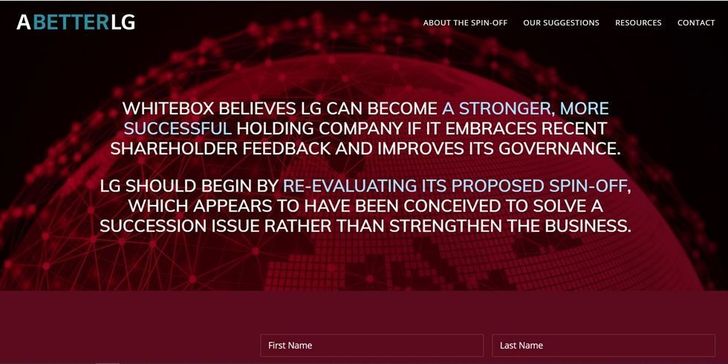
Seen is a screen capture of Whitebox Advisors' website used to protest LG's plan to spin off its affiliates.
Most of their efforts, however, have ended in failure. The Hankook & Company vice chairman was the only person who at least partially achieved his goal, after shareholders selected his nominee, Korea University professor Lee Han-sang, to join the company's board of directors.
The vice chairman's website is currently inaccessible. The others are still alive without further updates after the end of the general shareholders' meetings, except for “Go Beyond, Kumho Petrochemical,” where Park Chul-whan wrote he would continue to communicate with other shareholders and stakeholders.
“This shareholder proposal was a meaningful start to pave way for a more proactive culture of shareholder engagement in companies' business management,” he said.
Another feature of this year's proxy season was that opinions from the National Pension Service (NPS) and the Institutional Shareholder Services (ISS) had limited influence on most investors.
Until last week, the state pension fund voted against over 60 topics of 45 listed companies, but none of the topics were rejected.
The ISS recommended investors to oppose Samsung Electronics' reappointment of a nonexecutive director, as well as LG's spin-off plan and Shinhan and Woori financial groups' directorial appointments. However, none of the recommendations from the world's largest proxy adviser were accepted during the general shareholders' meetings of those companies.