Big corporations urged to help SMEs adopt ESG practices

This article is the second in a four-part series highlighting the importance of ESG criteria in management and making suggestions for Korea's financial, industrial and public sectors to come up with better ESG strategies for sustainable growth. ― ED.
Attention focused on environmental, labor issues in supply chains
By Park Jae-hyuk
Environmental and labor issues in small- and medium-sized subcontractor companies have emerged as major risks to the environmental, social and corporate governance (ESG) ratings of domestic conglomerates, multiple ESG experts warned.
The experts urged Korean conglomerates to start taking care of how small- and medium-sized enterprises (SMEs) respond to ESG criteria because global institutional investors are paying attention to the management of the entire supply chain.
“Employees of large companies account for only 20 percent of domestic workers,” McKinsey & Company Senior Partner Richard Lee said. “Most people are self-employed or working for SMEs without being protected by ESG standards, so this aspect will soon become an important issue in Korea.”
Korea Investment Corp. (KIC) CEO Choi Hee-nam cited Apple as an example to support the view that subcontractors can affect the ESG ratings of big corporations.
“The ESG ratings of companies are directly proportionate to their sizes and market caps in general,” the head of the nation's sovereign wealth fund said. “However, Apple has been rated low due to labor disputes involving its suppliers, including Foxconn.”
In contrast to SK, Samsung, Hyundai Motor and other chaebol groups that have been making preemptive efforts for sustainable management ever since ESG principles became a core factor for attracting global investments, most SMEs here have been considered to be indifferent to such efforts.
A recent survey by the Federation of Korean Industries (FKI) of research center heads at local securities firms showed medium-sized and small companies respectively scored five and four points out of 10 in their responses to ESG management standards, while large businesses got seven points.
According to the Korea Corporate Governance Service (KCGS), domestic SMEs were especially insufficient in their efforts to improve the “social” factors, which mainly comprise labor issues.
Samjong KPMG indicated in a recent report that multinational companies may face risks of the tarnished brand equities, if environmental and labor problems occur in the workplaces of their subcontractors.
“The European Union seeks to obligate due diligence of supply chains,” the accounting firm wrote. “Through the Korea International Trade Association (KITA), 300 Korean companies raised questions about the obligation, but considering the EU's stance, it is highly likely to be legislated, so countermeasures have been necessary.”
Lee said the planned enforcement of the law on punishment for serious industrial accidents will make the social factors be more significant for SMEs here. The law, which imitates the Corporate Manslaughter Act in the U.K., enables heavier punishments on corporations and employers, whose culpable conduct caused worker deaths.
The McKinsey partner suggested that conglomerates warn their subcontractors of receiving disadvantages if they fail to satisfy the ESG criteria.
Yoon Jin-soo, head of KCGS' ESG business division, said big construction firms should be stern to their subcontractors that have negligently caused industrial accidents.
He advised conglomerates to provide their subcontractors with education and technical and financial support for better ESG practices, given the fact that SMEs do not have enough human or material resources to organize taskforces to implement the values-based criteria.
“SMEs also need to take care of their own human rights management practices, which take into account the issues of irregular workers and workplace sexual harassment, because foreign institutions are looking into how well they follow such practices,” Yoon said.
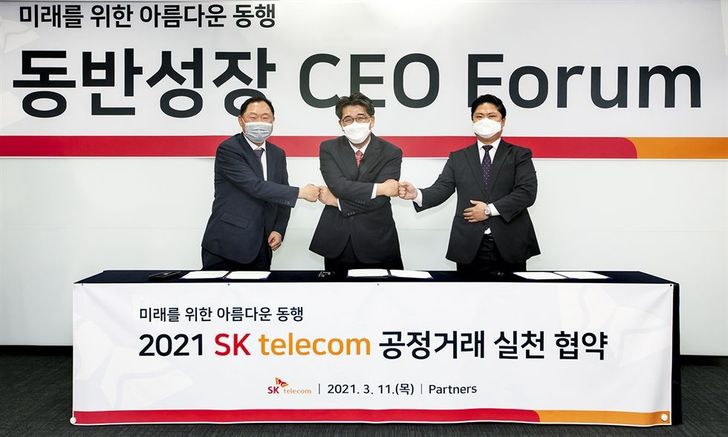
SK Telecom (SKT) supply chain management group leader Ahn Jeong-yeol, center, bumps fists with representatives from SKT's partner companies Uangel and Tbell, after signing an agreement for fair trade at the SK Namsan Building in Seoul, on March 11. SKT also decided to offer online lectures on ESG management for its 175 partners. Courtesy of SKT
First movers
In response, some conglomerates in Korea have begun to make preemptive efforts to improve the ESG practices of their subcontractors.
SK Telecom (SKT) decided to offer online lectures to support its suppliers that want education on ESG management. The mobile carrier said it will pay the entire cost of the education program, and its 175 subcontractors will be able to choose among lecture series that will be offered three times a year.
It will also raise an ESG fund with Kakao for the sustainable management of SMEs and startups.
“Based on the ESG management criteria that SK Group pursues, we will strengthen our foothold in this area for mutual growth with our partner companies,” SKT supply chain management group leader Ahn Jeong-yeol said in a statement.
POSCO E&C signed a memorandum of understanding with credit ratings company Ecredible in February to assess the ESG practices of its subcontractors.
The builder plans to develop an ESG evaluation model customized for small- and medium-sized builders by the end of the first half of the year, so that the criteria take root in the nation's construction industry.
In the financial sector, Shinhan Bank came up with a special loan product that offers favorable interest rates to exemplary companies in ESG practices and the partners they recommend.
“We will make efforts to support the virtuous cycle of the ESG management through our main business of financial services,” a Shinhan Bank official said.