Celltrion to boycott JPMorgan healthcare conference
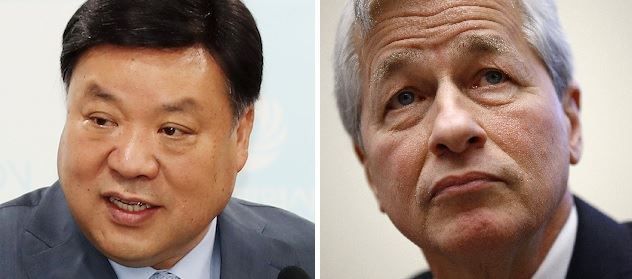
Celltrion Chairman Seo Jung-jin, left, and JPMorgan Chase & Co. CEO Jamie Dimon / Korea Times file
US investment bank also loses pension fund's trust
By Park Jae-hyuk
Celltrion has decided not to attend JPMorgan Chase & Co.'s annual healthcare conference scheduled for next month, after coming into conflict with the U.S. investment bank over a series of recent controversial reports accentuating its negative outlook for the Korean pharmaceutical firm
On Thursday, Celltrion said it recently informed the host of its decision. The company added it will instead focus on the development of its COVID-19 treatment. Celltrion completed Phase 2 trials for its CT-P59 antibody treatment last month and will likely ask the health authorities for conditional approval for use before the end of the year.
“Our company's top priority at this moment is the development of CT-P59,” a Celltrion spokesman said. “We have no time to spare to attend the conference.”
The decision came as a “surprise” to many in the industry as the world's largest healthcare investment symposium has long been used as a promotional venue for many domestic pharmaceutical firms.
Although the four-day conference will be held online amid the continued spread of COVID-19, small- and medium-sized biotech companies here are aggressively advertising their participation to entice global investors. Some of them have already enjoyed hikes in their stock prices after issuing press releases about this.
The annual conference has been held in San Francisco, but this year, the host decided to hold the 2021 event online. This has raised concerns among some biotech companies that they will face difficulties in contacting foreign investors.
Until early this year, Celltrion had also promoted its participation in the event. The company had attended the conference every year since 2010 and was allowed to give “main track” presentations this year and in 2019. Main track presentation slots are generally given to global pharmaceutical giants, such as Pfizer, Roche and Johnson & Johnson.
Because of Celltrion's absence, Samsung Biologics, which has delivered main track presentations since 2017, will be the only Korean company doing so in next year's conference. Hugel, HK inno.N, LG Chem and Genexine will deliver presentations as “emerging markets track” companies.
Some market observers attributed Celltrion's decision to JPMorgan's negative reports on the firm, although the pharmaceutical company denied the speculation.
JPMorgan released negative reports on Celltrion in September and December, while maintaining a favorable outlook for Samsung Biologics. The U.S. banking giant particularly warned investors against being too optimistic about Celltrion's development of potential COVID-19 treatments.
Given it set target prices much lower than the actual share prices of Celltrion and Celltrion Healthcare, retail investors suspected JPMorgan was trying to pull down Celltrion's stock price to cover its losses from a massive amount of short-selling.
Celltrion condemned JPMorgan, saying it published “unreasonable” reports to undervalue the company, compared to its rivals. The drug maker claimed the U.S. firm defamed Celltrion Chairman Seo Jung-jin and the company.
Started in 1983 by Hambrecht & Quist (H&Q), the conference changed its name to JPMorgan Healthcare Conference in 2003 after H&Q was acquired by JPMorgan.
Weakening partnership with NPS
Another unfavorable factor facing JPMorgan is the National Pension Service's (NPS) decision to downgrade the U.S. investment bank to third-tier from first-tier on its list of domestic and foreign brokerages that the pension fund will use for the trading of domestic stocks in the first half of next year.
The NPS has updated its list of brokerages every six months, taking into account factors such as financial stability, research capabilities, fees, social contributions and sanctions imposed by financial regulators.
The pension fund trades a higher amount of money through brokerages with higher grades, so first-tier ones can make handsome commissions. The only foreign company on the latest list as a first-tier brokerage was Malaysia's CGS-CIMB, which was also on the list in the second half of this year.
Goldman Sachs, Morgan Stanley, Macquarie, HSBC and Daiwa are on the list as second-tier companies. JPMorgan is among the third-tier group along with CLSA, Credit Suisse, UBS, Nomura and Citi.