Genome & Company makes poor debut at year-end IPO

By Anna J. Park
Microbiome- focused biopharmaceutical firm Genome & Company made its first-day debut on the nation's heavy-tech KOSDAQ market Wednesday, transferring its listing from the KONEX market ― the bourse market for venture startups and small- and medium-sized enterprises ― where its stocks had been traded since December 2018.
Since its listing at KONEX two years ago, Genome & Company grew to be the market's top company in terms of market cap, with about 741 billion won as of the end of November. With Wednesday's transfer listing to KOSDAQ, the biopharmaceutical company's market capitalization grew to 912 billion won.
The company's stock price began at 80,000 won ― double the price of its 40,000 won subscription price ― at the beginning of Wednesday's trading session, and the price soon went up to 95,000 won in just 15 minutes after the market opened at 9 a.m. Yet the price continued to drop, despite fluctuations in between, finishing at 68,800 won at the closing, which is a 14 percent fall from the initial opening price.
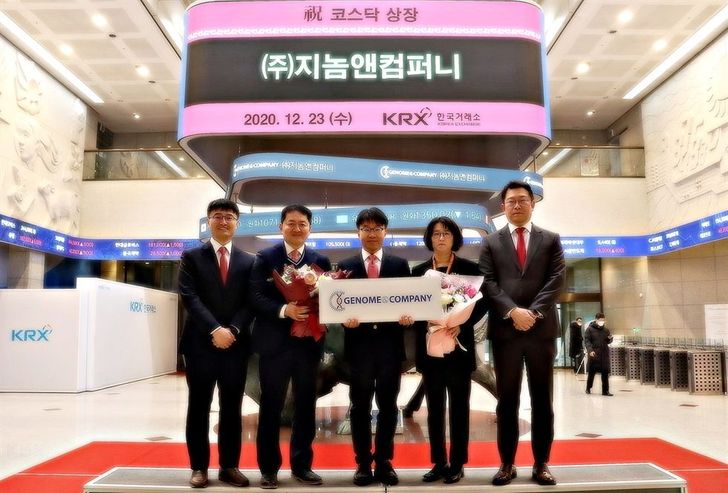
Genome & Company's CEO Pae Ji-soo, second from left, posed for a photo along with the biopharmaceutical firm's key management officials at its listing ceremony held in the lobby of the Korea Exchange (KRX) on Yeouido in Seoul, Wednesday. / Courtesy of Genome & Company
Despite the rather disappointing first-day performance at the KOSDAQ market, the company is still attracting much attention from local and global investors for its unique technologies for developing new drugs and products in various fields of immunology and anti-cancer treatments using microbes and probiotics; the company continues to build strong collaborations with global pharmaceutical firms in clinical research, recognized by the U.S. FDA.
Biopharma companies' IPOs thrive in 2020
With Genome & Company's transfer listing from KONEX to KOSDAQ Wednesday, 21 bio-based enterprises' IPOs for 2020 have been all wrapped up.
Biopharmaceutical and pharmaceutical companies take up 27 percent of the entire amount of 5.77 trillion won ($5.2 billion) raised on the IPO market this year, as they succeeded at raising about 1.5 trillion won in capital through public offering processes. The amount is a whopping 170 percent year-on-year increase from the previous year.
Out of the 21 newly listed firms this year, SK Biopharmaceuticals outplayed other companies, raising nearly 1 trillion won in its public offering. The stock price also hit the daily limit ceiling of a 30 percent increase for three consecutive days following its listing at the KOSPI market in early July, and it made it onto the MSCI Korea Index in just four months following its listing.
In December alone, a number of Korea-headquartered bio-related enterprises made their debut on bourse markets along with Genome & Company, including QuantaMatrix, Precision Biosensor and NGeneBio.
Market watchers attributed the bio industry's public offering performance this year to factors including ample liquidity, heightened investor interest in biopharmaceutical or pharmaceutical companies, as well as AI-based state-of-the-art technologies in this sector.
Diminishing demand for KONEX listing
Meanwhile, Genome & Company's less-than-successful transfer listing might exacerbate the already-weakening position of the KONEX market among venture companies.
In 2020, only eight companies were newly listed on the capital market for startup businesses, which is a plunge compared to 17 companies in 2019 and 21 in 2018.
Many market experts see the reason behind the diminished popularity of the KONEX market is that transfer listing from it to major bourses like KOSPI or KOSDAQ did not result in better records, compared to direct listing to major markets. For instance, stock prices of biopharmaceutical firm MiCo BioMed, which has transferred its listing from KONEX to KOSDAQ, has been hovering below its subscription price lately.
Of course, it is too early to make generalizations based on a few cases, as successful transfer cases like Genolution and VINAtech show that it is up to each firm to prove their competitiveness and market value in the end.