KDB's 'controversial' capital reduction plan for Asiana

From left are Kumho Petrochemical Chairman Park Chan-koo, his older brother former Kumho Asiana Group Chairman Park Sam-koo and KDB Chairman Lee Dong-gull. Yonhap
By Lee Min-hyung
Korea Development Bank (KDB) is in the hot seat over its decision to undertake an equal reduction in share capital for cash-strapped Asiana Airlines.
For corporate restructuring, creditors often adopt a differential capital reduction drive and apply steeper reduction for major shareholders than minority shareholders. This is because large shareholders should be held responsible for poor management.
But the main creditor of Asiana decided not to follow the typical restructuring process to keep its earlier promise to Kumho Industrial, the major shareholder of Asiana.
The state-run lender offered to sell Asiana shares obtained by Kumho at a “reasonable price” without taking steps for the differential capital reduction in 2019 when Asiana's restructuring was in its infancy. At that time, this raised controversy that the creditor was giving preferential treatment to the management of Kumho Industrial.
Even if former Kumho Asiana Group Chairman Park Sam-koo stepped down from the leadership in March 2019, a group of management-level executives who worked with Park still maintain their seats on the company's board of directors.
“Controversies will continue to repeat over the relationship between KDB and Kumho unless the creditor takes steps for the differential capital reduction,” an industry source said. “But KDB is unlikely to change its position for the time being due to the backlash from Asiana's minority shareholders, as this means KDB broke its promise and acknowledges that its earlier decision has failed.”
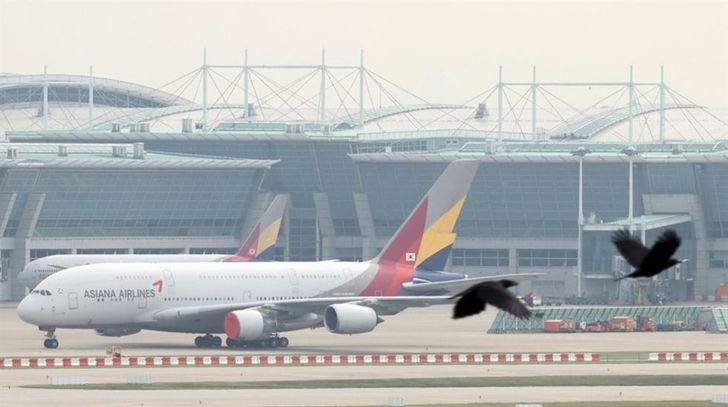
Birds fly around Asiana Airlines airplanes at Incheon International Airport on Sept. 11. Yonhap
Unceasing sibling feud of Kumho Asiana Group
The dispute over the method of the Asiana capital reduction is also drawing backlash not just from the minority shareholders, but also Asiana's second-largest shareholder, Kumho Petrochemical, which urges KDB to play fair and pursue differential capital reduction.
Kumho Petrochemical Chairman Park Chan-koo is standing at the center of the call, reigniting another controversy surrounding the decade-long sibling feud with his older brother Sam-koo.
The feud started back in 2006 when Sam-koo and Chan-koo were poles apart over Kumho's plan to take over Daewoo Engineering & Construction.
Their legal battle has since intensified each year for a decade. The sibling feud reached its peak in March 2014 when Chan-koo expressed opposition to Sam-koo's plan to become one of the executive directors of Asiana.
The discord appeared to subside in August 2016 when Kumho Petrochemical dropped all the lawsuits it had filed against Asiana's board of directors and Sam-koo.
For now, no legal disputes have resumed between Kumho Industrial and Kumho Petrochemical. It remains to be seen whether Kumho Petrochemical takes any corresponding legal actions against the creditor's decision for the equal capital reduction of Asiana.
“The decision is aimed at supporting major shareholders and creditors of Asiana by stealing the shares of minority shareholders who do not directly engage in the airline's management,” an official from Kumho Petrochemical said.
Kumho Petrochemical owns an 11.02 percent stake in Asiana Airlines, and is considering legal action against KDB's decision. KDB, meanwhile, reaffirmed its position that it would stick to carrying out the equal capital reduction.
“We have not discussed any plans over the differential reduction, and will keep carrying out the equal reduction in share capital through the end of this year,” a spokesman at the creditor said.
KDB is receiving consulting advice from two management consultancies ― EY Hanyoung and Bain & Company ― over the sale and restructuring of Asiana.
“Details over our next steps regarding the restructuring and sales of the airline will be announced after the consulting process comes to an end possibly around the beginning of 2021,” the official said.