Conflict deepens between ISS, Sustinvest
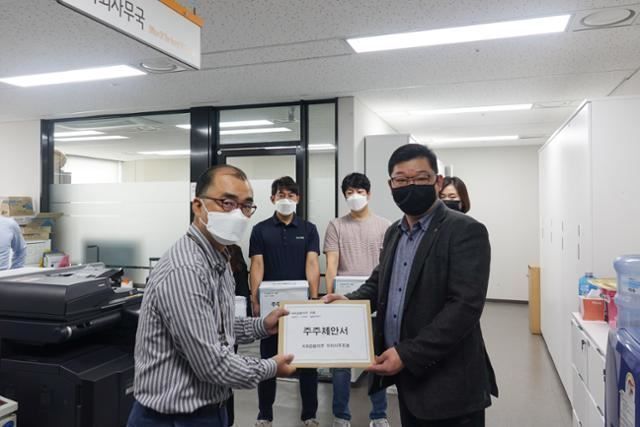
The KB Financial Group union submits a shareholder proposal at the group headquarters in Seoul, Oct. 29, to recommend Sustinvest CEO Ryu Young-jae and Seoul National University professor Yun Sun-jin as candidates for nonexecutive directors. / Courtesy of KB Financial Group union
Proxy advisers clash over KB, LG Chem, Hanjin
By Park Jae-hyuk
The Institutional Shareholder Services (ISS) is apparently facing an intensifying conflict with Sustinvest, the two have been giving differing advice to shareholders of listed companies in Korea.
Although a majority of domestic and foreign shareholders are still following the recommendations of ISS, the world's largest proxy adviser, the small local player Sustinvest pointed out the institution, owned by U.S. private equity firm (PEF) Genstar Capital, has “colonized” the Korean capital market using its powerful status.
Their latest quarrel started during the KB Financial Group union's recent attempt to appoint Sustinvest CEO Ryu Young-jae as one of the group's new nonexecutive directors.
The union is trying to obtain a board seat again, following its previous attempts in 2017 and 2018, both of which ended in failure. It recommended Ryu and Seoul National University environmental studies professor Yun Sun-jin as the candidates for nonexecutive directors, saying they are experts in management regarding environmental, social and governance (ESG) factors.
The ISS, which went against the union in 2017 and 2018, has once again advised KB shareholders to vote against the two candidates in the general shareholders meeting slated for Nov. 20. It agreed with the appointments of KB Chairman Yoon Jong-kyoo and KB Kookmin Bank CEO Hur Yin as directors.
Given that foreign shareholders own more than 60 percent stake in the Korean financial group, the union's latest attempt is highly likely to end in failure again.
“The union fails to present a compelling case for change at the company,” the ISS said in a report. “There are no issues concerning the board's independence although both management nominees are considered as non-independent directors under our classification.”
The report was published just a few weeks after Sustinvest had opposed LG Chem's bid to spin off its battery business, in contrast to the ISS, Glass Lewis and the Korea Corporate Governance Service (KCGS).
Sustinvest said last month the chemical firm's plan could hurt minority shareholders, while the ISS and other advisers saw the spin-off would enhance the company's growth potential by attracting investments.
The National Pension Service (NPS) sided with Sustinvest, but the spin-off plan was approved in a shareholders meeting on Oct. 30.
After the meeting, the Sustinvest CEO said the nation's capital market is still an “uneven playing field” which is controlled by the U.S. institution.
Some observers said the Korean proxy advisory firm may have pursued a different strategy from other players to draw more attention from the market.
When it recommended Hanjin shareholders to vote against the reappointment of Chairman Cho Won-tae in March, unlike the ISS and the KCGS, Hanjin raised questions about Sustinvest's neutrality and fairness.
“It seems to have an intention to rattle our group by joining hands with an activist fund that pursues its own interests,” the group said at that time.
Ryu, however, rather criticized the ISS' business model and its neutrality, saying its consultancy arm ISS Corporate Solutions had received money from Hanjin last year for offering consulting services to the Korean firm.